Finley: contemplative exercise

Contemplative exercise Finley

“Sit in meditation for about twenty to thirty minutes.

Slowly stand.

Walk in a slow mindful manner to the kitchen sink full of dirty dishes. Stand at the sink, mindfully gazing for a moment at the dishes.

 Slowly and mindfully put soap in the sink.

 Fill the sink with hot water, attentive to the simple givenness of the sound of running water.

Wash, rinse, and place each item in the drainer with mindfulness.

When the dishes are finished, pull the plug,

 listen to and watch the water going down the drain.

Rinse out the sink with mindfulness.

Dry each item and put it in its proper place with natural and deliberate mindfulness.

Wipe off the counter tops with mindfulness.

Slowly walk back to your place of sitting meditation

 sit for another twenty to twenty-five minutes.

Open a journal and  write spontaneously and sincerely about what it would be like to live in this way.”

From Richard Rohr’s daily meditations, August 5, 2017Adapted from James Finley, The Contemplative Heart , Sorin Books: 2000, 46, 125-126.
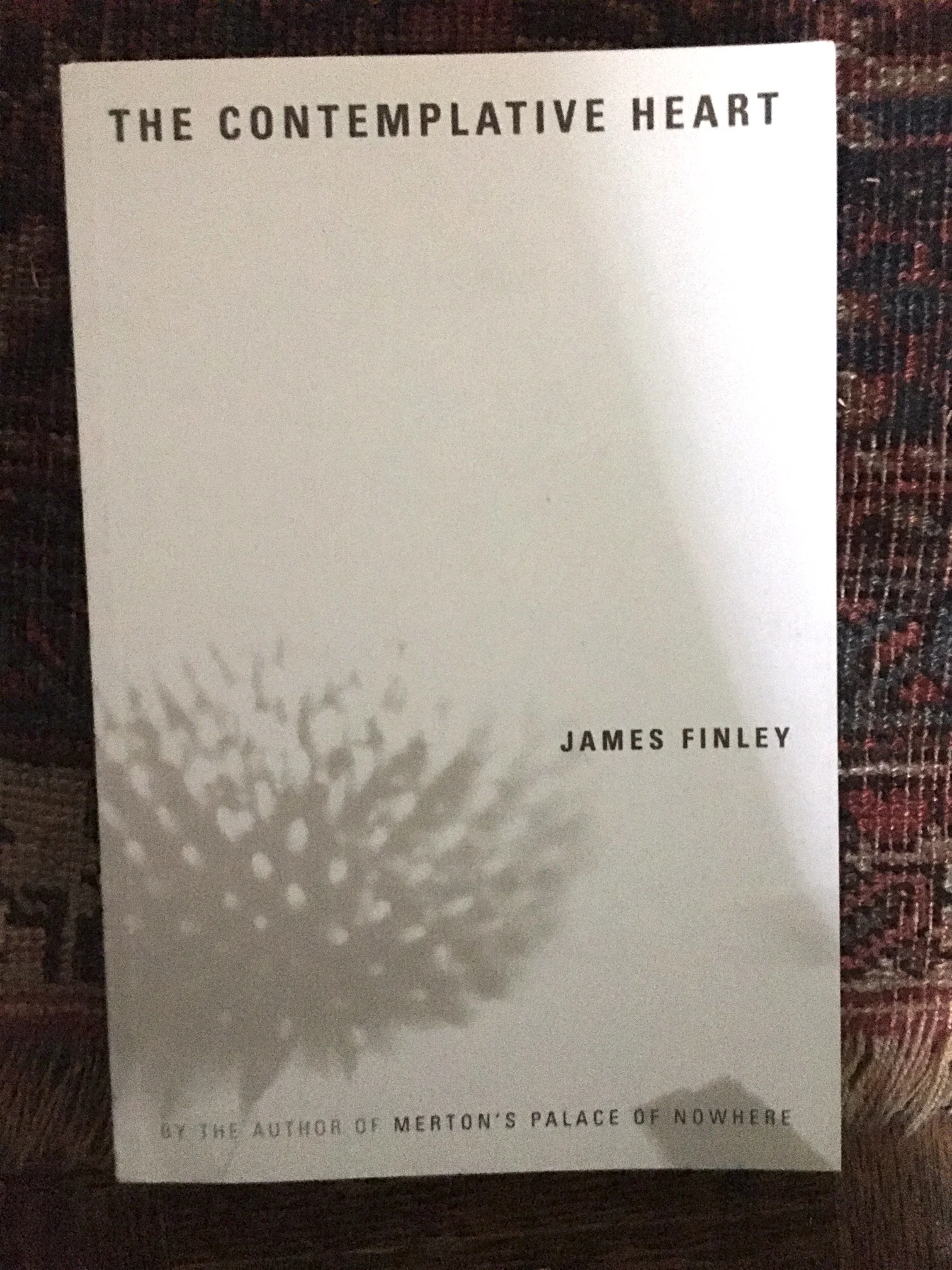
contemplative heart.JPG

James Finley writes about how meditation and performing daily tasks might be integrated. This is a mindful life. Finley offers us one more way to put ourselves in position to connect to God, especially if you have difficulty just sitting and meditating. He suggests starting small, with small tasks, moving boxes, filing papers, picking up the mail, taking out the garbage.  Do it for just a few minutes a day. Try it today. I’ll be experimenting with you.

Joanna         joannaseibert.com


Anders:Spinning Wisdom 2

Anders: Spinning Wisdom 2

“The threads of our lives lead both ways—vertically toward our Source, and horizontally toward each other.”  —Isabel Anders in Spinning Straw, Weaving Gold, her sequel to Becoming Flame: Uncommon Mother-Daughter Wisdom (Wipf & Stock, 2010).

window-2675866_1920.jpg

1. The Daughter loved the Spinning Room, where the rough, carded wool was transformed into shimmering, useful thread.

“See,” she said one morning to her Mother, pointing to the results of her effort, “our spinning teaches the wool to connect!”

“Yes,” acknowledged her mother, “and it is our most basic lesson in life, as well, to learn how to Connect.”

***

2. “I want to be present at that moment of transformation,” said the Daughter, “when the airy fibers and strands of my hopes and dreams become material substance in the real world.”

“By your words expressed—through the power of your desire—you have just made an instance of that very thing happen,” said her Mother.

**

22. “The threads of our lives lead both ways—vertically toward our Source, and horizontally toward each other,” the Daughter reflected, holding out her handiwork as an example.

“And the template of the Warp and Woof of life will guide you at every stage,” her Mother promised. “Its applications will become myriad as you grow further into maturity. See in them the Cross, for it is the vortex of life.”

         —Guest post by Isabel Anders from Spinning Straw, Weaving Gold: A Tapestry of Mother-Daughter Wisdom (London: Circle Books, 2012).


Joanna joannaseibert.com

Anders: Spinning Wisdom

Anders: Spinning Wisdom

“It is suggested in a legend that draws from the apocryphal Book of James that Mary as a young virgin spun scarlet thread for a curtain to adorn the temple—while Herod’s architects completely rebuilt the temple around her. In this imagined scenario, the acts of spinning and weaving are brought together against the backdrop of the construction of a holy sanctuary, all together symbolizing Woman enmeshed in her ideal Work.”  —Isabel Anders in Spinning Straw, Weaving Gold: A Tapestry of Mother-Daughter Wisdom (London: Circle Books, 2012). 

newborn-2653030_1920.jpg

This resonant, compelling image of Mary conjures for us the “red thread” of life, a mix of blood and tears, that binds together wisdom and love—here embodied in a feminine personage: the one woman who made possible the Incarnation of Jesus the Word made flesh himself. 

She who reconciles the ill-matched threads

Of her life, and weaves them gratefully

Into a single cloth—

It’s she who drives the loudmouths from the hall

And clears it for a different celebration.

—Rainer Maria Rilke.  (From Rilke’s Book of Hours: Love Poems to God, translated by Anita Barrows and Joanna Macy. New York: Riverhead Books, 1996, p. 64.)

          Indeed, this is exactly what Mary did.

I previously explored the vibrant image of fire as wisdom in my book Becoming Flame: Uncommon Mother-Daughter Wisdom (Wipf & Stock, 2010). I now add to it several complementary, similarly hopeful images to which women have a natural affinity. For instance, L Maloney (in The Lost Coin: Parables of Women, Work, and Wisdom by Mary Ann Beavis; New York: Continuum, 2002, p. 24) offers this insight:

“Our work is contextual and concrete; it sees the ordinary and the everyday as the place where God is revealed; it takes place ‘in the house.’ It is hard work; it is a struggle to find what we are seeking in the darkness that has covered it for so many centuries. But it is also characterized by joy and celebration, and by hope: a hope that assures us that God is with us. God has her skirts tucked up and is busy sweeping and searching too.”

         —Guest post from Isabel Anders from her Introduction to Spinning Straw, Weaving Gold.

 Joanna joannaseibert.com