On a Pallet

On a Pallet

“He suffered under Pontius Pilate, was crucified, died and was buried; he descended into hell. The third day he rose again from the dead.” Apostles Creed

paralytic.jpg

Bishop Jake Owensby of western Louisiana recently reminds us in his blog, Looking for God in Messy Places, about the line in the Apostles Creed where Jesus descended to the dead. (“Unbearable," Looking for God in Messy Places, July 1, 2018 jakeowensby.com) Bishop Owensby’s message is that our God goes to the places that seem like hell on earth to us. I also remember that our definition of hell is the absence of God. Perhaps the creed is telling us that even when we do not feel the presence of God, when life seems unbearable, God is still there.

When we are there in hell, when we feel unlovable, when our health fails, when our best friend dies, when depression lives not only in a cloud above us but flows in our bloodstream and in the synapses in our brain, this is a hard belief to remember.

This image of a loving, caring God must be written on our heart during times when we feel connected to God and live in what seems like heaven so that we  then can take it with us when our life descends into hell. This is still too hard. We cannot depend on ourselves to remember how much God loves us. This is why spiritual friends and community are so needed. This is why God calls us to community. When we become paralyzed with fear and loneliness and pain, we need spiritual friends to carry us on that pallet through the roof to God.  Otherwise life becomes too hard.

This is not the only answer, but it is the experience I have known best as my friends offer for me to be cared for by the God of love of their understanding until I again am connected to the God of love and compassion I once knew. Maybe more will be revealed.

Joanna  joannaseibert.com 
 

Clark Fork River and Love

The Clark Fork River and Love

“And so it is those we live with and should know who elude us, but we can still love them. We can love completely without complete understanding.” Norman Maclean, A River Runs Through It. University of Chicago Press.

montana doubletree.JPG

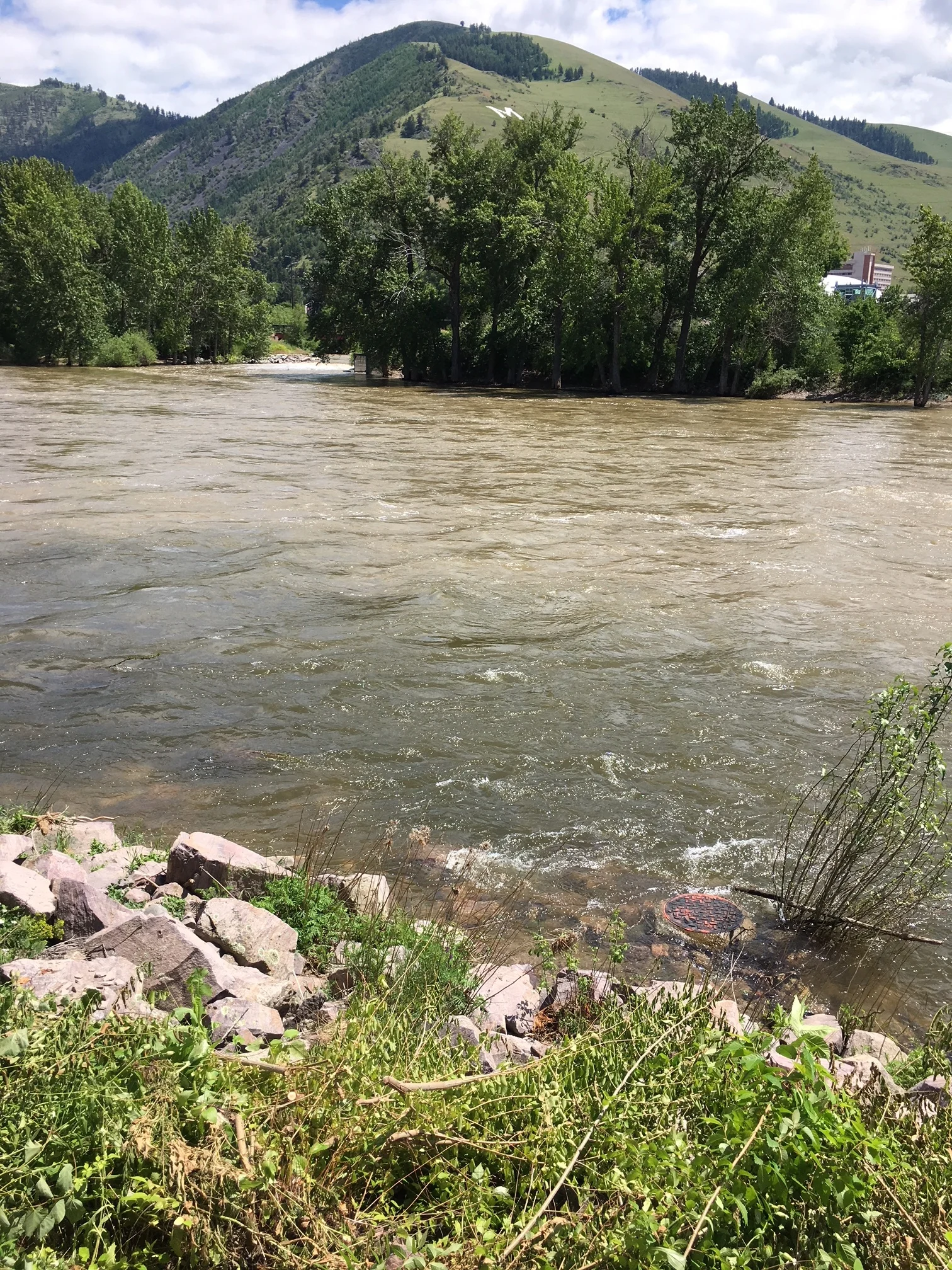
We are in Missoula, Montana, visiting our daughter, Joanna, and her husband, Dennis, with our oldest grandson, Mac, and his dad, John. Our hotel is right, I mean directly on the banks of Clark Fork, and the river is rapidly in real time running by our small porch on the first floor. We are mesmerized by watching the high-speed water, but it is the sound of the racing river that truly runs through us. It calms. It soothes. In its orchestral movement, it is peaceful. It sounds like a wind instrument, perhaps a distant native American flute.  Sometimes it has the “Om” sound that is chanted in yoga and eastern meditation. We begin to know the stillness of sitting or standing and just observing the wonder of something too magnificent for words go by. We can become so relaxed that we fall asleep.   Water, moving or still, has healing powers that we cannot understand.

I have watched Robert Redford’s movie, A River Runs Through It with all of our children and most of our grandchildren. We can often quote lines in the movie and answer back the responses to each other.   If you have not read the book or seen the movie, stop now because I am going to spoil it for you.

The story is about the Maclean family, a father and two sons, Norman and Paul, growing up fly-fishing in Missoula, Montana.  The words quoted today are near the end of the movie preached in one of the father’s last sermons. I could almost hear Norman’s father when we rode by that same brick Presbyterian church yesterday on the way to get ice cream.  The father is indirectly talking about Norman’s younger brother, Paul, who died an early traumatic death related to his addictions.

As I watch and listen beside the Clark Fork where the Macleans lived and loved a century ago, I think also of those I could not understand but wanted to love completely. My prayers today are to keep trying to hear these words by Norman’s father about them. Of course. there are also those I could not understand and never even wanted to consider loving the least bit, much less completely. I pray a little more to see them in a new light.  

Loving without understanding may be on the path to unconditional love, God’s love. Om.

Joanna  joannaseibert.com 

New word, Name again

New word, Name Again

 “But Moses said to God, ‘If I come to the Israelites and say to them, “The God of your ancestors has sent me to you”, and they ask me, “What is his name?” what shall I say to them?’ God said to Moses, ‘I AM who I AM.’ He said further, ‘Thus you shall say to the Israelites, “I AM has sent me to you.”’ Exodus 3:13-14.

starbucks.jpg

Every day I try to learn a new word. My word for today is splash stick. Actually, it is two words. It is the green stick that Starbucks puts in your coffee cup to keep the coffee from spilling from the hole you drink from. For years we have called it the green stick, spill stick, the thing, the stopper, long green thing, but now after so many years we know its real name, or at least what the courteous Starbucks' attendant or barista at the take-out window called it today. Barista was a word several years ago. Splash stick is today. Splash stick, I will now honor you and call you by your proper name.

How important it is to be called by our right name. There is something enriching in hearing our name called properly. It means we are real, a person, we are known, someone knows who we really are. My name is Joanna, but sometimes people call me Joanne. I want to say, I am not Joanne, that is my friend who has died. Of course, Seibert is called so many things, it is humorous, Cebert, being the most common. We always know we are getting a call from someone who does not know us when they open with, “Hello, Mrs. Cebert.” I can usually tell when I have called someone by the wrong name, which now is happening more that I would like to say. There is an unrest in the air that previously was peaceful and a look of pain on the person’s face, never completely concealed.

As for God, we don’t really know God’s name. “I Am.” God doesn’t seem to have this hang up that we humans do to be called by name. God just desperately wants us to love him or her or whatever and maybe say something. “I am mad about you, God. I am so thankful, God. I love you God.” All these seem acceptable. Spiritual friends suggest that maybe we don’t really have to call God by name, but just sit and be present with God. This tells us a little about the difference in God’s wisdom and ours.

 So, what should we do? Perhaps we are to continue to call each other by name whenever we can and continue to try to see the great mystery of God’s love, so different from ours. Perhaps we are to continue to love as best we can and offer that love up to a God who someday may tell us his name. Maybe instead, God will surprise us and give us another name as he did for Abraham and Paul. Maybe someday we may realize that our name is already several syllables or “I AMS” written into the mysterious parts of God’s name.

Joanna  joannaseibert.com