Kanuga Chapel

Kanuga Chapel

“The God who existed before any religion counts on you to make the oneness of the human family known and celebrated.” Archbishop Desmond Tutu
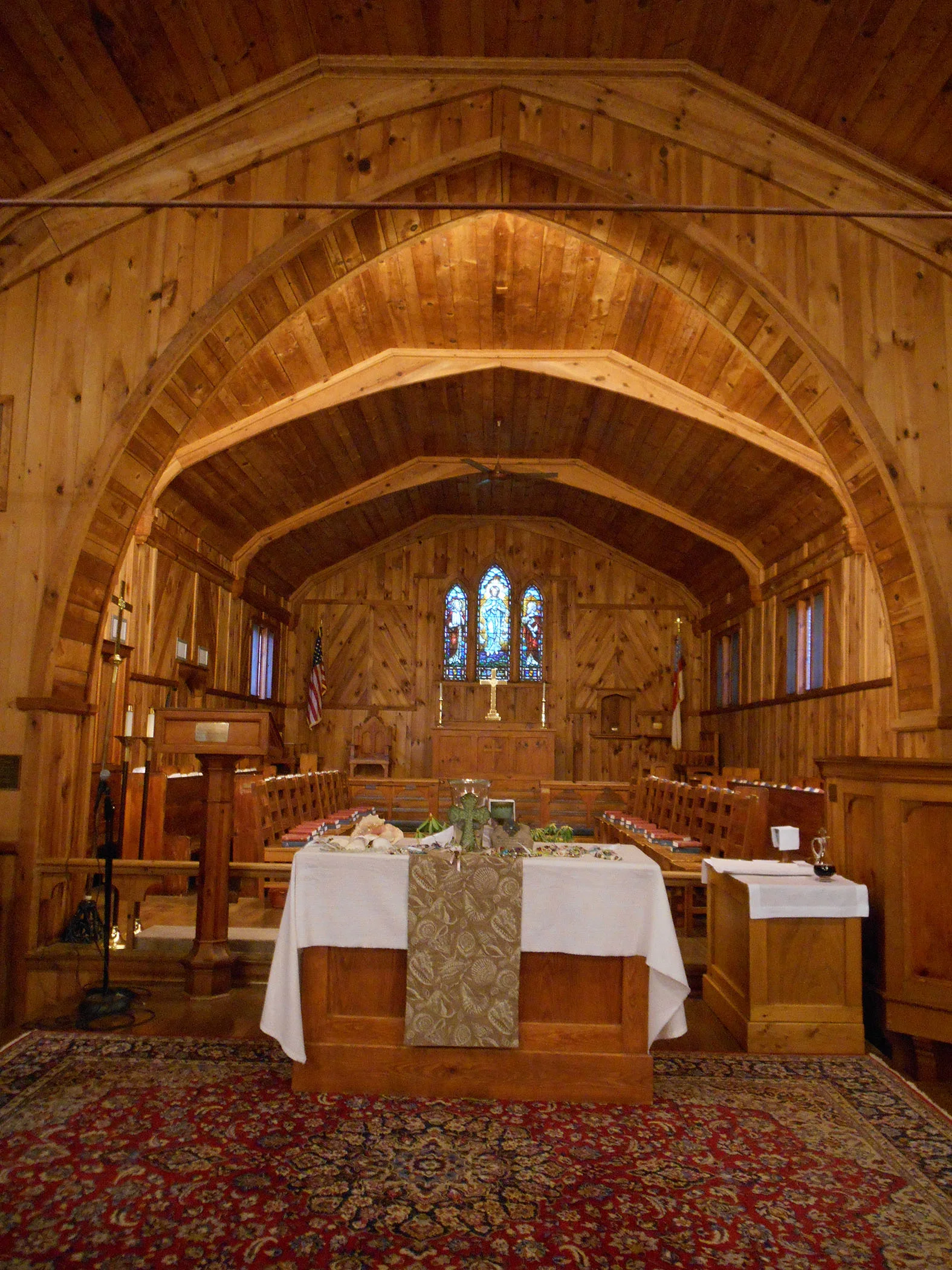
altar copy.jpeg

The Chapel of Transfiguration at Kanuga Conference Center in North Carolina has always been a place where the family of God is celebrated for so many reasons. I love the outer and inner appearance of the chapel as it is made of southern Carolina white pine from trees downed from a severe storm in 1936.

My mind always wanders as I sit in the chapel waiting for any service to begin, and I remember more. The wood for the chapel was not pretreated so there are these unusual dark oval markings on the wood representing the oiled fingerprints of the workers. The simple markings are more prominent at the top of chapel where it was more difficult for the builders to work. When I am in the chapel I not only feel surrounded by the thousands of prayers of people on retreat who have worshiped here, but I feel surrounded by the hands of those who labored here as well.

I especially remember the day sitting  in the chapel when I had found out that my fingerprints for my TSA Pre-check did not go through strong enough. That meant I would be investigated by the FBI before I got my Pre-check, which would take some time before I could get my traveler number! This is the identification you receive in order to go through a special lane through security where you do not have to take off your shoes or coat or put your laptop out separately. I walk with a cane and have special long lace up shoes that are difficult to take off and on, so getting my traveler number is significant for me.

I have a new appreciation for the builders of this chapel who must have been so much stronger and have been tightly holding onto the wood to leave their prints in this a sacred space.

I remember other services in this chapel that I wanted never to end. I have memories from a preaching conference dancing around the altar with Barbara Brown Taylor as I offered the bread and she followed with the wine. I see Bishop Tutu dancing on the green after an amazing closing Eucharist at a retreat led by Trinity Wall Street. Priceless. I remember two Lenten retreats where we were snowed in. Breathtaking.

I played my harp at one of the retreats that Phyllis Tickle led in this chapel because the scheduled musicians could not get here. A privilege.

Thin places like Kanuga give us a full album of memories to go back to and remember times when God’s presence and love was eminently present or as Gordon Cosby would tell us, we lived in the real world.

Joanna   joannaseibert.com


Daily Protection Prayer

“May the guiding hands of God be on my shoulders,
may the presence of the Holy Spirit be on my head,
may the sign of Christ be on my forehead,
may the voice of the Holy Spirit be in my ears,
may the smell of the Holy Spirit be in my nose,
may the sight of the company of heaven be in my eyes,
may the speech of the company of heaven be in my mouth,
may the work of the church of God be in my hands,
may the serving of God and my neighbor be in my feet,
may God make my heart his home,
and may I belong to God, my Father, completely.”

Lorica of St. Fursa (Fursey), 9th Century, Translation composite, from Facebook Page of the Rev Dr Frederick Schmidt

clay banks  unsplash

clay banks  unsplash

Fred Schmidt puts a prayer on his Facebook page almost every day. I cannot get this one out of my mind. St. Fursa was an Irish monk who was among the first to spread Christianity to Anglo-Saxon England in the seventh century.  A Lorica is a protection prayer in the Irish Celtic tradition often used before going to battle. It may have come from the original Latin word lorica meaning breastplate or armor.  It is suggested to have been inspired by Paul’s writing in Ephesians 6: 11 to “put on the whole armor of Christ.”

We have so much to learn still from the Celts. We have a treasury of their wisdom because writing and education were so important to them. I think of others who worshiped God but we know nothing of their traditions because their experience not the writing was important. We need both.

This is the kind of prayer that should meet us as we wake up in the morning, maybe with that first cup of coffee or even before.

We may need to go back to it during the day, so we might put it in a convenient place where we will not miss putting on the whole armor of God. Sometimes life does seem like going into battle. My experience is, however, that when prayers like this one become part of our being, we see that the battle is over and that love has already won.

Joanna  joannaseibert.com


Deb Cooper on Parker Palmer

Guest Writer: Deb Cooper

Parker Palmer: On the Brink

“I like being old.  Age brings diminishments, but more than a few come with benefits.  I’ve lost the capacity for multitasking, but I’ve rediscovered the joy of doing one thing at a time.  My thinking has slowed a bit, but experience has made it deeper and richer.  I’m done with big and complex projects, but more aware of the loveliness of simple things. . . I like being old because the view from the brink is striking, a full panorama of my life. . . Looking back, I see why I needed the tedium and the inspiration, the anger and the love, the anguish and the joy.  I see how it all belongs. . . I’m not given to waxing romantic about aging and dying.  I simply know that the first is a privilege and the second is not up for negotiation.”  Parker Palmer, On the Brink of Everything: Grace, Gravity & Getting Older, pp. 1-2,  2018, Berrett-Koehler Publishers, Inc.

parker palmer.jpg

More than twenty years ago, I was having a conversation with Barbara, a co-worker, when I asked her, “What is your favorite season of the year?”  Her response: “In the winter, I like summer the best; in the summer, I like winter the best.”  I was so taken aback by her response that I could think of nothing else to say, and the conversation ended.

I am curious why this conversation came to mind as I reflected on Parker Palmer’s words about “aging.”  As I read Palmer, I recognized my almost 70-year-old self as being “in transition” – currently multitasking while yearning for a narrower focus, currently working through a complex project while yearning for more depth in my relationships with friends, with God’s creation, with my own Self.  Perhaps my experience with Barbara came to mind just in time to give me pause to reflect more about just where I am at this moment.  

Over the last few weeks, I’ve been in conversation with Sandra, someone I’m just beginning to know.  She is an artist who paints landscapes of all the seasons—spring, summer, fall, winter—and she also loves to paint the flowers she grows in her own garden.  About her painting flowers, Sandra said she often uses good quality artificial flowers as her model in the dead of winter.  It is her way to bring spring and summer into a cold January.   Sandra brings life to everything she paints, and our conversations have breadth and depth. 

This is a common experience for me—life juxtaposing very different situations, bringing them both into a present moment, as if to say, “it is time to choose.”  I have something to learn from both Barbara and Sandra as I step into one more life transition, and thanks to Palmer’s book, I’m beginning to “see how it all belongs.”  

Deb Cooper

Joanna joannaseibert.com