Feminine Wisdom

Wisdom

To the disciples who were always asking for words of wisdom, the Master said, "Wisdom is not expressed in words. It reveals itself in action." But when he saw them plunge headlong into activity, he laughed and said, "That isn't action. That's motion." Anthony de Mello, Synthesis Today Quote, August 19, 2018.wwwsynthesispub.com.

Manet Fainting Couch

Manet Fainting Couch

There is a Greek myth about Psyche and Eros that many people doing Jungian work use to describe the conscious development of women. The story is the basis for She by Robert Johnson and Till We Have Faces by C.S. Lewis. In order for Psyche to reunite with her lover, Eros, she is given several tasks. At the beginning of each task, Psyche collapses and weeps as she sees the task so insurmountable.

My image is Psyche lying on one of those old-fashioned fainting couches that every woman of means possessed with her hand turned palm up on our forehead, her eyes closed, and her head leaning backwards on or off the couch. It is the feminine body language of surrender and stillness. Instead of plowing directly into a difficult task she has been given, the feminine waits, rests. In the waiting, answers come that are completely out of the box. They are truly answers to prayer. Some would say the answers come from the Spirit of God within her. Help comes from places she never imagined.

This is wisdom, the action of waiting, stillness, especially before we are asked to do something we do not think we are capable of doing.

I remember waiting in an outer office before a difficult meeting with other physicians. At first I was upset that I, this important person, had to wait! Slowly I realized the waiting was a gift, wisdom from a mysterious source, a time to quiet myself, to surrender to the moment, and to be still before taking on a meeting that might be difficult. When I was able to do this, I often took into the meeting the feminine energy of staying in relationship that could make all the difference in what happened.

Joanna joannaseibert.com

Parker Palmer: Violence

Parker Palmer: Violence

“Violence is what happens when we don’t know what else to do with our suffering.” Parker Palmer, p. 48, On the Brink of Everything, Grace, Gravity & Getting Old, Berrett-Koehler Publishers, Inc.2018.

on the bring of  large.JPG

I am not even one quarter the way through this recent book by Parker Palmer and already have most of what I have read underlined. I am especially moved by this quote about violence from a commencement address by Parker Palmer to the class of 2015 at Naropa University in Boulder, Colorado.

We daily see this in our lives. Violence comes from accumulated suffering that we and generations before us can no longer bear. Violence is grief that cannot find any other outlet or transformation. Maybe we have just inherited this way to respond to grief. Violence is grief over the loss of identify, loss of what we think may be ours, loss over loved ones, loss of land, loss of life’s work, loss of the rights that others have, loss of food, shelter, loss of love.

Grief is a powerful energy. I know it best in working with people in a grief recovery group, Walking the Mourner’s Path. Grief saps us of all energy. Grief takes up all our energy. We at times become paralyzed. When we are grieving, we can become violent to others, blaming them for the loss of our loved one. We can become violent to ourselves, becoming bitter, a victim.

There is hope, great hope. I have seen this enormous energy transformed into something other than violence. It can be transformed into empathy for others who are suffering as we hear their story. When suffering moves away from its own pain and reaches out to the pain of others, it becomes love. It can become compassion. Compassion leads to ways to move through the suffering, especially in community, that are nonviolent.

Suffering may not be the only factor in violence, but it may help to look at violence in ourselves and others and the world to see what part suffering may play in it. This involves looking at what must be going on in ourselves and others with some compassion when violence raises its ugly head.

Our faith stories teach us that finding love and compassion out of suffering can lead to resurrection experiences.

Joanna. Joannaseibert.com

Prejudice and the Daily Office

Prejudice and the Daily Office

“Do not let the oppressed be shamed and turned away;
Never forget the lives of your poor.” The Daily Office, https://dailyoffice.org .

daily office.PNG

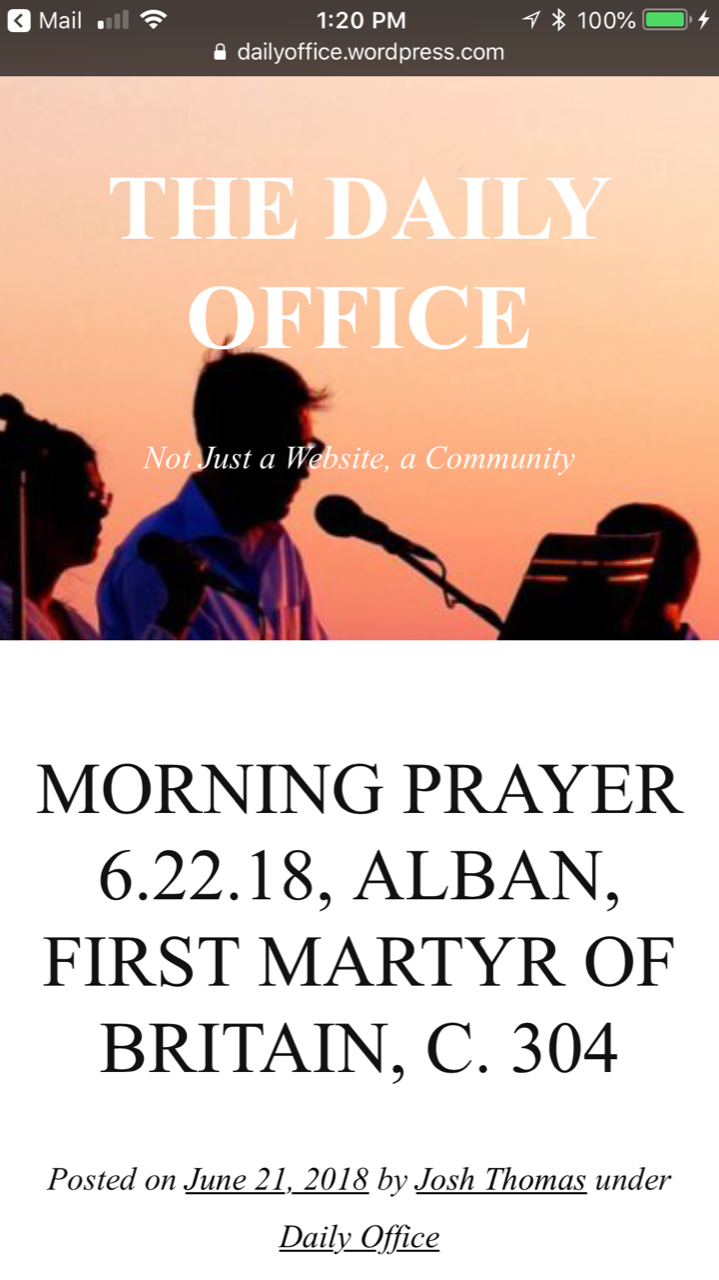
If I cannot attend the office of Morning Prayer at St. Mark’s, I try to read it from this website. If you do not know about this Daily Office website, you are in for a new adventure. Besides having all the readings right there in front of you for morning and evening and noon day prayer, the Lay Vicar, Josh Thomas, of the website offers hymns and pictures that relate to the readings and offers prayer petitions from those who send to them. It is not just a website but a community praying individually as well as participating in a live broadcast of morning and evening prayer service twice a day from the site. I always feel connected to pray-ers all over the world when I connect to The Daily Office.

As I read these prayers through this community, my mind takes me out of my own problems, and I move more globally. I see the children and families of Latino origin who are still separated and incarcerated at our southern border with Mexico. I cannot stop thinking and praying about them and those who are making and supporting a policy that has brought on great tragedy.

Then I remember an episode yesterday from our food pantry. I go to St. Mark’s weekly food pantry just meet and talk with those who come for their groceries. I see a brown colored woman with black hair and three children with similar appearance come in who seem to be confused about the process. I immediately think they must be Latino and motion to our member who speaks Spanish to go over and help them. The mother tells him she speaks English. Later, as I talk with the children I realize they are Native American.

I learn about my own prejudice that all brown skinned people must be of a certain heritage. I cannot condone the prejudice of those who are harming immigrant children and their families who are seeking asylum in our country, but I have a little insight into my own darkness.

I make amends to the family and hope I have learned some life lessons taught to me by those who were here in this land long before me.

Joanna joannaseibert.com