Watch for the Light

“The spiritual Experience, whether it be of faith, hope or love, is something we cannot manufacture, but which we can only receive.” Philip Britts, “Yielding to God,” Watch for the Light, p. 111-112. Plough 2001.

watch for the light.jpg

Watch for the Light is a daily reading for Advent and Christmas by some of the best-known spiritual writers, Bonhoeffer, Dillard, Donne, Eliot, Hopkins, Kierkegaard, L’Engle, Lewis, Luther, Merton, Norris, Nouwen, Underhill, Yancy and many others. The short essays are three to five pages long making this an Advent and Christmas reading that will take fifteen to thirty minutes to read and digest. This is a daily reading where we decide to devote a little more time to our Advent meditation with some of the most beloved spiritual writers. I am a major underliner, so I went back through the book to look for the most underlined essay. It was difficult since there were many underlined passages in every writing. One favorite was the essay “Yielding to God,” by the British poet, Philip Britts. Britts writes that Mary’s example for us of “let it be with me according to your word,” is the essence of the Christmas story. Jesus is conceived out of surrender and born not out of “the head of Zeus” like Athena, but in a lowly stable with all the animals and the cold and the dirt.

Britts writes that Christ was born into poverty to heal the poverty of our hearts. Christ did not come as a moral tune up or as self-improvement guru or spiritual teacher. He came to show that the same breakthrough can occur in our hearts today just as “ the word becoming flesh” changed the world over 2000 years ago.

Joanna. Joannaseibert.com

A Dog in the Manger

A Dog in the Manger

‘”I want to put Jesus in the manger!”

You did it last year. It’s my turn.”

No, I’m the oldest, I get to do it.”

Well, I’m the youngest, I think I should!”

Maggie grabbed the figure from Jack and accidentally dropped it face down on the hard floor.

“Now you’ve done it,” cried Jack.”’

Jim Simons, A Dog in the Manger and other Christmas stories, p 1, Rowman and Littlefield 2015.

dog in a manger.jpg

Jim Simons is an Episcopal priest who decides to write and tell a story for his Christmas Eve sermon every year which eventually now births into this collection of Christmas sermons called A Dog in the Manger. Simons reminds us that Jesus tells stories and the birth narratives consist of two different stories told by two authors, Luke and Matthew. He reminds us how the Christmas season is a special time to tell stories, stories about our roots, our parents and grandparents, and our early life.

Simon’s stories are entertaining but with a deep and meaningful message of hope about the significance of the birth of Jesus, and especially the deep love of God for each of us. The stories are fiction but no doubt have been taken from his life experiences. The book’s title comes from the first story about a puppy whose passion becomes going around town bringing back home to his new owner all the baby Jesuses from outdoor nativity displays.

I bought the book a few years ago when I was preaching more often looking for material for sermons for the Christmas season. I often preach about Christmas pageants because I have been involved in so many, and at least half of Simons’ stories are related to these dramas that always add some new and unexpected incarnational wisdom to Christmas.

This past year I have been reading a great deal of spiritual nonfiction writings in preparation for this book and two others. As Advent approaches I know I have been hungry simply for stories, and serendipitously this book appears in my stack for the Christmas season. My goal has been to read at least one story or at the least a half a story a day, but most days I find myself not being able to put the book down. Indeed, perhaps one factor for this craving has been the months I have put reading fiction on hold.

A Dog in the Manger has been exactly what I needed at the beginning of this liturgical year, and so I share it with you if by chance you are hearing a similar call.

Joanna. Joannaseibert.com

Kidd: Cocoons

Sue Monk Kidd: Cocoons

“Our deepest struggles are in effect our greatest spiritual and creative assets and the doors to whatever creativity we might possess.” David Whyte, p. 62, The Heart Aroused, Poetry and the Preservation of the Soul in Corporate America, Crown Business 2002. .

suzanne d williams unsplash

suzanne d williams unsplash

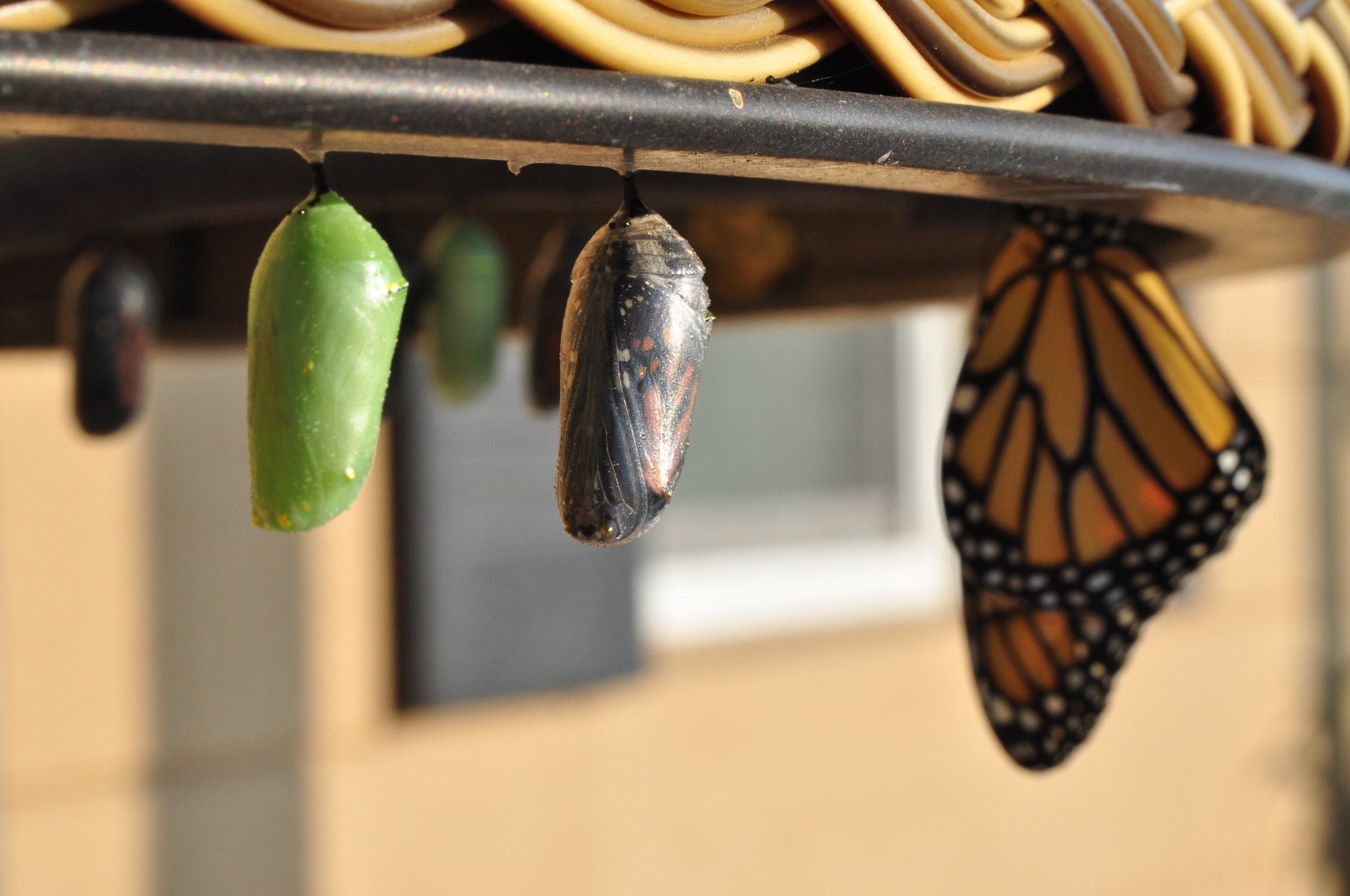
In When the Heart Waits, Spiritual Direction for Life’s Sacred Questions, speaker and writer, Sue Monk Kidd, shares her spiritual journey at mid-life. She compares this journey to being in a cocoon of darkness and finally emerging as a butterfly. Even though this image is more often one of Easter, it can also be an image of our journey through Advent. In the cocoon, Kidd shares with us her experience of the false selves that keep us from being the person God created us to be, the defenses we use for survival that like an addiction eventually harm us. She reminds us to embrace them, kiss them, thank them for caring for us, but now it is time to see what is beneath the thick skin cover-up.

Kidd describes the word crisis that in the Greek means separation, to leave the dead. Crisis is a holy summons to cross a threshold. Our response to crisis can be fighting it by looking for comfort or justice or by waiting and using the time to be soul-making (the narrow gate). Instead of trying to ride the crisis she writes about attempting to understand and identify the feelings that come up in the crisis like sorting tangled ribbons and then expressing these feelings especially through symbols such as a cocoon, which may come in writing or sharing our story or in dreams.

Those who are a part of a sacramental tradition where everyday symbols such as water, bread and wine and oil are used as an outward symbol of an inner grace can identify with the use of earthly symbols in our spiritual lives.

Kidd talks about the difficulty of letting go by comparing it to the caterpillar’s resistance to change called “diapause.” We fear leaving this former life as if it is “all we have.” I personally experienced this “nothing left” as I heard a call to transition from my medical career.

Letting go also happens at retirement and when we find an empty nest after our children leave or after we experience the death of a loved one. Kidd quotes from Rilke that as we resist, we should try loving the questions in our heart like locked rooms or books written in a very foreign language. We should live the questions in the darkness, and the answers will later come as we see resurrection. Jesus, of course, was the master of leading people to growth with more questions.

As Kidd moved from the cocoon of darkness to light, she began eastering or experiencing resurrection. She experienced delight in life, found a feminine side of God, learned a love of creation, and made a connection with her body. She learned that when she showed disrespect for her body, she also showed disrespect for the earth.

She also had a desire to live in the present, the now here instead of the nowhere when we live in the past or future, where we prepare to live instead of living. When we live in the present, time becomes not a straight line but a deep dot.

Kidd describes three stages of her contemplative awareness, first, hearing the words but not the music, then hearing the words and the music, and finally being the music.

Our orchestra seats for the Arkansas symphony in Little Rock are almost on the front row. I wonder if these seats may be an unconscious icon to be the music. This may be an attempt to become the music as we live in the present listening to the music, and as Kidd also did, little by little, learning about our authentic self, the true self that musical piece God has made.

Joanna joannaseibert.com