Blessing

Blessing

“The Lord spoke to Moses, saying: Speak to Aaron and his sons, saying, Thus you shall bless the Israelites: You shall say to them,

The Lord bless you and keep you;

the Lord make his face to shine upon you, and be gracious to you;

the Lord lift up his countenance upon you, and give you peace.

So they shall put my name on the Israelites, and I will bless them.” Numbers 6:22-27

zain bhatti unsplash

zain bhatti unsplash

This passage from Numbers is a frequent benediction in so many congregations. This morning for some reason I stop and listen to the words. We are giving God human characteristics. Using human terms and feelings for God, as you know, is a big word with rolling syllabuses called anthropomorphism. Sometimes this is our only way to express what we would like to say about God. It has its traps, but it can on occasion give us the tiniest glimpses of the magnitude of the love and care we receive from God.

How wonderful to pray that God’s face will be directed to us and even more so, God’s face will shine on us and we will receive God’s Grace. We are asking God to look directly at us, look us right in the eye and give us peace. We are indeed asking for a connection, a blessing, an ancient blessing that was given to the Hebrews and now to us many centuries later.

I love knowing that the ancient Hebrews were just people like us, asking for a blessing, a relationship, calling on God to look directly at us and to bring us peace.

What is the face of God? Is it the horizon, the stars, the oceans, the forests, the moon as far as we can see? Is it the solar system, the planets Mars and Jupiter, or is it a multitude of solar systems and beyond? We are full circle back to the word solar which pertains to the sun, a brightness that shines above all others for us. Yet, we know that the brightness of our sun pales in face of the love of our God that shines on sunny and dark days and nights.

Joanna. joannaseibert.com
St. Francis Hoeing, Gandhi:Dying

St. Francis: Hoeing, Gandhi: Dying

“Saint Francis, hoeing his garden, was asked what he would do if he knew the world would end tomorrow. ‘Continue hoeing my garden,’ said the saint.” Suzanne Guthrie, Synthesis Today, Quote for June 15, 2018, attributed to St. Francis. www.synthesispub.com

js office copy.jpg

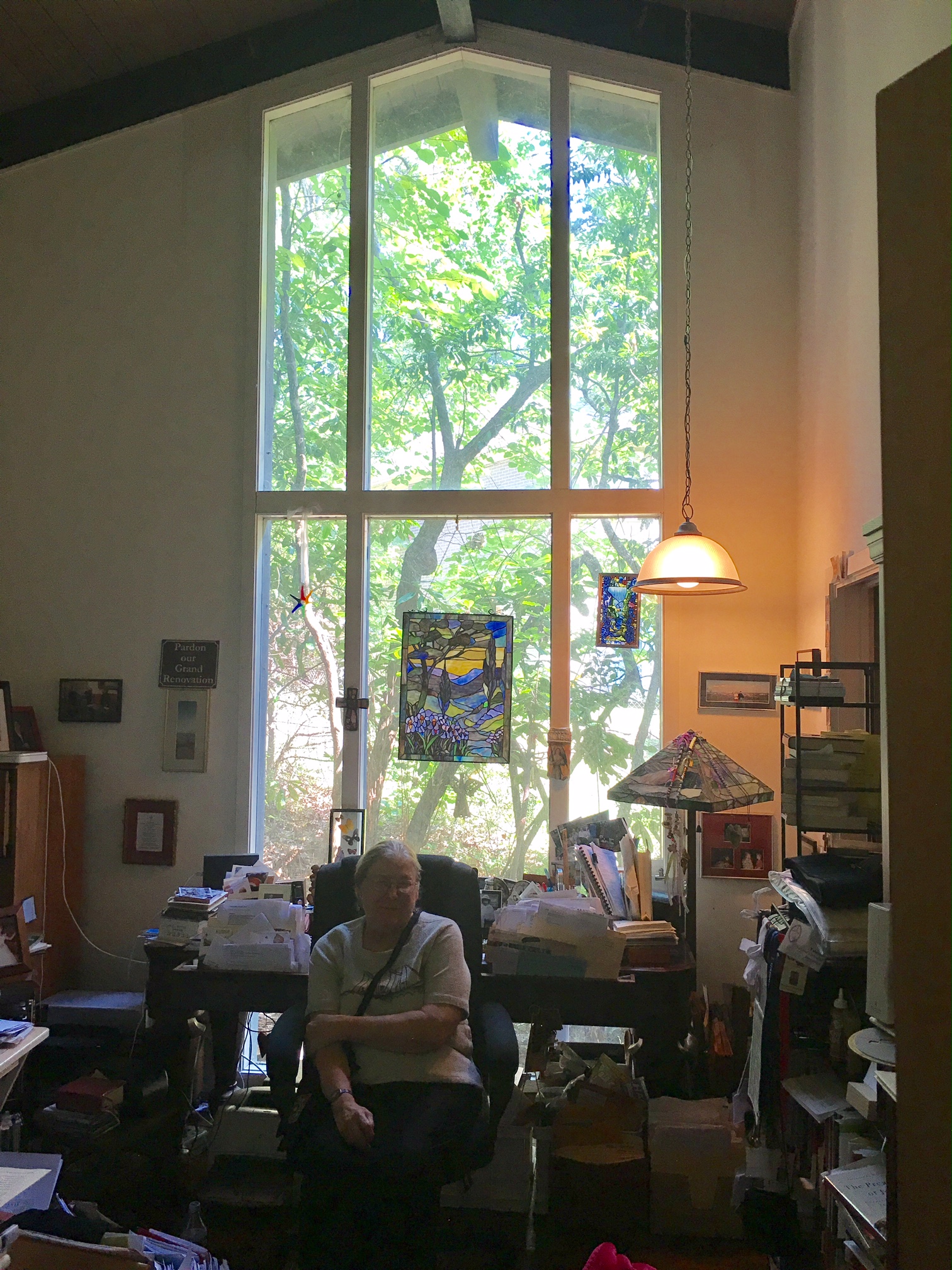
I have heard this phrase attributed to St. Francis often and wondered what I would do as well if I knew I was about to die. I have made writing every day a discipline for almost two years. Would I keep on writing? Writing has become one of my best spiritual practices. As I look outside to trees and birds and sky from the floor to ceiling window in my office and my fingers hit the keyboard, I feel a peace that I hope is God’s presence.

I know I would spend as much of the last day with my family, actually as much as possible. I might entice my grandchildren to watch a movie with me and then just secretly watch them. I would want to be with my husband as much as possible. I would want to make certain my family and friends knew how much I loved them by my action and words. I would like to have a meal with my family and friends. I would look at old pictures to keep memories with me. I would spend more time with the family pictures and icons and remembrances of joy which surrounded my desk. I would ask for prayers from the good pray-ers I know, especially the women in Daughters of the King. I would also spend time in prayer at a sacred space.

Of course, if everyone else knew the world was coming to an end, this would be interesting to see how our paths might cross!

So, what does all this mean?

“Live as if you were to die tomorrow. Learn as if you were to live forever,” is attributed to Mahatma Gandhi.

I try to carry these two quotes by Gandhi and St. Francis with me each day and share them with spiritual friends as well. The quotes are a good daily benchmark as to whether we are doing the practices that bring us closer to God.

Gandhi’s quote is a paradox, an anchor metaphor for our life which is a constant ambiguous paradox. Each day this year I hope to spend more of my time doing the things which help me realize what are my best connections to God and myself and my neighbor and my family and friends.

Of course, often the connections lead me to other places, and I pray to stay open to these new adventures.

Joanna joannaseibert.com

Thich Nhat Hanh: Walking Meditation

Thich Nhat Hanh: Another Walking Meditation

“People say that walking on water is a miracle, but to me, walking peacefully on the earth is the real miracle. The Earth is a miracle, each step is a miracle. Taking steps on our beautiful planet can bring real happiness.” Thich Nhat Hanh, p. 58, The Long Road Turns To Joy, a Guide to Walking Meditation, Parallax Press 1996.

thich nhat hanh walking.jpg

For many years, I would walk around the block in my neighbor for twenty minutes before going to work at the hospital. This seems to quiet the committee meeting in my head. Putting my feet on the earth, even the pavement of the road, seems to reconnect my head to my body as I become “grounded.” Always when I am outside, I realize there is a world greater than the one I live in. There is a power greater than myself. I have trouble meditating by simply sitting, but some movement such as walking can lead me into that meditative journey.

The Vietnamese Buddhist, Thich Nhat Hanh, is one of the most well-known meditative walkers. His pocket-sized book is full of simple mindfulness exercises to think about as we walk. He introduces us to several methods of following and listening to our breath as we walk. He teaches us to be aware of the ground, our foot as it touches the ground as well as our breath. My pattern became breathing in on the right foot, breathing out on the left. This was similar to walking the labyrinth and paying close attention to the path.

In mindful walking, as we stay with our breath, there are no more rooms available for that committee to meet in our heads. Thich Nhat Hanh compares walking to eating, nourishing our bodies with each step. With each step, we massage the Earth. When the baby Buddha was born, he took seven steps, and a Lotus flower blossomed under each step. Thich Nhat Hanh suggests we image with each of our steps, a flower blossoming.

We can also practice mindful walking anywhere, between meetings, in hospitals, at airports, walking to our car. The Buddhist monk also offers several poems to recite while walking: “I have arrived, I am home, in the here, in the now. I am solid. I am free. In the ultimate I dwell.”

Joanna. joannaseibert.com