De Mello, Ignatius: Consciousness of the Past

De Mello, Ignatius: Consciousness of the Past

“The postulate is that awareness alone will heal, without the need for judgment and resolution. Mere awareness will cause to die whatever is unhealthy and will cause to grow whatever is good and holy. There is no need to use your spiritual or psychological muscles to achieve this.”

Anthony de Mello, p. 101, Sadhana: A Way to God. ImageCatholicBooks.

sunset.jpg

I try not to read too many de Mello exercises a day in his book, Sadhana: A Way to God, but I find myself not being able to wait to read the next installment! As I start to write, I am ending up listing almost all of the exercises as so useful especially exercise 30, “Consciousness of the Past,” practiced at night, where we think of our whole day as a film, unwinding the day as a movie, not approving or condemning what we did, just becoming aware.

This is different from the Ignatian Examen where we do examine and make judgements from our day. In the Examen, we review our day, give thanks, review where we found God and where we ignored God, recall actions we wish we had not done, ask for forgiveness, and ask for grace for the next day. (James Martin, The Jesuit Guide to Almost Everything, p. 97, HarperOne 2010).

De Mello believes on the other hand, that if we are only aware, we will heal without the need for judgment and resolution. The finale of the exercise by de Mello after we have observed the day as a movie is noticing where Christ was with us in the day. How did Christ act? De Mello asks us to concentrate on how “Christ” acted in our day more than on how we acted.

We can see similarities in both of these spiritual exercises and differences. This is just one more small example of the diversity of how we can try to be aware of our connection to God.

My experience is that when I simply become aware and look for Christ, as de Mello describes as I review the movie of my day, God indeed heals, much slower than I would like, however. At other times I need the awareness exercises described in the Ignatian Examen to get me back on track.

I am going to have to stop describing all of the de Mello exercises. Otherwise, I will be going over his whole book! The miracle of finding and choosing his book as well as the exercises of St. Ignatius was an answer to prayer, and I now share it with you!

Joanna. joannaseibert.com

Robert Johnson, Joyce Rockwood Hudson: Dreams Again

Robert Johnson, Joyce Rockwood Hudson: Dreams Again

“If we go to that realm (the inner life or unconscious)  consciously, it is by our inner work: our prayers, meditations, dreams work, ceremonies, and Active Imagination. If we try to ignore the inner world, as most of us do, the unconscious will find its way into our lives through pathology: our psychosomatic symptoms, compulsions, depressions, and neuroses.”Robert Johnson, p. 11, Inner Work, Using Dreams and Active Imagination for Personal Growth, Harper&Row 1989.

inner works natural spirituality.JPG

My spiritual director best helps me and others connect with God through dreams. Dreams are certainly one way that God, the dream maker, speaks to us. Working with our dreams is like studying a new language. It is the symbolic language of the unconscious. We connect to the unconscious with dreams, imagination, and incidents of synchronicity or coincidences or serendipity.

We study our dreams learning about personal symbols that may be specific to us like sea and trees for me. There are collective symbols which may be universal, such as water representing the unconscious, light being our consciousness, a child being the creative part of us, animals representing instincts, vehicles representing energy or how we get along with a car representing our independent energy and buses, planes, trains being collective energy.

Dreams also speak in the language of mythology, fairytales, religious rituals, music.

Consider learning about dream work as a spiritual practice. Join a dream group, for the gold in dreams can be so much richer with the help of others. Two books to start with to learn more about dream work are Inner Work: Using Dreams and Active Imagination for Personal Growth. by Jungian analyst, Robert Johnson, and Natural Spirituality: A Handbook for Jungian Inner Work in Spiritual Community by Joyce Rockwood Hudson. Both are also good books to read together in a group.

If this spiritual discipline interests you, just start by keeping an electronic or old fashion notebook by your bed and write down your dreams as soon as you awaken, and see what happens!

Joanna. joannaseibert.com

Waiting for God

Waiting for God

“O Lord, my heart is not lifted up,

My eyes are not raised too high;

I do not occupy myself with things too great and too marvelous for me.

But, I have calmed and quieted my soul,

Like a weaned child with its mother;

My soul is like the weaned child that is with me.”

Psalm 131

st. mark's.jpg

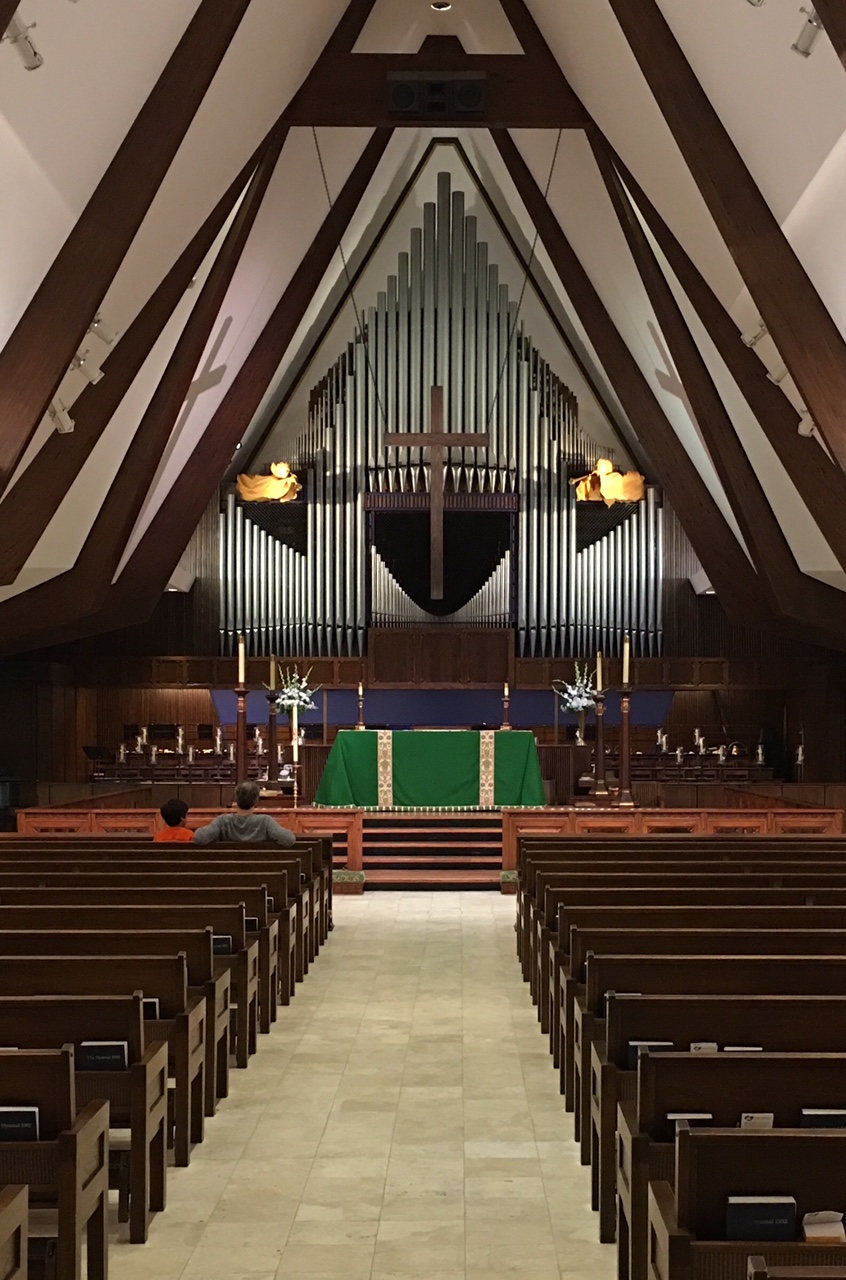
I remember a recent Sunday when I came to early church with all the concerns of the day and the present week and the past week. I am not playing the harp because I am having difficulty putting in two new strings that have recently broken. It was the first meeting for discernment for the Daughters of the King at St. Mark’s. We have a wellness forum during the adult formation hour that I have been working on. There are some pages missing in the Eucharistic Prayer for the next service in the Altar Book. I decide to go and sit at the back of the church and try to quiet the busyness about these concerns and more. The church is absolutely quiet. The short green season hangings are more calming and simplistic with a hint of the ornamental. The candles are lighted and flickering. The spring flowers are in honor of the mother of a friend.

I am in a beautiful place built to bring us closer to God, but my head is still a mess. How can I see or taste a glimpse of the holy before the service starts? Must I wait for some moment during the liturgy, at the scripture, in the prayers, the sermon, the music, the Eucharist? I pray for guidance, actually for help. The message comes. Start intercessory prayers. You have not said your private prayers this morning before church. Too busy. I start praying for those I am committed to pray for each day. If I know them, I imagine them with Jesus. Almost immediately, I feel that peace that passes understanding, a calm.

Time after time this is my experience. I begin to know a peace whenever I can get out of myself and my world and my concerns and send love to my neighbor by visiting, calling, writing, serving or a multitude of other ways, but especially in intercessory prayer. I rarely know how these prayers affect those I pray for, but with each prayer, my mind and my body also take my heart to find Jesus as I try to connect others to that healing love.

Joanna joannaseibert.com