Guest writer: Burton: In the Present

Guest Writer Burton: In the Present

“Wherever you turn your eyes the world can shine like transfiguration. You don’t have to bring a thing to it except a little willingness to see. Only, who could have the courage to see it?” Marilynne Robinson, Gilead

Gilead.jpg

My spiritual director patiently reminds me to be “in the present.” Good advice for a Type A personality like me. Good advice and good luck, my closest friends would add. But while on a week-long holiday recently, I found myself practicing being in the moment. It was a remarkable experience.

It is not as if I haven’t tried this before. I have failed at meditation more times than most people have tried. I still work at it. Of course, that is just the problem. Being present is not something to be done, it is more something to be experienced. When asked why I am in spiritual direction, I say, “People tried to make me think I was bad. God invited me into something better.” I guess it is not so strange that being present to the moment offers that “something better.”

When I first read Marilynne Robinson’s novel Gilead, I saw the old pastor as an image of my father. Re-reading it now—at age 75—I relate more personally. A remark the minister makes rings truer now than it ever did: “Wherever you turn your eyes the world can shine like transfiguration. You don’t have to bring a thing to it except a little willingness to see. Only, who could have the courage to see it?”

During that week-long holiday, we went to hear the Brahms Requiem. It was a magisterial performance led by one of the world’s great conductors. Surprise washed over me when I realized the violins did not participate in the opening movement. I’ve sung the Requiem and been to at least a dozen performances. Never had I realized what anyone with a score in front of them or anyone who was really present already knew. The sounds of the violas, cellos and bases was transfixing. I had never really heard it before.

There were other moments, far more mundane, too. Not worrying about arriving, but rather enjoying the walk. Not being concerned about appearance, and instead experiencing a shining present moment. It was indeed “something better.”

Not to worry. This is not a tale of transformation from cocoon to butterfly. I’m still pretty much a slug—to mix my images. But that isn’t the point. The point is that I have had moments of being in the moment, of being present, and it is where I want to spend more time, not in the future, but…well you understand. This is a journey undertaken not because someone convinced me I was bad, stained, flawed; but rather a journey undertaken because God invited me—us—to something better.

Larry Burton
Being with the Dying

Being with the Dying

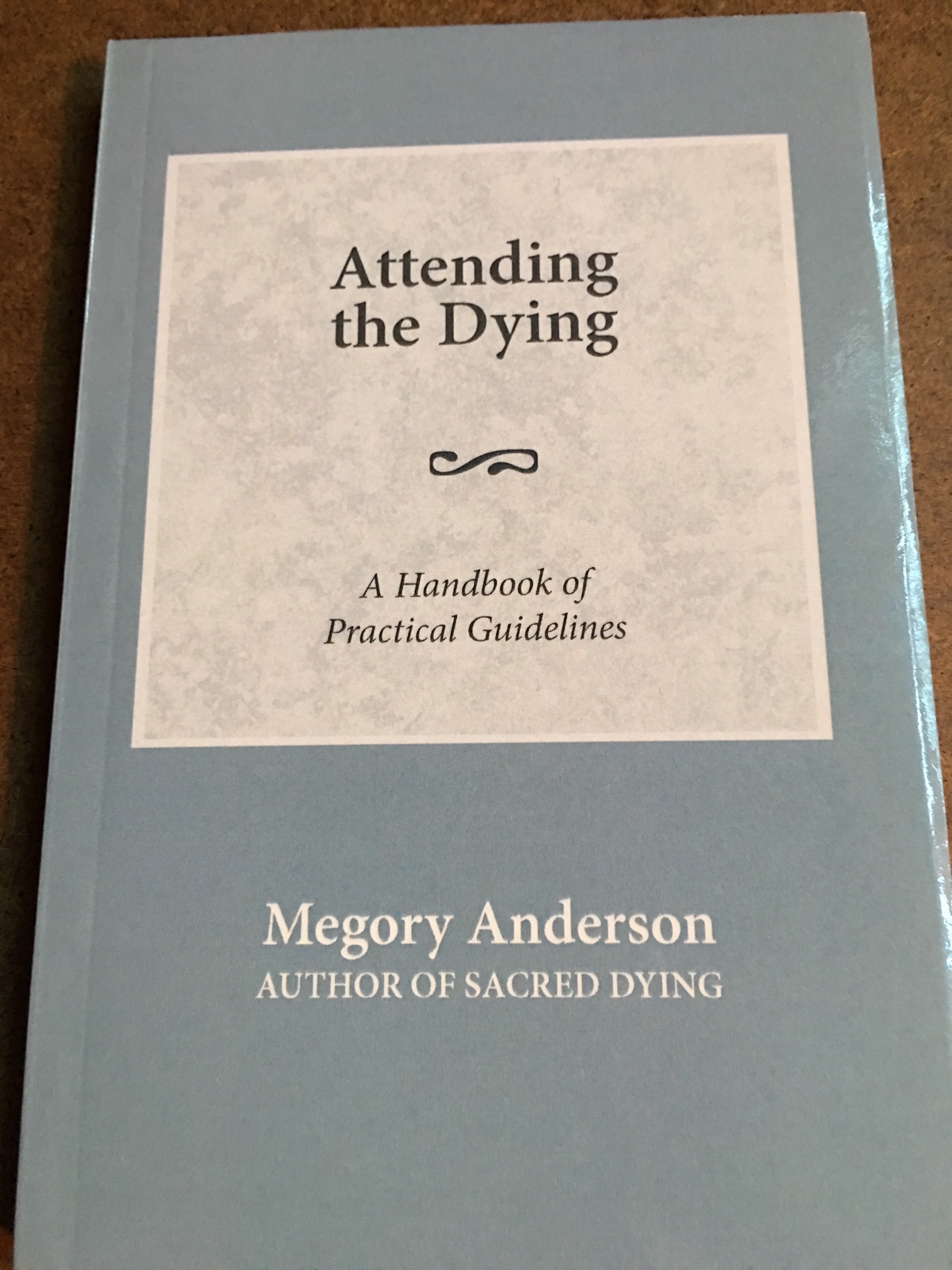
“Being witness to a death is a profound experience for everyone-for family members and loved ones and for health care professionals who have cared for the patient-and certainly for the person who ministers spiritually. When you have sat vigil with a dying soul, you are forever changed. You have experienced a great mystery.”

Megory Anderson, Attending the Dying: A Handbook of Practical Guidelines, Morehouse Publishing 2005.

attending the dying_.JPG

Megory Anderson, who recently died, has written a large volume on being with the dying as well as a short pocket-sized handbook. Many people come for spiritual direction related to the death of a loved one. Someone significant has died or is about to die. Often the death is very imminent. If there is time we can go over some of the very concrete directions Megory Anderson gives and then gift them the small handbook.

My experience is that often there is not even time for friends to digest the handbook which can be so very helpful. Frequently the person or caregiver is so overwhelmed that even reading is difficult. It is similar to my experience with hospice. My father-in-law was put on hospice care the day before he died. We so often wait too long before asking for help or accepting the reality of the situation.

Anderson teaches us so much. Attending the dying is like the privilege of being at a birthing. It is a sometimes-painful celebration of a new life. I especially try to reread her section about creating a sacred space. We talk to the family about clearing clutter from the room, bringing in sacred objects such as devotional icons, prayer beads, photographs, maybe even childhood books, reading favorite stories, even childhood poems. Favorite music, a lighted candle, a favorite quilt, fresh flowers from someone’s garden remind us all that something special is happening here. We come to be with the person dying, listen to them and hear their story. Conversations should be directed to them. My experience is always to speak to the dying as if they can hear what we say.

As the death approaches, I know of many who midwife their loved one into a new life by singing favorite hymns, reading the psalms, taking turns saying prayers, and performing rituals for the dying from their traditions. After the death, saying prayers and preparing the body can be one last loving ritual for family and special friends. My father-in-law grew magnificent roses. The night he died, our family took rose petals from the flowers in his room and scattered them over his body before walking his body out to the funeral hearse.

This book is invaluable to anyone who is attending the dying. The author describes preparation for death, the death process, and what to do afterwards as well as how to react to the very unusual behavior of well-meaning family and friends. We so rarely have a guidebook for life’s more difficult journeys. This is one.

Joanna. joannaseibert.com

May:Contemplative Prayer

May: Contemplative Prayer

“There is considerable evidence that highly experienced contemplatives may not have more unitive experiences, but they at least recognize these experiences more often.”

Gerald G. May, Will and Spirit, p. 205. HarperOne 1982.

kanuga 2013 sd copy.jpg

Gerald May, a psychiatrist associated with the spiritual direction program at the Shalem Institute in Washington, D.C., in Will and Spirit, writes about the dynamics of the human mind and its relationship to God in contemplative prayer. May’s central theme is the “unitive” experience as the keystone to contemplative spirituality, being at one, loss of self-definition, totally wide awake and open, aware, more concerned for others and compassionate.

It is not something that can be achieved or made to happen, but is a gift from God, given through grace, what those in 12-step programs would call, “a moment of clarity”, where the addict or alcoholic sees for a brief second how he or she is relating to the world.

As opposed to a psychedelic experience which leaves a person right where he started, a unitive experience develops growth or integration. We may put ourselves in position in spiritual direction to find such experiences, but it is impossible to make them happen. May compares the struggle to that of the addict to quit on willpower over desire. When will power is all we have, desire wins hands down. The act of legitimate spiritual surrender must be conscious, intentional, and freely chosen and we must be willing to accept responsibility for surrender.

Contemplative practices may be associated with a greater recognition of the divine in daily life, but it should not to be associated with achievement, attainment or even a constant state of unity. Emotions must be noticed, but left alone. Some contemplatives like those who live with chronic pain, and very young children can be better at this as they stay aware and “keep their hands off their minds.”

Pascal writes that “all human evil comes from our being unable to sit still in a room.” The practice of quiet is an exercise in “not doing,” a study in surrender, letting go, which Jung points out is quite different from “doing nothing.”

May believes we cannot expect to grow in spiritual awareness without some intentional practice of silence.

Joanna. joannaseibert.com