Myrrh Bearers

Myrrh Bearers

“But on the first day of the week, at early dawn, they came to the tomb, taking the spices that they had prepared.” —Luke 24:1.

One of the myrrh bearers

One of the myrrh bearers

I am preparing to present a workshop at the International Community of Hope conference this summer in Texas. Community of Hope began out of a need to train those who are not ordained to be hospital chaplains at St. Luke’s Hospital in Houston. The training program is now used all over the world for people interested in visiting the sick and homebound. I have been involved in the Community of Hope in our diocese for more than twenty years, and continue to see it as outstanding preparation and study for anyone called to a ministry involving pastoral care. One of the hallmarks of the training is that it is steeped in Benedictine spirituality.

The image of the Community of Hope Chaplains that keeps coming to me is that of the “myrrh bearers,” the women who brought spices to the tomb of Jesus on that early Easter morning. They brought their most precious resources to honor the one who had cared for them. My experience is that this has also been the story for many of those called to the ministry of pastoral care. They know what it is like to be wounded, and they have been ministered to by other healers. They understand what it is like to be loved and cared for by others. Their only way of sharing and continuing and keeping that love is to carry what they have learned to someone else.

What happens with the myrrh bearers’ visit is something totally unexpected. They go to honor their friend and teacher and instead they are promised a new life, a resurrection in this life and the next.

I have never experienced a visit at which I did not receive resurrection. We are touched and healed by those we go to visit. We take our most precious possessions, ourselves, our time, our presence, and make an offering. In return we always meet the resurrected Christ in so many forms.

Joanna. joannaseibet@me.com

Purchase a copy of A Spiritual Rx for Lent and Easter from me, joannaseibert@me.com, from Wordsworth Books in Little Rock, or from Amazon.

Recognizing God and Angels

Recognizing angels and God

“But Mary stood weeping outside the tomb. As she wept, she bent over to look into the tomb; and she saw two angels in white, sitting where the body of Jesus had been lying, one at the head and the other at the feet. They said to her, “Woman, why are you weeping?” She said to them, “They have taken away my Lord, and I do not know where they have laid him.” When she had said this, she turned around and saw Jesus standing there, but she did not know that it was Jesus. Jesus said to her, “Woman, why are you weeping? Whom are you looking for?” Supposing him to be the gardener, she said to him, “Sir, if you have carried him away, tell me where you have laid him, and I will take him away.” Jesus said to her, “Mary!” She turned and said to him in Hebrew, “Rabbouni!” (which means Teacher).”

—John 20: 11-17

rebecca Stephens Facasantos.jpg

My mind and my heart are flooded with thoughts about this Easter as I am reading the works of others and have new images from old readings like this one about the appearance of Jesus to Mary Magdalene. Bishop Jake Owensby of Western Louisiana suggests in his Easter blog this year “that Mary Magdalene did not recognize Jesus because “She is looking right at the risen Christ.. and yet she sees nobody. For Mary Magdalene the gardener is a nobody.” Owensby’s theme is that our vocation as people of the resurrection is to “find the risen Christ in every body, no matter what their physical appearance.” Christ is no longer in one body but in each and every one of us. No exceptions.

Frederick Buechner also speaks to this theme in The Faces of Jesus. Buechner writes that “it hardly matters how the body of Jesus came to be missing because in the last analysis what convinced the people that he had risen from the dead was not the absence of his corpse but his living presence.”2

One more insight into Mary Magdalene’s visit to the tomb. Angels speak to her. There is no recognition that this is an awe filled moment. Perhaps she sees and speaks to angels all the time, but if we try to put ourselves into the scene, we may have been more like the other Mary at the annunciation, full of fear or astonishment or wonder. My best guess if I stay in the scene with Mary Magdalene that she may not recognize them as angels. We are reminded one more time about the difficulty in recognizing the Christ in our neighbor as well as the angels in our life who come to guide us at formidable times.

Mary Magdalene must have recognized all this later, as is often our case. Otherwise we would not know her story.

1Jake Owensby, “Every Body is Somebody,” Looking for God in Messy Places, Jakeowensby.com, April 19, 2019.

2 Frederick Buechner “The Cross as the crossroads of eternity and time,” in The Faces of Jesus (Paraclete 2005), p. 87.

Easter Vigil 2

Easter Vigil 2

“How blessed is this night when earth and heaven are joined and man is reconciled to God.” —Book of Common Prayer.

easter vigil copy.jpeg

I revisit this past Holy Week and remember some wonderful stories of the excitement of the Easter Vigil at each of the churches where I have served. I remember one priest telling us at his homily many years ago that our presence at the Vigil didn’t give us extra points with God. We weren’t getting more stars in our crown for being there. It was simply a privilege to be among the first ones at the empty tomb to meet the risen Lord.

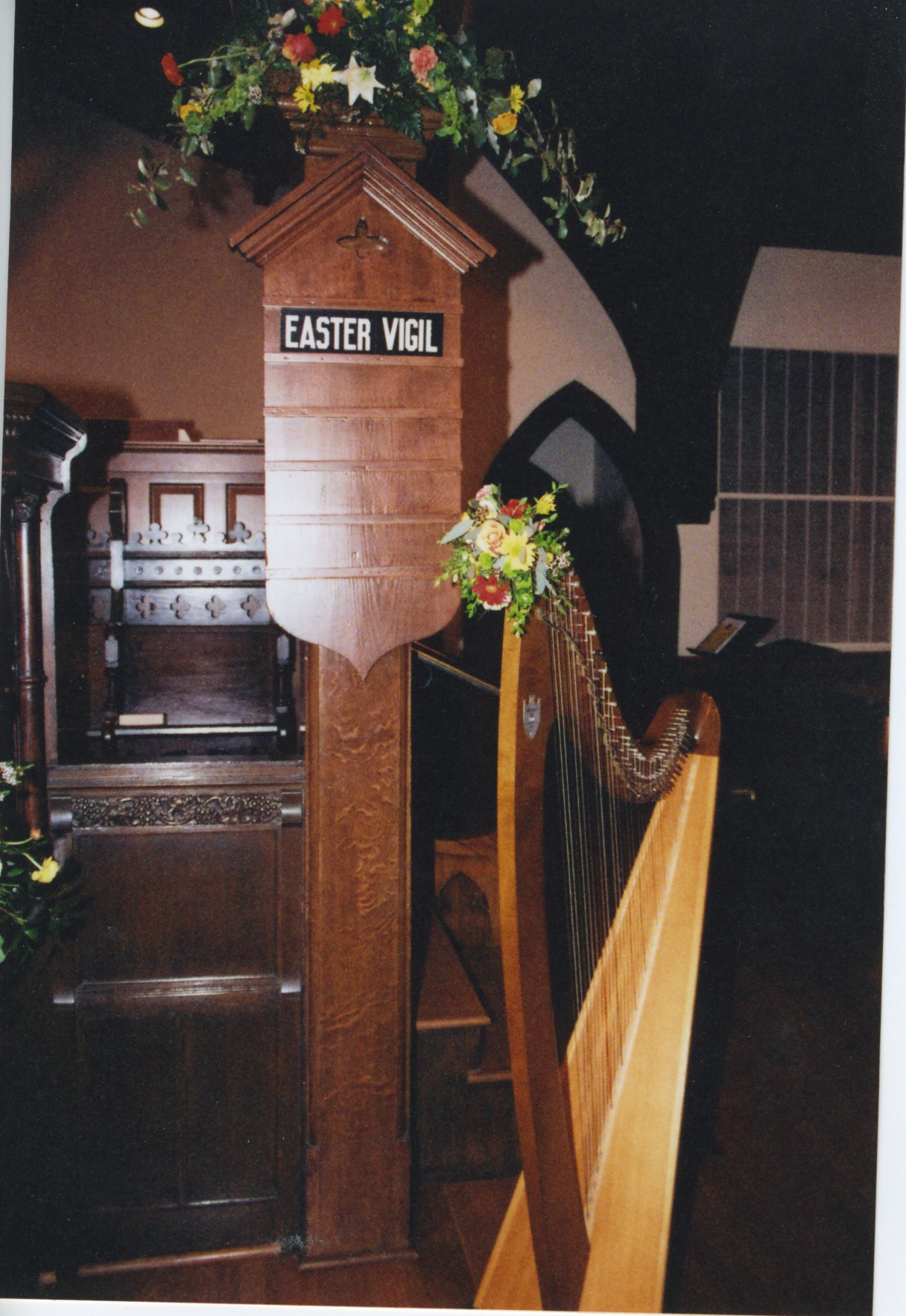
One of my favorite surprises was waiting to see how the Altar Guild would choose to decorate my larger harp for the Easter Vigil.

Many congregations then follow the Vigil service with an elaborate reception or dinner late at night at church or at someone’s home.

Once at Trinity Cathedral, as the deacon tilted the candle ever so slightly to light its wick from the first fire, oil ran out of the top of the candle and the fire became surreal, like the tongues of fire described at Pentecost. At St. Margaret’s we did the Vigil in the Columbarium garden and I played a smaller lap harp as I sang the Exsultet to stay on key. I cannot describe the exhilaration of shouting out in the great outdoors, “The Lord has risen indeed!

At St. Luke’s, a lector reading one of the Old Testament Lessons was having difficulty seeing in the dark. In the middle of the long reading, my dear friend put her candle closer to the microphone at the lectern, catching the microphone’s foam covering on fire. She so elegantly promptly blew out the fire and didn’t miss a beat in the reading. Also, at St. Luke’s one of the amazing teachers of the children’s ministries and her two children planned a flashlight egg hunt for older children after the Vigil. The young people searched outside around the church, which was a huge success as well as increasing the number who came to the service!

The Vigil is so unusual, however, that it is easy to get caught up in the many tiny details of this once-a-year liturgy and view it as a performance rather than an offering. The Vigil is a service to be enjoyed and celebrated. We can always count on the Vigil to bring surprises just like the risen Lord.

Joanna. joannaseibet@me.com

small.jpg

Purchase a copy of A Spiritual Rx for Lent and Easter from me, joannaseibert@me.com, from Wordsworth Books in Little Rock, or from Amazon.