Rachel Held Evans: Searching for Sunday

Rachel Held Evans: Searching for Sunday

“This is what’s most annoying and beautiful about the windy Spirit and why we so often miss it. It has this habit showing up in all the wrong places and among all the wrong people, defying out categories and refusing to take direction.” Rachel Held Evans in Searching for Sunday (Nelson Books 2015), p. 196.
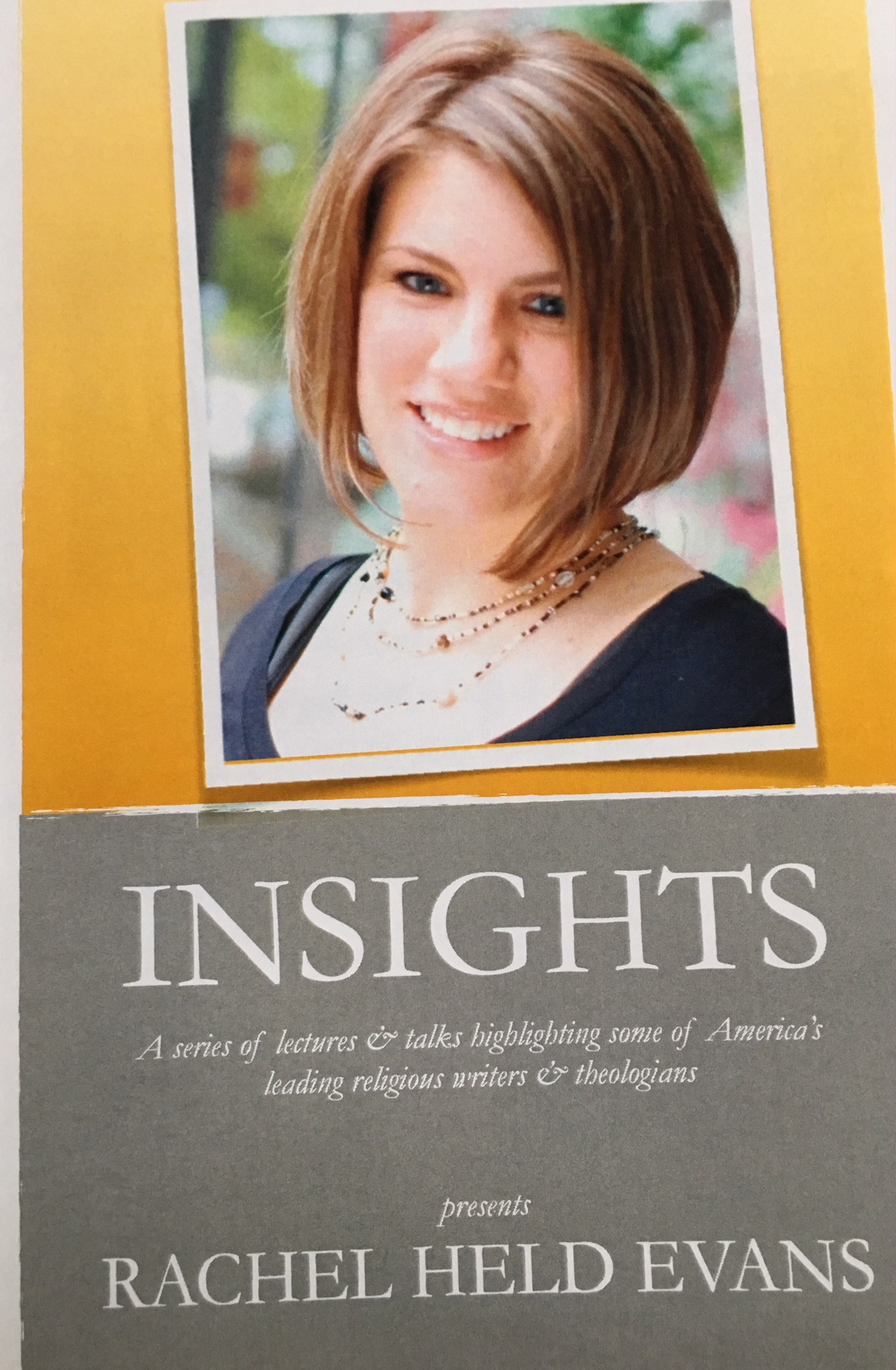
rachel evans.jpg

Our world grieves the death of 37-year-old Rachel Held Evans this past Saturday, May 4th, 2019. She was a spiritual voice for so many millennials as well as their parents and grandparents. I treasure that I meet her on her podcasts and at writing conferences, and at our cathedral in Little Rock when they invited her here to speak.

Larry Burton recently reviewed on this blog her newest book, Inspired, a book about the interpretation of some of our favorite Bible stories as she wrestles with some of our greatest questions about suffering and doubt.

Today’s writing relates to a quote from Searching for Sunday where Rachel struggles through the liturgical year trying to find her faith and a church community as she journeys through the sacraments. At Pentecost I hope I will remember that Rachel reminded us that the wind, the Holy Spirit that Jesus described to Nicodemus goes even to the Pharisees, one who eventually heard the wind, spoke up for Jesus at his trial, and personally cared for Jesus’ body when he had been abandoned by most of the rest of the world.

Rachel reminds us that the Spirit is inside but also outside the traditional church if we only have eyes to see and feel it. There is never a corner of the world where God has abandoned its people even when it is so hard to see God in that place or with that people. She reminds us we will know the presence of the Spirit when we know and see the fruit of the Spirit: peace, joy, love, patience, kindness, goodness, faithfulness, gentleness, self-control.

Today we may honor Rachel Held Evans as we try to keep looking for God and the fruit of the Spirit in all kind of places and talking about it in community and writing about it as much as we can.

Joanna. Joannaseibert.com

Charleston: Being Resilient and La La Land

Charleston: Being Resilient and La La Land

“Life is hard. The losses, the sudden arrival of illness, the struggles within families, the pressure of a world trying to find a reason to hope. If it is to endure the gale force winds of chance, faith must be deeply rooted, anchored in trust, strengthened by courage, able to bend but never break. So here is a prayer for all of you living in the real world: may you find your faith as tough as you are and as resilient as the love that keeps you going.” —Bishop Steven Charleston, Facebook Post.

la la land.jpg

I think of the end of the 2017 Academy awards, when Warren Beatty couldn’t understand what was in the envelope to announce the best picture of the year. He handed the confusing envelope to Faye Dunaway, who saw the name La La Land and announced that movie as the winner. They had been given the wrong envelope! It was the one announcing Emma Stone as best actress from La La Land, which had been reported earlier. The producers and cast of La La Land were so excited, they came up and thanked numerous people. Men with headsets scurried on stage and handed Jordan Horowitz, one of the La La Land producers, the correct envelope as he announced, “I’m sorry. No. There’s a mistake. Moonlight, you guys won best picture!”

I will always remember the grace with which Horowitz gave up his Oscar—his whole team on stage, his dream suddenly crushed, after years of hoping to win, his Oscar now being handed over to another producer before a live television audience in front of millions of people. Later Horowitz said to Adele Romanski, a Moonlight producer, “I got to give a speech and then give you an award!”

When I think of resilience, I will remember and tell his story. I compare it to all the mistakes I have been involved in: taking my family, particularly my husband, for granted; failing to speak to a patient’s family because I was too busy; all the potential mistakes I fear, such as reading the wrong Gospel, preaching from the wrong Lessons, not chanting well, running out of bread at the Eucharist, forgetting to visit someone who then dies. Then there are all the frustration dreams of going to take a test for a class I had not attended or studied for.

Knowing that a time-honored institution such as the accounting firm of PricewaterhouseCoopers can make such a mistake somehow helps me forgive myself for my own failings. This firm, which has overseen the Oscar ballots for eighty-three years, also was gracious, asking forgiveness, making amends for the confusion, apologizing for their human error.

When spiritual friends ask about forgiveness, we always return to Desmond and Mpho Tutu’s outstanding book, The Book of Forgiving, in which they also talk about forgiving yourself by admitting your mistake and making amends as do those in twelve-step recovery. We now have role models who have forgiven others for great injustices, such as Nelson Mandela in South Africa who forgave his captors for his eighteen years in prison. We have the Amish community in Nickel Mines, Pennsylvania, who forgave the gunman who killed five of their children and critically wounded five others on October 2, 2006. Forgiveness and amends can transform guilt and shame and anger and turn revenge and resentment into resilience and even more. Resurrection.

Joanna. Joannaseibert.com

Purchase a copy of A Spiritual Rx for Lent and Easter from me, joannaseibert@me.com, from Wordsworth Books in Little Rock, or from Amazon.

Sue Monk Kidd: Incubation in Darkness

Sue Monk Kidd: Incubation in Darkness

“Today (August 12) is my birthday. It makes me think of the new life I’m incubating and the Birth-day still to come. Today I’ll talk to myself. I’ll say, ‘Accept life—the places it bleeds and the places it smiles. That’s your most holy and human task. Gather up the pain and the questions and hold them like a child on your lap. Have faith in God, in the movement of your soul. Accept what is. Accept the dark. It’s okay. Just be true.’” —Sue Monk Kidd, “A Journal Entry” in When the Heart Waits: Spiritual Direction for Life’s Sacred Questions (HarperOne, 1992).

sue monk kidd copy.jpg

Today we continue to share stories from author Sue Monk Kidd. I found two copies of her book, When the Heart Waits: Spiritual Direction for Life’s Sacred Questions, unread in my home library. When I saw the book on the list for my spiritual direction studies at the Haden Institute, I took that as a sign to read it. I still remember the first time I met Sue Monk Kidd. She was on a tour for her book The Dance of the Dissident Daughter. I took all of my female partners in my medical group and my daughter to hear her. One of my partners cried the entire time and bought several books.

Kidd is as amazing a speaker as she is a writer. She reminds us of Marion Woodman’s writings about creative suffering in the dark. Creative suffering burns clean, as opposed to neurotic suffering, which creates more soot. Creative suffering “easters” us or transforms us, chooses a new way, owns our shadow, heals our wounds—as opposed to neurotic or self-pitying suffering, which is untransforming and leads to despair. Kidd continues to tell us that pain may not kill us but running from it might.

At a retreat she led at Kanuga conference center she described a healing exercise in which everyone placed on the altar cut-up scraps of colored paper representing wounds and pain from their lives—offering them up, turning them over instead of pushing them down, trying to escape from them.

She reminds us that the most significant events in Jesus’ life occurred in darkness: birth, arrest, death, resurrection. As tiny bits of light come out in our lives, we begin eastering—much like the lighting of the Paschal candle at the Easter Vigil. This is a great image for me, as the deacon usually carries the Paschal candle, saying “the light of Christ” three times before singing the Exsultet, praising the light. The Paschal candle we use is real wax and for some reason is always very difficult to extinguish!

Kidd describes how our addictions keep us unaware of what is going on inside of us as well as outside of us. This reminds me that when I am living in my addiction, I am denying the harm to my body and soul and heart that comes from wearing my many false selves. Twenty-eight years ago, when I was introduced to a twelve-step program, I got my voice back; but the recovery in the darkness of dealing with the tensions of all the false selves is still part of my recovery as I try to live the steps. I experience more and more easterings or resurrection; but it is still hard work. When the true self emerges, there is delight in life. Gratitude is what living in the true self brings. God becomes our playmate and we find our inner child.

Kidd writes about our accelerated, instant, quick “fast-food” society. I remember once talking to a ten-year-old about playing chess, and her response was, “It takes too long.”

Kidd reminds us of our desire for shortcut religion as well, looking for what Bonhoeffer called cheap grace, “Long on butterflies but short on cocoons.”

I go down to our den this afternoon and find my husband and our almost thirteen-year-old grandson quietly playing chess. I feel hope.

Joanna. joannaseibet@me.com

small.jpg

Purchase a copy of A Spiritual Rx for Lent and Easter from me, joannaseibert@me.com, from Wordsworth Books in Little Rock, or from Amazon.