Wounded Healers

Ericson: Wounded Healers

“May our Lord Jesus Christ who walks on wounded feet, walk with you.

May our Lord Jesus Christ who serves with wounded hands, serve with you.

May our Lord Jesus Christ who loves with a wounded heart, love with you.

And may you see the face of Christ in everyone you meet.

And may the blessing of God the Father, God the Son,

and God the Holy Spirit be with you and remain with you always. Amen!”

—Borrowed from Assisting Priest Bill Ericson, Holy Spirit Episcopal Church, Gulf Shores, Alabama.

chapel c of p copy.jpg

It takes some time to realize how our own difficulties—or what Stuart Hoke would call our own darkness—can prepare us to minister to others as well as to connect to Christ. When our woundedness is redeemed and worked through, we are called to reach out to others who also have been wounded. It usually is not helpful or at all comforting to know this while we are being wounded, or while the wounds are still raw and open. But with time, our prayers can become to make it to the recovery room and to move from victim to survivor—and then eventually to become healers.

The scars do not go away, but are a reminder that we share these wounds with Christ and with the rest of a suffering world. I do eventually give this prayer to spiritual friends who are seeking answers to their unreasonable suffering. Over time, many will be able to connect their wounds to Christ. There are no easy answers; but it helps to realize that we are not alone, and that the God we are trying to connect to also knows about suffering. God suffers with us and beside us, and reaches out to us through God’s own wounds to offer connection and healing.

This wood and bronze sculpture by Gurdon Brewster is called Welcome Home and is in the Chapel of Saint Augustine of Hippo at the former Cathedral College of Preachers at the National Cathedral in Washington. For so many years this cross has been my image of the wounded Christ caring for us in our wounds and teaching us how to do the same.

We were so excited to learn that the College is being renovated and reopening to become a new educational center.

Joanna. Joannaseibert.com

Stories when God shows up

“Like the unexpected call of a friend just when you need it most, grace arrives unannounced. A door opens. A path becomes clear. An answer presents itself. The right person walks into your life. These thousand silent streams, the movement of grace, weave through our lives, protecting, nurturing, supporting, transforming us from helpless to hopeful, giving us the tools to craft change, revealing a different future. Grace is the Spirit's art: each one designed uniquely, shaped to fit perfectly, given in beauty, received in wonder. Grace is what it feels like to be touched by God.” Bishop Steven Charleston Facebook Page.

Watching the Arkansas River Rise

Watching the Arkansas River Rise

Stories: Where God Shows up in your life

At St. Mark’s we are starting a weekly story in the Remarks and Bulletin sharing with each other when and how God shows up in our lives. Pentecost with the observance of the gift of the Holy Spirit is a great time to start this series. This is my recent story to begin our story time together.

Because of the massive and persistent rains in Oklahoma, our rivers, particularly the Arkansas River are surpassing previous flood stage levels. We all have friends who have left their homes because of the rising waters. Our family does live very close to the Arkansas River, but we live high above the river on an elevated ridge, so we should be safe.

In the last two days, I have received calls and emails from two friends I went to high school with on the east coast almost a thousand miles away. One lives in Winston Salem, North Carolina, and one lives in Richmond, Virginia. They both were concerned that we were displaced by the flood. One even suggested they would come and get us. These are friends from almost sixty years ago with whom we stay connected through occasional class reunions. Both my husband and I were moved to tears and were speechless by the love and concern of old friends from so many miles away. This is our most recent occurrence when God suddenly shows up in our lives.

It is important for us to share our God appearances with each other. When we feel lost, we must remember these stories about times God vividly takes on flesh and lives among us. We also need to encourage each other by sharing these stories of hope and love with our neighbors.

St. Mark's wants to hear from you about times God shows up in your life. Also, let us know if we may share your story with others.

Joanna. Joannaseibert.com.

Send stories to. joannaseibert@me.com

Seeking Wisdom

Canticle: A Song of Pilgrimage

“Before I ventured forth,
even while I was very young,*
I sought wisdom openly in my prayer.
In the forecourts of the temple I asked for her,*
and I will seek her to the end.
From first blossom to early fruit,*
she has been the delight of my heart.
My foot has kept firmly to the true path,*
diligently from my youth have I pursued her.
I inclined my ear a little and received her;*
I found for myself much wisdom and became adept in her.
To the one who gives me wisdom will I give glory,*
for I have resolved to live according to her way.
From the beginning I gained courage from her,*
therefore I will not be forsaken.
In my inmost being I have been stirred to seek her,*
therefore have I gained a good possession.
As my reward the Almighty has given me the gift of language,*
and with it will I offer praise to God.”

—Ecclesiasticus 51:13-16, 20b-22.

This “Song of Pilgrimage from Ecclesiasticus” is one of the Canticles offered for Morning and Evening Prayer in Enriching Our Worship 1, as one of the alternative Canticles for the Book of Common Prayer.

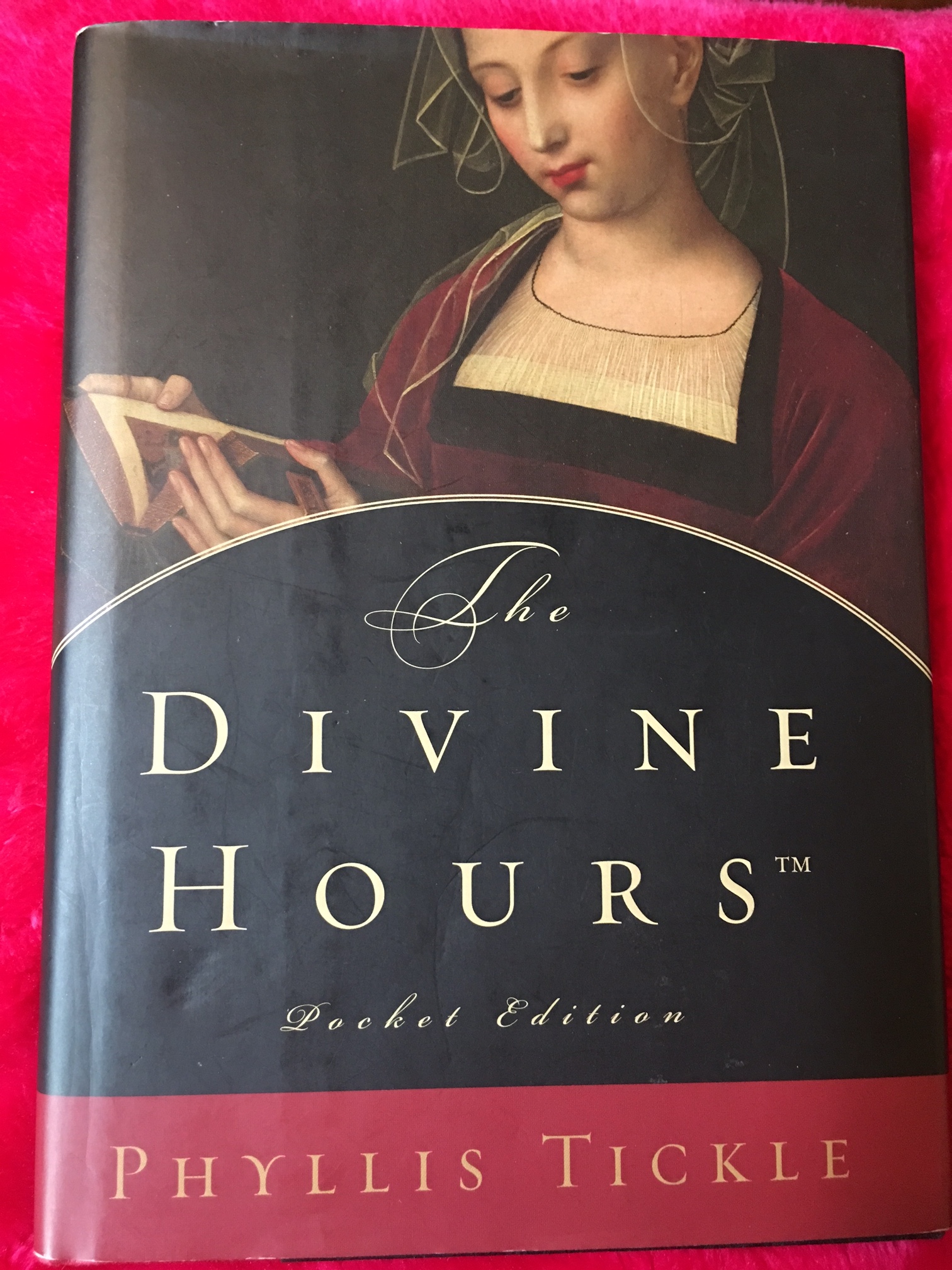
pocket edition.JPG

Christians inherited a pattern of daily prayer from the Jews, who set aside a time for prayer three times daily. More diligent Christians later took to heart the Psalm 119:164 verse that says, “seven times a day do I praise you”; and by the Middle Ages, monks had developed a tradition of seven daily times of prayer: Matins before dawn and Lauds at daybreak—which were combined into one service; then at sunrise, midmorning, noon, and midafternoon came Prime, Terce, Sext, and None; Vespers was observed at sundown, and Compline at bedtime. This schedule was kept faithfully over the centuries by monks and nuns in monasteries. Lay people could come when possible.

In 1549 in the first English Book of Common Prayer, Archbishop Thomas Cranmer revised the structure so that ordinary people might also follow a prayer schedule and praise God at the beginning and end of each day in just two services: Morning and Evening Prayer. The present 1979 BCP restored Noonday Prayers and Compline. (See A User’s Guide to Morning Prayer and Baptism by Christopher Webber.)

Phyllis Tickle, the theologian, writer, and founding Religion Editor of Publisher’s Weekly, reintroduced a shorter version of daily observation of the Divine Hours in a series of books which many now follow. There is a pocket edition for easy carry. Her shorter versions of morning, noon, evening (vespers), and bedtime (compline) prayers, readings, and Scripture are easier to observe than one would think, and offer a way to stop our work and reconnect to God frequently during the day and evening.

The readings are also online at http://www.explorefaith.org/prayer/fixed/hours.php and at http://annarborvineyard.org/tdh/tdh.cfm.

Joanna. Joannaseibert.com