Interruptions

“While visiting the University of Notre Dame, I met with an older professor and while we strolled he said with a certain melancholy, ‘you know, my whole life I have been complaining that my work was constantly interrupted, until I discovered that my interruptions were my work.’” —Henri Nouwen in Reaching Out: The Three Movements of the Spiritual Life (Image Books, 1975), p. 52.

stop.jpg

This has been my experience. I have an agenda, but I am slowly, often painfully learning that God most often meets me in the interruptions in my life that are not on my agenda. There is that call from a friend or family member when I think I am too busy to talk. For me this is a sure sign that I am in trouble, losing priorities of what life is all about, if I cannot stop and talk. Interruptions are like a stop or yield sign to go off script, and listen for a grace note. Nouwen calls them opportunities, especially opportunities for hospitality and new experiences. When I come back to a project after an interruption, I usually have fresh ideas; but there is that false idea that keeps ever lurking and speaking in my ear that if I stop, I will lose my creativity or my train of thought.

Interruptions are also a reminder of how powerless we are. If we think we are in charge, the interruptions remind us that this is a myth. On the other hand, when I seal myself off and refuse to respond to anything but what is on my agenda, I become exponentially isolated. My world, my God become too small. I become the center of the universe and fossilized. I develop a high hubris titer.

Joanna joannaseibert.com
Holy Smoke

“And the smoke of the incense, with the prayers of the saints, rose before God from the hand of the angel.” —Revelation 8:4.

candle-2358276.jpg

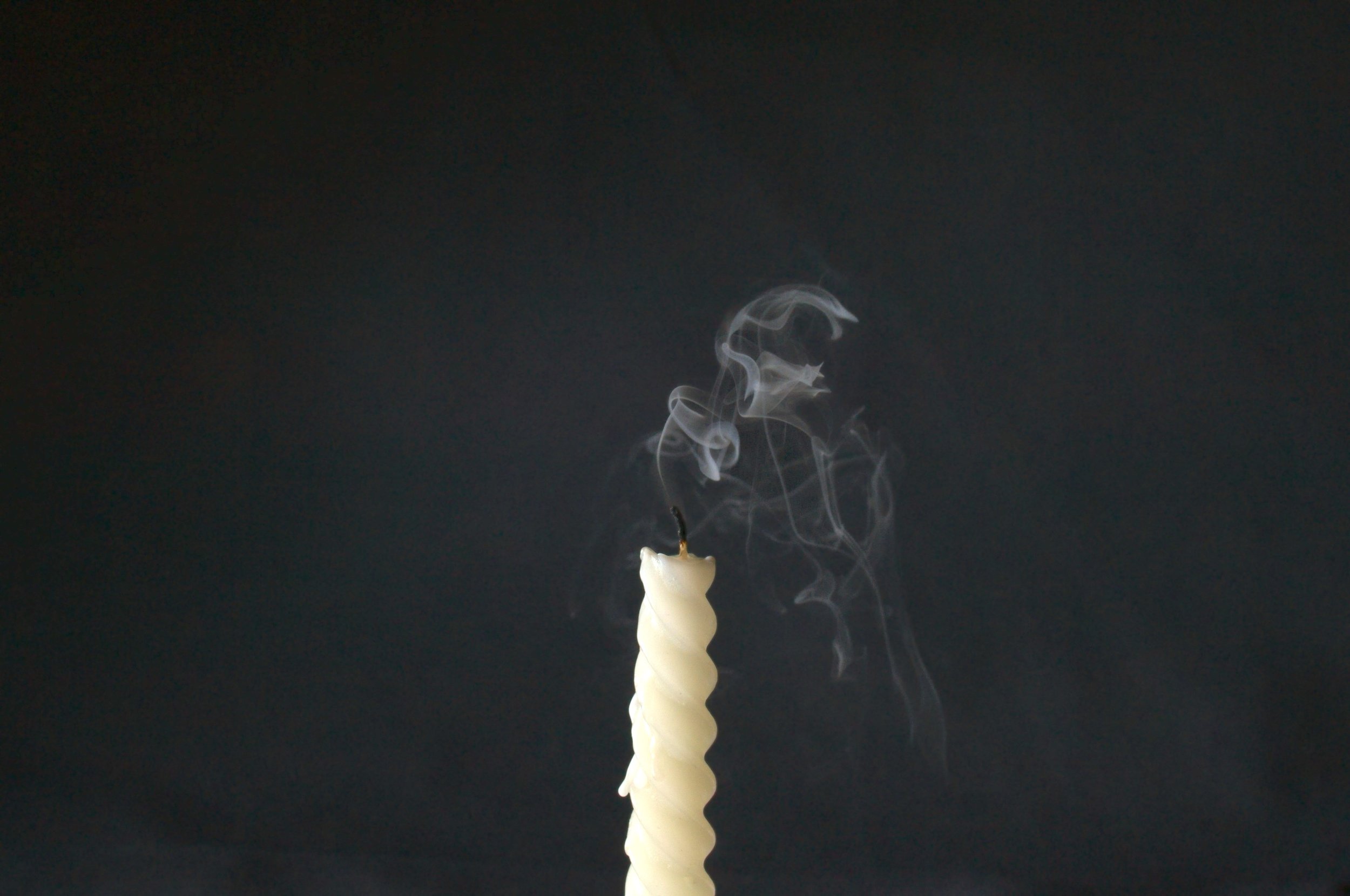
I slowly stand up from my seat next to the Bishop’s chair near the altar at Holy Spirit Episcopal Church in Gulf Shores, Alabama, as the organist plays the prelude to the closing hymn, “Lift High the Cross.” The music is uplifting, but suddenly I am transported and raised to another space. There is an unusual burning smell in the air. I look up and see two almost straight lines of black smoke rapidly rising at least a foot above the altar—and just as quickly disappearing into the air in front of the congregation.

I am aware, as the acolyte in the white alb passes by me to reach for the silver processional cross, that she just extinguished the two candles on the glass altar.

This smell is different from what I usually perceive at the end of the service. For me this is an especially holy smell, and it is accompanied by an uplifting holy smoke, stronger than incense. It is raw, attention getting, signaling that something has happened. The black smoke can be seen, certainly, by those few in the front rows of the congregation; but the smell probably persists only around the altar. By verse two of the hymn, as the crucifer starts to lead the choir members in their blue cassocks and white surplices out of the church, I realize what this is all about.

The Altar Guild of Holy Spirit uses real candles, not the oil candles that I am familiar with in many of the churches I visit or serve. This is the smell and smoke from extinguished candle wax.

This is also the residual fragrance after a session of spiritual direction with seekers as they depart. I light the candle at the beginning of a session when I am doing spiritual direction to symbolize our meeting as holy, as we care for our souls. I extinguish the candle at the end of our time to symbolize the passing on of what we have shared. I know our time together as spiritual friends is holy work, just as our Eucharist together on Sunday is a holy time.

The smell and the smoke tell me that whatever has happened is now being lifted up, spreading into the air of our surroundings, our universe. The Word we had together has now moved away from the altar or our meeting place and out into the world. We can no longer see the smoke, but it is there. I experience the smell only briefly, but it is an icon of what is happening.

The holy Word has moved on with its healing blessing out into the world, making a difference in all our wounded spaces.

Bless the Altar Guild of Holy Spirit for teaching me a little more about the movement of the holy.

Joanna. joannaseibert.com

Esther Harding: Change

“We cannot change anyone else; we can change only ourselves, and then usually only when the elements that are in need of reform have become conscious through their reflection in someone else.” —M. Esther Harding in The ‘I’ and the ‘Not-I’: A Study in the Development of Consciousness at InwardOutward.org.

the I and the not I.jpg

Esther Harding was a British American who is considered to be the first significant Jungian Analyst to practice in this country. Her first book, The Way of All Women (1975), was one of the first books I read in my early days of seeking to connect to a feminine spirituality.

President Jimmy Carter wrote recently about getting to the place where we can give thanks for our difficulties. That is almost impossible; but I can see his reasoning a little more clearly in Esther Harding’s writings. We wear our character defects and self-centeredness like an old bathrobe that is ugly and tattered, but comfortable and a known entity. Our habitual manner of life has become our familiar identity. We can only recognize these defects and behavior patterns in others, as we are repulsed by them—and finally identify them as our own. Our behavior and reaction to the world is what is keeping us from our connection to God.

I continually am amazed how God uses everything, everything to bring us back to God’s love, to connect us to the God within us and within our neighbor. We find out what is blocking us from God’s love by first seeing the barriers in someone else and realizing how unbeautiful they are.

At some point, when the time is right, I can share Harding’s insights with spiritual friends who also are suffering. I, as well, have spiritual friends who listen to me when suffering brings awareness that opens up a crack of light into my own life.

Joanna. Joannaseibert.com