Enneagram

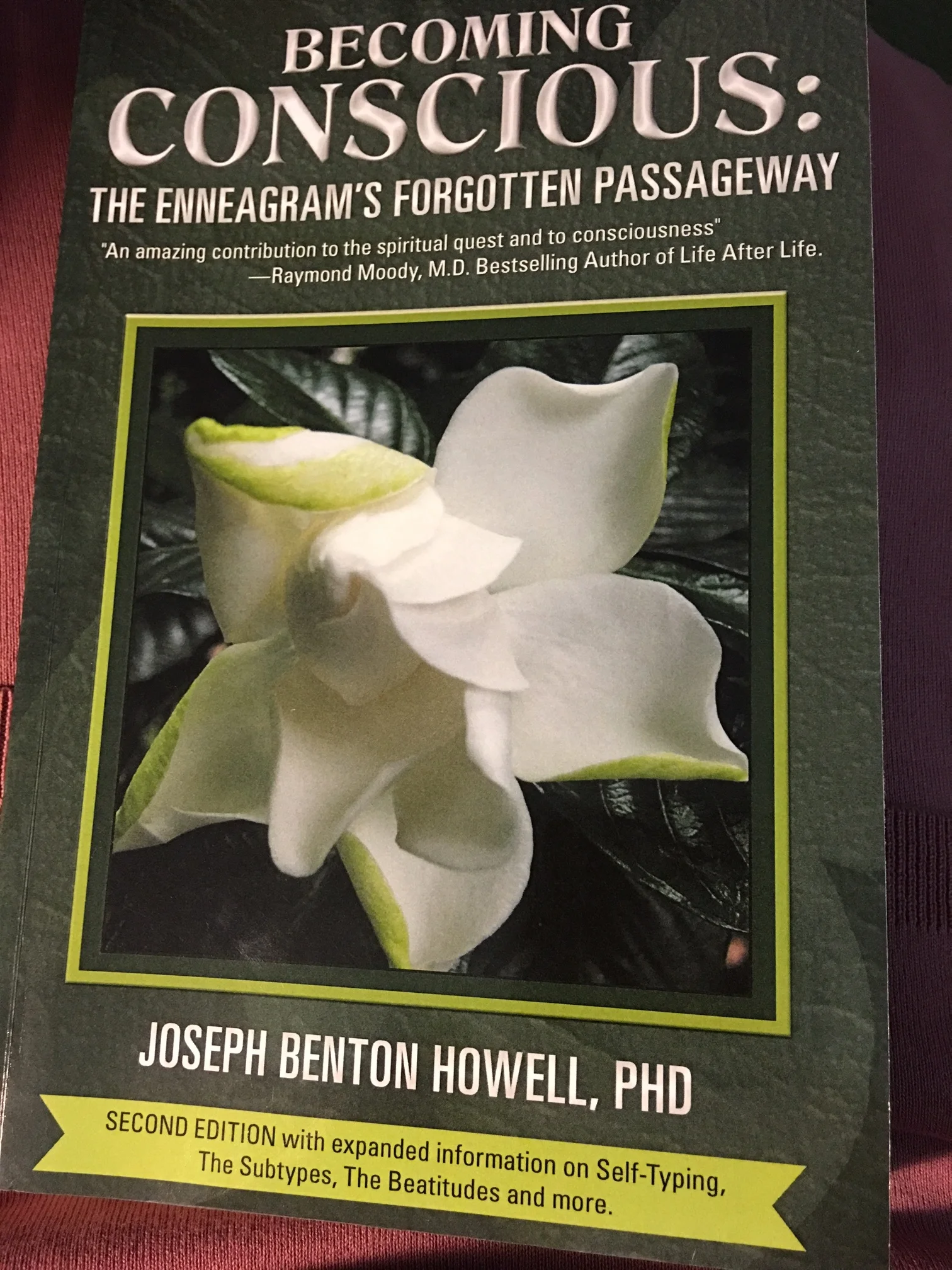
“In the study of personality, the Enneagram is designed for self-inquiry. By discovering one’s Enneagrammic personality, one comes to know the many layers of self in a personal and particular way. The Enneagram points out how a person’s strengths can become more stable and more dynamic, and how weaknesses can be brought to consciousness and even healed.” —Joseph Howell in Becoming Conscious: The Enneagram’s Forgotten Passageway (Balboa Press, 2012).
becoming conscious.JPG

We recently spent a weekend at an Enneagram conference led by Dr. Howell at Kanuga. This nine-point ancient study of the personality can be helpful not only by teaching us about ourselves and our strengths, but in the healing of wounds that led to our forming certain personality traits. The Enneagram can also help us learn to become compassionate with ourselves and with others of different personality types.

On the Enneagram, I am a two, the helper, with a strong three wing, the achiever. My other wing, the four, the creative type, can lead me to the source of my basic essence or God within. That may explain why I am attempting to write this daily message about spiritual direction for a whole year.

At the conference, there were nine tables where people could go and talk to others who shared one of the nine personality types. I immediately identified with the twos’ table. I heard the music in my mind and in my body from “Going Home,” the theme from Dvorak’s Largo in his New World Symphony. I was with a group of people who knew me and I knew them. I could see their woundedness and I could easily recognize their soul, the God in them.

If a person comes to spiritual direction who has had some experience with the Enneagram, I try to help that person to see God, the soul within—for this is what the ancient practice is all about.

Rebecca Spooner will be leading an Enneagram Retreat at St. Mark’s Episcopal Church, Little Rock, Saturday, February 29, 2020. Mark your calendars!

Joanna. Joannaseibert.com

Spiritual Practice of Fishing

“If, then, I were asked for the most important advice I could give, that which I considered to be the most useful to the men of our century, I should simply say: in the name of God, stop a moment, cease your work, look around you.” —Leo Tolstoy in Essays, Letters, and Miscellanies (Scribner’s, 1929).

surf-fisherman-2069142_1920.jpg

I sit outside each early morning on the Gulf Coast just after sunrise and watch lone surf fishermen come like clockwork to the water’s edge with their fishing rods, fishing rod holders, buckets, bait, and folding beach chairs. They are early risers, arriving before the pelicans and sea gulls and dolphins come out of hiding. The members of this all male club mark their territory as they spike two rod holders into the sand as the only signs of human presence. They unfold their chairs, bait their lines, cast them beyond the roaring, white ocean’s surf, and sit and wait between the two holders for the rods to jump and bend.

The nibbles are infrequent, so they spend most of the time sitting and staring out into the Gulf. They peer out as if they can see all the way beyond South America. They do not take out their cell phones or read books. They wait patiently, usually for several hours, presumably with great faith that their efforts will connect them to the gift of unknown food from beneath the sea.

I have become so interested in watching the fishermen that I recognize them by their walk, what they are wearing, whom they talk to, what time they come out, and how long they stay. When I have talked to them, they have taught me much about spirituality and faithfulness and how to surrender to a spiritual practice. Indeed, some of the fishermen refer to their daily routine as a spiritual practice; while others would be appalled at giving their fishing exercise such a name. They all agree that this recreational sport does bring them peace; and most realize that it is not fish that they are after. It is indeed re-creation.

Perhaps this uncertainty girded by faith is also part of our spiritual practices: Centering Prayer, saying the Rosary, walking the labyrinth, praying, fasting, lectio divina, worshiping. The peace comes in the offering of time, a piece of our life, to the practice, rather than always reaching any goal or making or receiving a connection.

My second gift from our fishermen is that in spending time observing them I have stayed grounded, connected to my surroundings, living in the present moment. The fishermen are teaching me about looking out beyond the turbulent water’s edge and having faith that there is something greater than any of us that is constantly trying to connect to us.

Joannna. Joannaseibert.com

De Mello: Out of the Head

“The head is not a very good place for prayer. It is not a bad place for starting your prayer. But if your prayer stays there too long and doesn’t move into the heart, it will gradually dry up and prove tiresome and frustrating.” —Anthony de Mello in Sadhana: A Way to God (Liguori, 1998).

demello sadhana copy.jpeg

Anthony de Mello’s Sadhana: A Way to God is an amazing book—a collection of “one of a kind, practical spiritual exercises” blending Eastern and Western spiritual practice for contemplative prayer. De Mello describes contemplative prayer as communicating with God with a minimal use of words. He lists forty-seven exercises, all of which can be learned through practicing each for a week at a time.

In his first section, de Mello repeatedly teaches about how contemplative prayer comes after achieving an awareness—awareness of the body, not just the mind; and awareness of God’s presence.

The second section is about using fantasy in prayer; and the last section is on employing devotion in contemplative prayer. The awareness exercises especially help us get out of our head and into our bodies—where de Mello says we must return to our senses. He describes the head as a place to begin to pray; but becoming aware of the feelings in our whole body, paying attention to our breath, and returning to our senses is what keeps us in the present presence. It is in the present moment that God meets us—not while we are anticipating or dreading the future or resenting or gloating over the past, but in the now. Our head lives in the past or future. Our body, our heart, grounds us to the present moment.

Joanna. Joannaseibert.com