Literary Readings in the Season after Pentecost

Arthur: Literature for Pentecost

At the Stillpoint “is a journey of the imagination guided by poets and authors, both classic and contemporary, who have known the things of God but speak in metaphor.”—Sarah Arthur in At the Still Point (Paraclete Press, 2011), p. 7.

At the Still Point, by Sarah Arthur, is a literary compilation of daily and weekly readings and prayers designed for the long green liturgical season between the Day of Pentecost and Advent. Arthur has also published similar guides for Advent, Christmas, and Epiphany (Light Upon Light); and for Lent, Holy Week, and Easter (Between Midnight and Dawn).

In these twenty-nine weeks between the Day of Pentecost and the first Sunday in Advent, Arthur kindles our imagination as she exposes us to brief excerpts or short works of well-known writers and offerings from authors we may not know but should! As we encounter some readings in this anthology, Arthur warns us that there should be an alert: “Warning: Powerful Spiritual Moment Ahead!” She suggests we read these passages not as assignments for our English Literature class or for pleasure, but as liturgical pieces for worship, especially prayer.

Each week begins with an outline for the next seven days, comprising an opening prayer, Scripture passages, readings from literature, a place for personal prayer and reflection, and a closing prayer. Arthur suggests applying the ancient principles of Lectio divina, or divine reading that many of us have used with Scripture, now applied to selected weekly poetry and fiction writings. We read the passage, meditate on it, pay attention to a word or phrase that connects to us, and finally rest in God’s presence with what we have experienced. It has been helpful to carry that word or phrase with me during the day or perhaps the entire week. Since this process is now used for literature and poetry rather than Scripture, Arthur has christened it holy reading or Lectio sacra.

I invite you to journey with Sarah Arthur and me during this “Ordinary Season” with an extraordinary spiritual practice of daily worship and prayer.
Joanna https://www.joannaseibert.com/

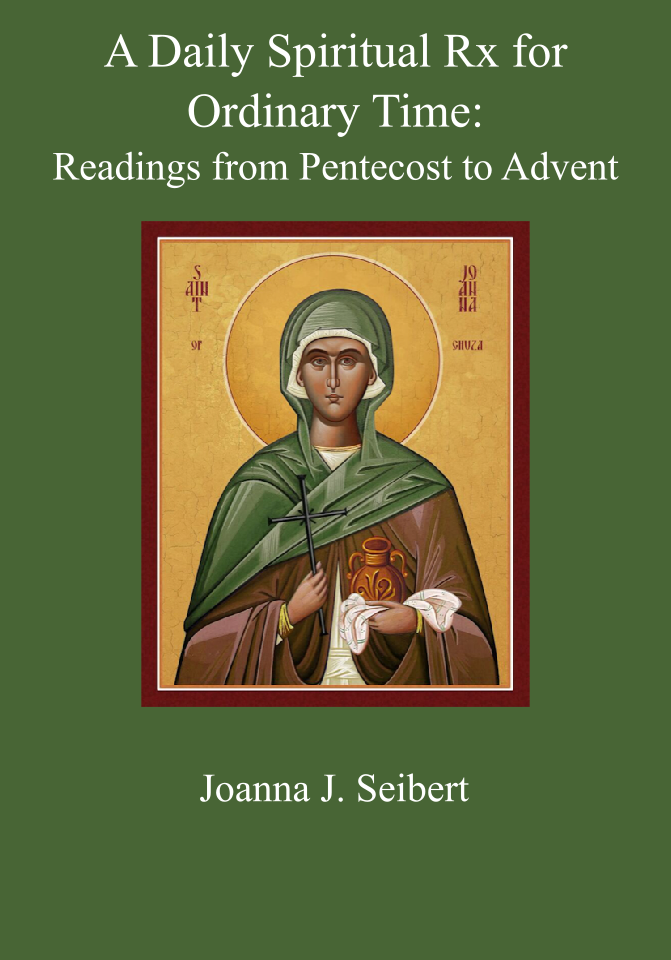
Thank you for supporting our camp and conference center, Camp Mitchell, on top of Petit Jean Mountain, by buying this book in the daily series of writings for the liturgical year, A Daily Spiritual Rx for Ordinary Time: Readings from Pentecost to Advent. All proceeds from the books go to Camp Mitchell. If you like this book, could you briefly write a recommendation on its page on Amazon? https://smile.amazon.com/Daily-Spiritual-Ordinary-Time-Pentecost/dp/B08JLTZYGH/ref=sr_1_1?dchild=1&keywords=joanna+seibert+books&qid=1621104335&sr=8-1

 More thank-you’s than we can say!!!


Celtic Spirituality and the Trinity

De Waal: Trinity Connected

“If I am estranged from myself, then I am also estranged from others too. It is only as I am connected to my own core that I am connected to others.”

—Esther de Waal in Living with Contradiction: An Introduction to Benedictine Spirituality (Morehouse, 1997).

Esther de Waal’s writings make the Celtic way of life accessible to us. It is a life where we learn about ourselves in relationships with others, nature, and daily life in the world outside. This life requires almost constant prayer, connection to God, and awareness of each precious moment. De Waal reminds us how easy it is to walk or drive, rushing from task to task without any awareness of the people we pass by in our paths. All too often, instead of silently sending love to them, we make snap judgments and label them by their appearance or clothes.

I am indebted to de Waal for one more book on Celtic spirituality, The Celtic Way of Prayer: The Recovery of the Religious Imagination. I was rereading her chapter on Celtic prayers about the Trinity as we prepared for Trinity Sunday. She reminds us of the Celtic tradition of placing three drops of water on an infant’s forehead immediately after birth to remind us that the Trinity is now indwelling in the infant.

In the Celtic tradition, the Trinity is a natural part of the daily songs and prayers at work, and is praised through the changing seasons. The day of Celtic life begins with splashing three handfuls of water on the face in the name of the Trinity. The day ends as the embers of the household fire are spread evenly on the hearth in a circle divided into three equal sections, with a square of peat laid between each. This is called the Hearth of the Three. A woman then closes her eyes, stretches out her hand, and softly sings this prayer:

The sacred Three

“To save,

To shield,

To surround,

The hearth,

The household,

This eve,

This night,

Oh! this eve,

This night,

And every night,

Each single night.

Amen.”—Carmina Gadelica I, “The Trinity” in The Celtic Way of Prayer (Doubleday, 1997).

De Waal describes what she has learned from the Celtic Trinitarian tradition: “It allows me to be at ease with a mystery that no longer threatens, but supports, refreshes, and strengthens me.”

The Threeness and connectedness of the Trinity also remind me of an anonymous prayer, sometimes attributed to William Blake—but sounds so Celtic:

      “I sought my God;

      My God I could not see.

      I sought my soul

      My soul eluded me.

      I sought my brother

      And I found all three.”

Joanna. https://www.joannaseibert.com/


The Trinity

The Trinity

“Trinitarian theology says that true power is circular or spiral, not so much hierarchical. If the Father does not dominate the Son, and the Son does not dominate the Holy Spirit, and the Spirit does not dominate the Father or the Son, then there’s no domination in God. All divine power is shared power.”—Richard Rohr in  The Divine Dance: The Trinity and Your Transformation (Whitaker House), pp. 95-96.  

Rublev Icon

Robert Farrar Capon says when humans try to describe God, we are like a bunch of oysters attempting to describe a ballerina. But we can’t help but try, especially as we strive to understand the doctrine of the Trinity, perhaps one of the greatest mysteries of the Christian faith.

At a summer course at Oxford University, a Greek Orthodox bishop, Timothy Kallistos, introduced us to Andrei Rublev’s 15th-century icon, The Trinity, or The Hospitality of Abraham. It pictures the three angels who visited Abraham at the Oak of Mamre (Gen. 18:1-8) to announce the coming birth of his son, Isaac. We have interpreted it as a symbol to help visualize the mystery of the interrelationship in the Trinity of Father, Son, and Holy Spirit. Each figure is in circular harmony with the other, humbly pointing to each other with mutual love. We miss the mark if we relate only to the Trinity in its separate parts. The Persons are in a community, transparent to each other, indwelling, and in love with each other. They have no secrets from one another, no jealousy, no rivalry. Instead, they teach us how to live in community. Barbara Brown Taylor describes their relationship as the sound of “three hands clapping.”

The doctrine of the Trinity calls us to a radical reorientation in our way of seeing and living in the world. We are what we are in a relationship with. The God of the Trinity is not an I, but a we; not mine, but ours. Our belief in and understanding of the Trinity can definitely make a difference in how we drive our cars; how we fill out our tax returns; how we relate to others of different faiths, colors, and political views; how we stand about war; how we treat the person sitting across the aisle from us, as well as those living across the Interstate and outside our country’s borders.

Richard Rohr’s and Barbara Brown Taylor’s thoughts are excellent to meditate on when we have a conflict with another person, when the Christ within us is having difficulty seeing the Christ in another. 

[See Barbara Brown Taylor, “Three Hands Clapping” in Home By Another Way (Cowley), pp. 151-154.]

Thank you for supporting our camp and conference center, Camp Mitchell, on top of Petit Jean Mountain, by buying this book in the daily series of writings for the liturgical year, A Daily Spiritual Rx for Ordinary Time: Readings from Pentecost to Advent. All proceeds from the books go to Camp Mitchell. If you like this book, could you briefly write a recommendation on its page on Amazon? https://smile.amazon.com/Daily-Spiritual-Ordinary-Time-Pentecost/dp/B08JLTZYGH/ref=sr_1_1?dchild=1&keywords=joanna+seibert+books&qid=1621104335&sr=8-1

 More thank-you’s than we can say!!!

Joanna https://www.joannaseibert.com/