Putting God in charge in spiritual direction

Gerald May II: Our Part, God’s Part in Spiritual Direction

“In spiritual direction, one might say, ‘My prayers are for God’s will to be done in you and for your constant deepening in God. During this time that we are together, I give myself, my awareness and attention, and my hopes and heart to God for you. I surrender myself to God for your sake.’”—Gerald May in Care of Mind/Care of Spirit (HarperSanFrancisco, 1982), p. 121.

In Care of Mind/Care of Spirit, May encourages us to begin spiritual direction with a similar silent prayer—remembering that it is like being in prayer, except that we are with someone else and with God. We are to help direct the visitor or guest’s attention, moment by moment, to God while simultaneously knowing that we can do this only if we are tuned in to our own prayer life.

May advises on bringing up sexuality early in the sessions, so it is a familiar topic: “What are times you have felt closest to God? What about nature, music, sex, worship, or times of crisis?” May also makes a strong case for spiritual directors to be careful about relationships with their directees outside the direction relationship. Dr. May’s detailed chapter on referral is easily understood, primarily because he writes about many of his personal experiences. Perhaps of most significant importance to those in the healing community is May’s concept of the difference between healing in the greatest sense and curing a specific disorder.

I am grateful that I have been in a group of spiritual directors that took May’s advice and met regularly to discuss concerns and issues that arise in our work. We meet for mutual support, prayer, and questioning, knowing that we are not doing this ministry alone, but in community.

May asks us to identify in spiritual friends their experience of God beyond their belief system, emphasizing that belief and experience are two different areas to explore. We must use the language of the directees’ own spiritual experience, not our own. We should avoid solving people’s spiritual problems with statements such as, “You should pray this way” or “You need more faith.” May writes that the spiritual friend needs to know that the desire for an experience of God is already the experience of God they seek.

I hope to remember that I am a companion, at most a midwife, on a person’s heart journey with God, and that this is God’s business. God is in charge, even though I may have such beautiful ideas!

Joanna. https://www.joannaseibert.com/


Gerald May: Spiritual Direction

Gerald May: Spiritual Direction

“Besides differing from psychotherapy in intent, content, and basic attitude, spiritual direction is generally surrounded by a characteristic atmosphere seldom encountered in any other interpersonal relationship. As one person put it, ‘Being in spiritual direction is just like being in prayer, only there’s someone with me in it.’”—Gerald G. May in Care of Mind/Care of Spirit: A Psychiatrist Explores Spiritual Direction (HarperSanFrancisco, 1982), p.113.                

When I took down Dr. May’s book Care of Mind/Care of Spirit from my bookshelf and opened it, a bulletin from September 1990 fell out. It mentioned a book group at my church reading Care of Mind/Care of Spirit. The book had no marks, so I knew I had not read it. This happened over thirty years ago, two months before I went into recovery.

Our book group had read May’s book Addiction and Grace the previous year. For some reason, at that time, I was not ready to hear May’s words. But on this day, it was different. In 1990, I became a missionary member from my church, starting another Episcopal church in a growing part of our city. Alas, May’s book would have been helpful in starting a new congregation as I began life in recovery, and even more so nine years later when I was studying to become a deacon. 

This has been one of the best books I have read about spiritual direction. Dr. May emphasizes how spiritual direction differs from his own highly effective psychotherapy. In therapy, the director or caregiver “hopes to encourage more efficient living in the prevailing culture, seeking to bolster an individual’s capacity to achieve a sense of autonomous mastery over self and circumstances.” Spiritual direction “seeks liberation from attachments and a self-giving surrender to the will of God.”

This means that at some point, spiritual direction may stand in opposition to many cultural standards and values supported by psychotherapy. May skillfully writes about how a spiritual director constantly seeks rabbit holes or traps that the directee may encounter while simultaneously looking for God in their life. May also reminds us that the real healer is God, and that the director and directee are merely channels.

May cautions spiritual directors about how easy it is to become distorted in our roles, “playing God.” This is a book I keep as close to me as possible while doing the direction. Sometimes I have to avoid obsessing about what May would say about something that comes up in a meeting. Then, after the time together, I hurry to look up the appropriate chapter. But, of course, May would say that our job is not to worry about what we say at the moment, but to focus solely and “most soulfully” on connecting this person to God during that moment!

Joanna.   https://www.joannaseibert.com/
 

Chan West and Story Telling

Chan West and Story Telling

“Jesus invites us into a story that is bigger than ourselves, bigger than our culture, bigger even than our imaginations, and yet we get to tell that story with the scandalous particularity of our particular moment and place in time. We are storytelling creatures because we are fashioned in the image of a storytelling God. May we never neglect the gift of that. May we never lose our love for telling the tale.”–Rachel Held Evans in Inspired (Nelson Books Nashville), p. 164.

chan by kathleen wesson

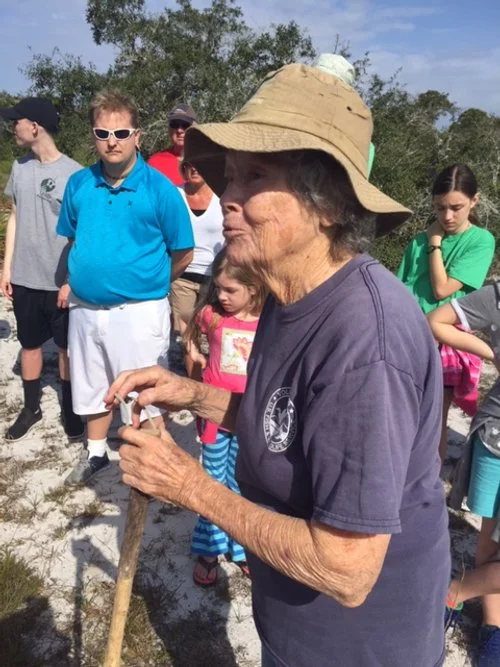
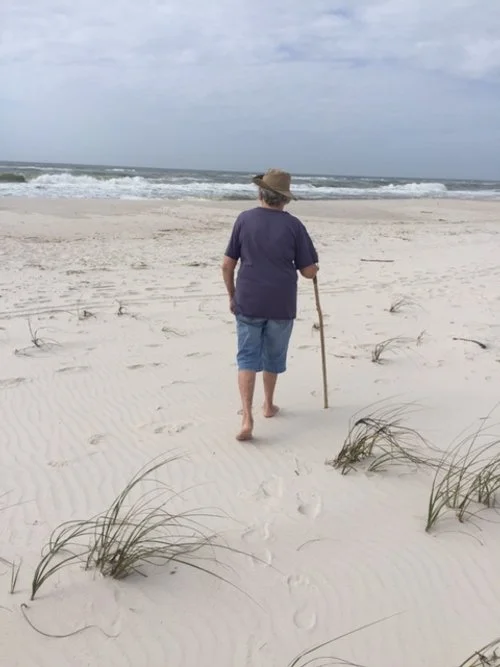
Chan West died August 1, 2021, at age 91. There is no person who met her who will not miss her or want to tell you Chan stories. She was a faithful member of Holy Spirit Episcopal Church in Gulf Shores, Alabama. Before the 8 am service, you would meet her in the kitchen, fixing refreshments, putting out the altar flowers, setting the altar, reading the lectionary readings, or praying the prayers of the people. She was almost always barefooted before the service.

If you took time to talk to her, you heard stories of her life in the Bon Secour National Wildlife Refuge, where as a child during World War II, she met German spies who came onshore. Or you heard about times she encountered alligators, or about turtles she saved. She was an original turtle person looking for signs of new nests to care for before the baby turtles hatched, helping them migrate back to the sea. Or you might have heard about the Christian Service Center, where she served others for many years. Or you might have been on one of her tours of the Refuge. Perhaps you were with her when she stopped a church service to rescue a dying dog dropped off at the church during difficult times.

 These are all beautiful ministries, but I think I will most remember someone we always wanted to be with on our visits to Holy Spirit. She had a unique ability for anyone to feel comfortable in her presence. Maybe it was because she was so comfortable herself,  as well. I don’t know what it was. Others may have a better idea. I think that living so close all your life to the land and loving it makes you alive and comfortable in your own skin and in touch with God’s presence so revealed in the world around you. Maybe it is daily knowing the cycle of life and love and seeing its beauty even in difficult times.

Others describe her as a no-nonsense person. Some say her passion for life was contagious. All remember her generosity of time for the earth and whomever she met. She is the kind of person you think will never die because she is so alive. Well, of course, she has not died. She will live in the hearts of each of us until we meet her again and undoubtedly hear more of her stories.

Chan talking