Celtic Hospitality in Community

Celtic Spirituality: Celtic sacred life of hospitality in community

         “I sought my God;

    My God I could not see.

    I sought my soul

    My soul eluded me.

    I sought my brother

    And I found all three.”

In the Celtic hospitality tradition, God is present not only in Nature, but also in our neighbor, ourselves, and especially in the stranger. This is a sacredness in relationships. I am told there is no word in the Irish language for private property. Faith is lived in a community with a combination of periodic seclusion and community and mission. Anamchara or soul friends or spiritual friends or spiritual directors are essential relationships. Women are regarded as equals, and communities are not hierarchical. Monasteries rather than parishes are the basis of the church. The Celts value education, art, and music.

We traveled to Iona off the western coast of Scotland twice and would return in a heartbeat. You don’t simply stumble on Iona, however. You really do have to want to go there by ferry, down a one-lane winding road, and finally walking over on a ferry onto the small, three-mile-long island in the Inner Hebrides where Columba brought Celtic Christianity to England in 563. Here, the breathtakingly illuminated manuscripts of The Book of Kells are believed to have begun to be written at the end of the 8th century. Iona is considered an exceptionally “thin” space where the membrane between the spiritual and the secular is extremely thin. This was our experience as well. You walk a lot, eat good food, worship outdoors and in the ancient abbey and a decaying nunnery, listen to the wind and waves, study high crosses, wear warm clothing, and watch the sea change the color of the abundant million-year-old rocks by the shoreline.

I often meet with spiritual friends who describe Celtic Spirituality when they have no name for it. This seems a sign of the universality of this type of spirituality. The sacred presence of God in each of us is a start.

Again, further reading might include Philip Newell’s Celtic Benediction, and John Miriam Jones, With an Eagle’s Eye, Esther de Waal”s Celtic Way of Prayer, John O’Donohue’s Anam Cara.

Joanna    https://www.joannaseibert.com/


Living in the Present Moment

   Richard Rohr, Poe: Seeing and Living in the Present Moment

  “Most people do not see things as they are because they see things as they are!” Which is not to see at all. Their many self-created filters keep them from seeing with any clear vision.”—Richard Rohr, Center for Action and Contemplation, daily Rohr Meditation.

Edgar Allan Poe also gives us more clues about having a clearer vision in “The Purloined Letter.” The Paris police chief asks a famous amateur detective, C. Auguste Dupin, to help him find a letter stolen from the boudoir of an unnamed woman by an unscrupulous minister who is blackmailing his victim.

The chief of police and his detectives have combed the hotel where the minister lives, behind the wallpaper, under the carpets, examining tables and chairs with microscopes, probing cushions with needles, and found no sign of the letter. Dupin gets a detailed description of the letter and visits the minister at his hotel. Complaining of weak eyes and wearing green spectacles, he disguises his eyes as he searches for the note. Finally, he sees it in plain sight, in a cheap card rack hanging from a dirty ribbon. He leaves a snuff box behind as an excuse to return the next day and switches out the letter for a duplicate.

Rohr is calling us to put on a new pair of glasses, perhaps 3-D glasses, to see the depth of what is in plain sight immediately around us in the present moment.

Guides and friends in our community remind us to meet God in the present moment. They remind us to listen to this call from God to live in the present moment, especially in the stories of the Epiphany season in our Sunday Bible readings.

Epiphany means an illuminating realization.

 The season of Epiphany calls us to see more clearly, living in the present moment.

Epiphany Wisdom from Wise Men

 “Three Wise Men.”  Epiphany Wisdom  

 “The three were hermits on an island in the Black Sea, very pious and humble and loving to all men but terribly ignorant.  A bishop goes in a steamer to see them and teach them a few prayers, but finds them too old and stupid to learn.  At last, he gets—or thinks he has got—one very short and simple prayer into their heads, and leaves the island, feeling rather contemptuous.  Then, when night falls, he sees a bright light advancing swiftly over the sea behind the steamer. The old men have come, walking on the waves, begging him to be patient with their great stupidity and to teach them the prayer again.”—Tolstoy.

food pantry car line Thanksgiving

My husband sent me this story. He tries to read it to me, but is so moved that he cannot speak. Alas, if all of us could be that way when we hear this story. I think of people I have talked with leading retreats and classes, hoping to share the word of God with them. But instead, I learn more about God by listening to them.

I learn this truth first from recovery meetings, where I hear wisdom from people I would never have previously listened to. Wisdom comes from those with no education who can barely speak intelligently. Wisdom comes from men and women who have spent most of their lives in prison. Wisdom comes from those who have lost their children because of their addiction. Wisdom comes from women who have lived on the streets. Wisdom comes from people experiencing homelessness.

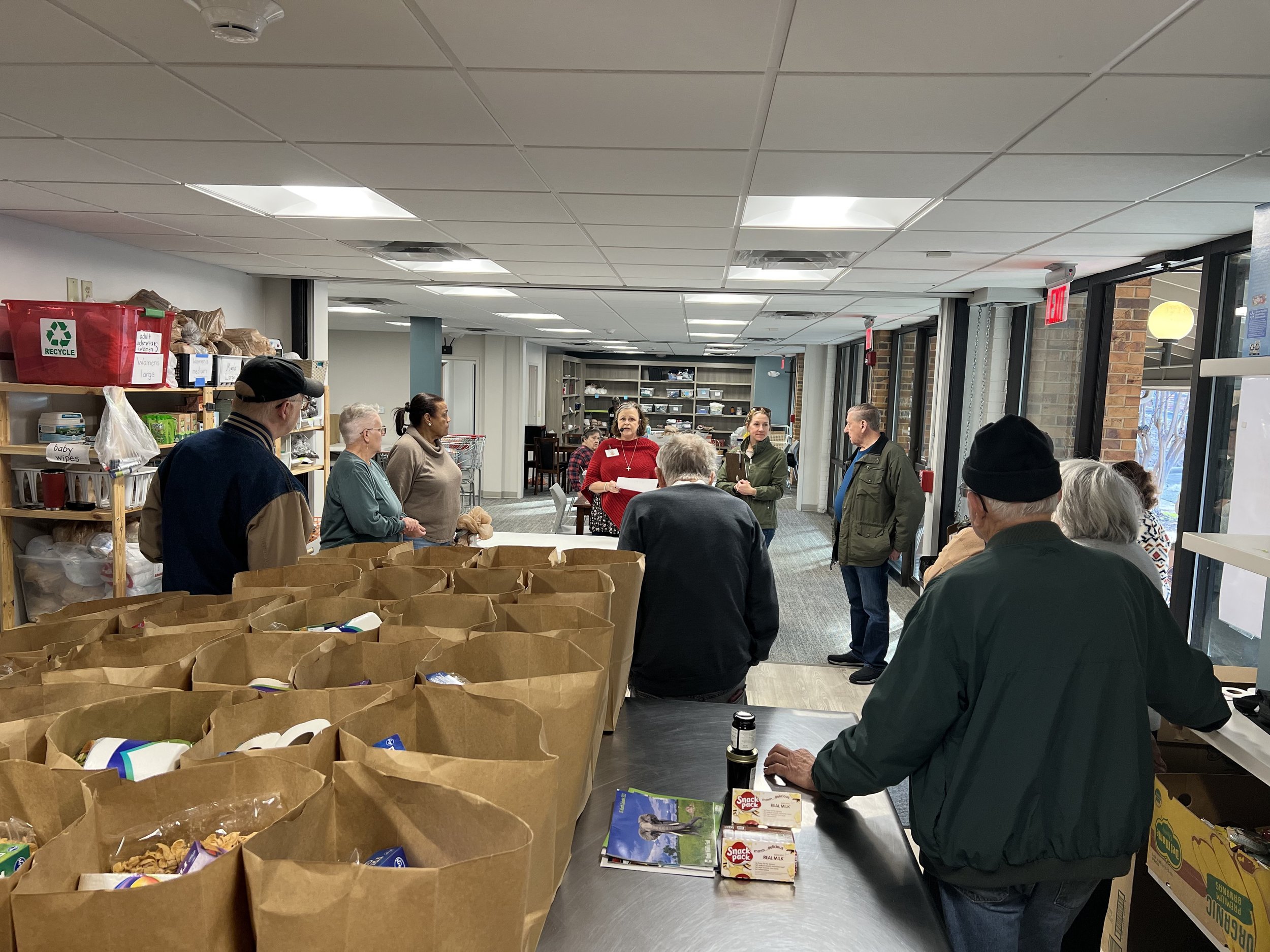
I also heard this wisdom at our Food Pantry, where people come each week for just enough food to survive. They tell us how grateful they are and bless us. They tell us how blessed they are. They share what they receive with other families. They teach us how to turn our lives and our wills over to God. They teach us how to live in community.

In this season of Epiphany and into a new year, may we keep our ears and hearts open to hear wisdom in “wise men” and women at all places, in each precious moment, and especially where we once least expected it.

prayers before starting at food pantry