Nouwen:Zero-Sum

Nouwen: Zero-Sum

“Fearful people say: ‘There’s not enough food for everyone, so I better save enough for myself in case of emergency,’ or ‘There’s not enough knowledge for everyone to enjoy; so I’d better keep my knowledge to myself, so no one else will use it’ or ‘There’s not enough love to give to everybody, so I’d better keep my friends for myself to prevent others from taking them away from me.’ This is a scarcity mentality. It involves hoarding whatever we have, fearful that we won’t have enough to survive. The tragedy is what you cling to ends up rotting in your hands.”—Henri Nouwen, “Temptation to Hoard,” Henri Nouwen Society Daily meditation, May 6, 2017. From Bread for the Journey, Henri J. M. Nouwen (HarperSanFrancisco 1997).

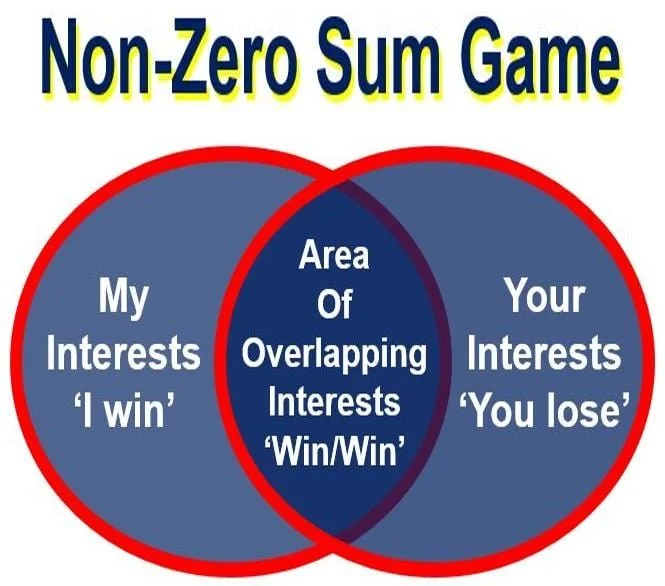
Nouwen first describes our life as a zero-sum mentality. We can only do well, win, or succeed if someone else loses, so we will not share because there is so much food, love, and land to go around.  

There is one pie. If someone takes a slice, there is less for the rest. So, one person’s gain is another’s loss. This theory describes situations where total wins and losses add up to zero. Thus, one party benefits at the direct expense of another.

There is only so much and not enough for all. Some must lose for others to gain. It is a competitive scarcity worldview. It leads to a fear-based society.

 The opposite of the scarcity mentality is a positive-sum situation or abundance mentality, which occurs when the total gains and losses are greater than zero. A positive-sum plan occurs when we see resources as abundant. We plan an approach where the desires and needs of all concerned are satisfied.

One example would be when two parties gain financially by participating in a contest, regardless of who wins or loses. Positive-sum outcomes occur in distributive bargaining, where different interests are negotiated to meet everyone’s needs. With an abundance mentality, there is enough for all.

How we view our neighbors, ourselves, and the world is totally different in these two views. A zero-sum lifestyle is isolated and lonely, with our own self-interest guiding us. A positive-sum life sees abundance and gives away food, love, and knowledge to those in need. Consequently, Nouwen reminds us, “There are many leftovers.”

Jesus’ feeding of the 5000, found in all four gospels, is a story of a positive-sum experience.

 My experience is that I live in fear with a zero-sum lifestyle when I compete with others for the love, attention, or support of some entity or person. However, there is peace in my life when I live, knowing there is enough love, support, or attention for all.
Joanna      https://www.joannaseibert.com/


Painting as a Spiritual Practice

Painting as a Spiritual Practice

Guest Writer: Ken Fellows MD

Window and Reflections

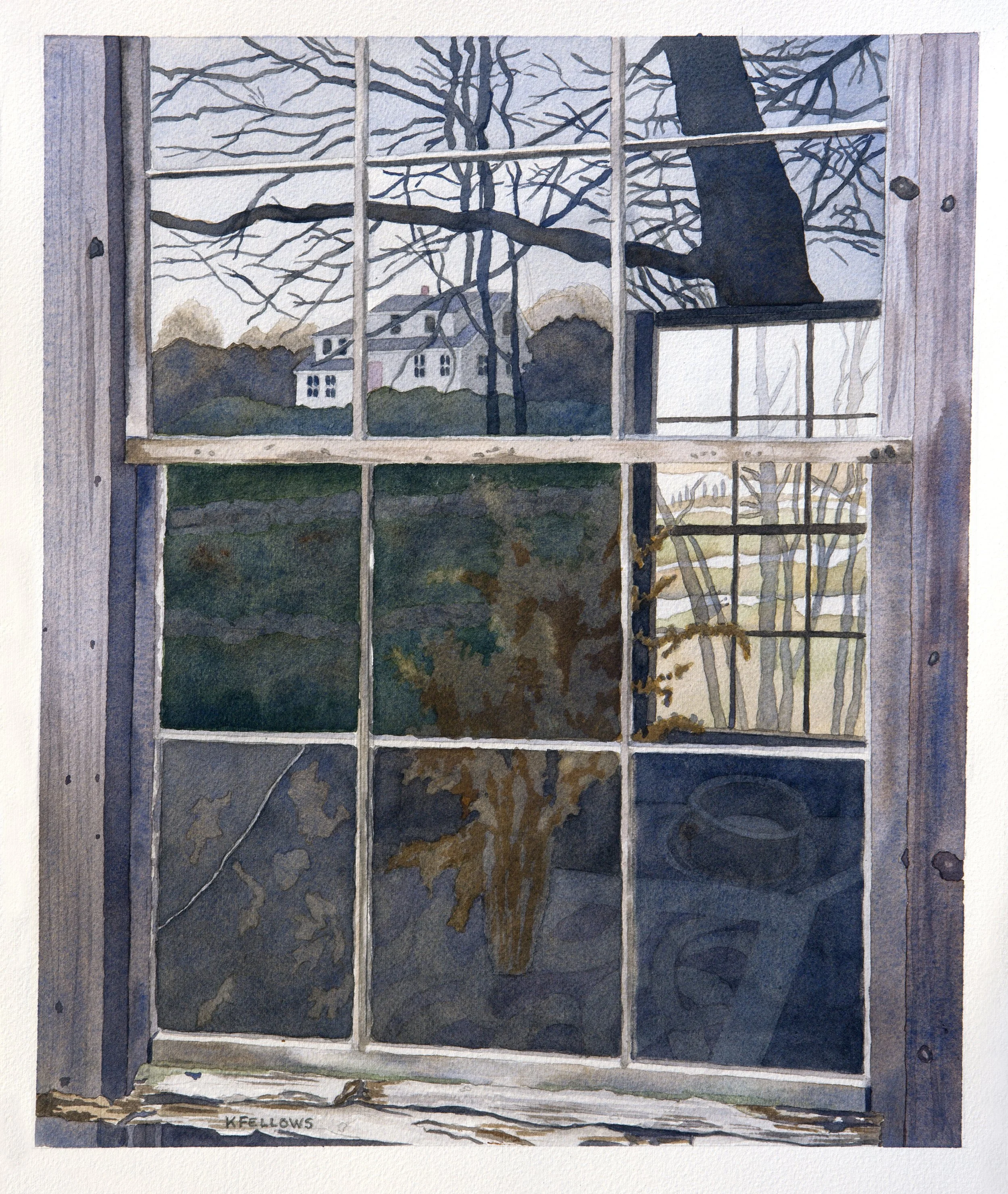
   An old, white farmhouse perched on a hill overlooking a large Atlantic Ocean marsh called Brave Boat Harbor resides in our little Maine town. I’ve long wanted to compose the scene, but couldn’t imagine how to incorporate the house and the directly opposed marsh in one effective painting. Then, one day, the solution materialized while exploring the marsh shore, as reproduced in the accompanying watercolor image. But it’s a bit complicated.

     The window displayed in the painting is on one side of a small, marsh-edge shack. The farmhouse is far behind the viewer, who is looking through a weathered window into the old shed. In the lower two rows of window panes, the observer sees the shack’s contents – a patterned table-top supporting dried flowers and a pottery bowl …and beyond them, a window in the far side of the shed through which the water, trees, and marsh islands of Brave Boat Harbor are also visible. Most of the upper two windowpane levels are reflections of the quaint white farmhouse, its surrounding landscaping, and a large tree with crooked branches, all in the back of the viewer.

    I’ve been painting in retirement for over 20 years. I create scenes that are intriguing to me, and I paint for pleasure. My artwork intends no hidden meanings, no messages

     However, when I consider this painting done several years ago, it occurs to me that it contains a subliminal metaphor about life – that whatever we think, imagine, or observe is overlaid by reflections from our past, reflections of things far behind us. These reflections comprise large parts of our emotions, which are a huge part of human decision-making. In varying ways, reflections are part of the human contemplative life.

     All this seems quite involved and more than was ever intended. But ultimately, it’s just a painting, and any meaning or interpretation belongs entirely to the viewer.

Ken Fellows MD  

Joanna   https://www.joannaseibert.com/


The Clark Fork River and Love

The Clark Fork River and Love

“And so it is those we live with and should know who elude us, but we can still love them. We can love completely without complete understanding.”—Norman Maclean, A River Runs Through It (University of Chicago Press 1976).

I remember being in Missoula, Montana, visiting our daughter, Joanna, and her husband, Dennis, with our oldest grandson, Mac, and his dad, John. Our hotel is directly on the banks of Clark Fork, and the river is racing in real-time by our small porch on the first floor. We are mesmerized by watching the high-speed water, but the sound of the raging river enters our being and, indeed, runs through us. It calms. It soothes. In its orchestral movement, it is peaceful. It sounds like a wind instrument, perhaps a distant Native American flute. Sometimes, it has the “Om” sound chanted in yoga and Eastern meditation. We begin to know the stillness of sitting or standing, and simply observing the wonder of something too magnificent for words as it rapidly passes by. We can become so relaxed that we fall asleep.   Water, moving or still, has healing powers we cannot understand.

I watched Robert Redford’s movie A River Runs Through It with all of our children and most of our grandchildren. We can often quote lines in the film and answer back the responses. Stop now if you have not read the book or seen the movie, because I will spoil it for you.

The story is about the Maclean family, a father and two sons, Norman and Paul, growing up fly-fishing in Missoula, Montana. The words quoted today are near the movie’s end, preached in one of the father’s last sermons.

I could almost hear Norman’s father when we rode by that same brick Presbyterian church yesterday on the way to get ice cream. The father indirectly talks about Norman’s younger brother, Paul, who died an early traumatic death related to his addictions.

As I watch and listen beside the Clark Fork, where the Macleans lived and loved a century ago, I also think of those I could not understand but wanted to love completely. Today, my prayers are to continue to try to hear these words from Norman’s father about them. Of course, there are also those I cannot understand and may never want to love the slightest bit, much less completely. I pray to see them in a new light, seeing the Christ in them.  

Loving without understanding may be on the path to unconditional love, God’s love. It is also the balm to heal our differences. Om.

Joanna  https://www.joannaseibert.com/