Chant, The Music of Silence

Silence, Waiting for dolphins, Chant

“When chant music stops, sometimes quite abruptly, an audible silence reverberates throughout the room, especially in the high arches of the oratories in which it is sung. If we listen carefully, we discover that chant inducts us into this silence, that is the ground of our being.”—David Steindl-Rast, O.S.B., The Music of Silence.
We sit silently on a balcony overlooking the Gulf in the early morning, watching, waiting for the sunrise, waiting for the dolphins to make their first run. Then we wait for a line of pelicans to sweep silently by. The rhythm of the waves is like a heartbeat. Today, it is a slow heart rate. At home in Arkansas, when the weather is warmer, we sit with our son and his family on his back deck as the sun sets behind the trees of his backwoods, and wait for the hummingbirds to come and feed before they finally rest for the evening.
Nature seems to call us to wait, to wait. Our own heartbeat slows. Our body seems to say we are connecting to something greater than ourselves. Our mind wants to repeat Julian of Norwich’s famous words, “And all shall be well, and all shall be well, and all manner of things shall be well.”
We are ready for whatever comes. We think. Maybe. The dryer stops working. We know whom to call for help, and we wait again for the repair workers to arrive. We pray to take time between tasks between breakdowns.

What do we do between sunrise, dolphin, pelican, sunset, and hummingbird times?
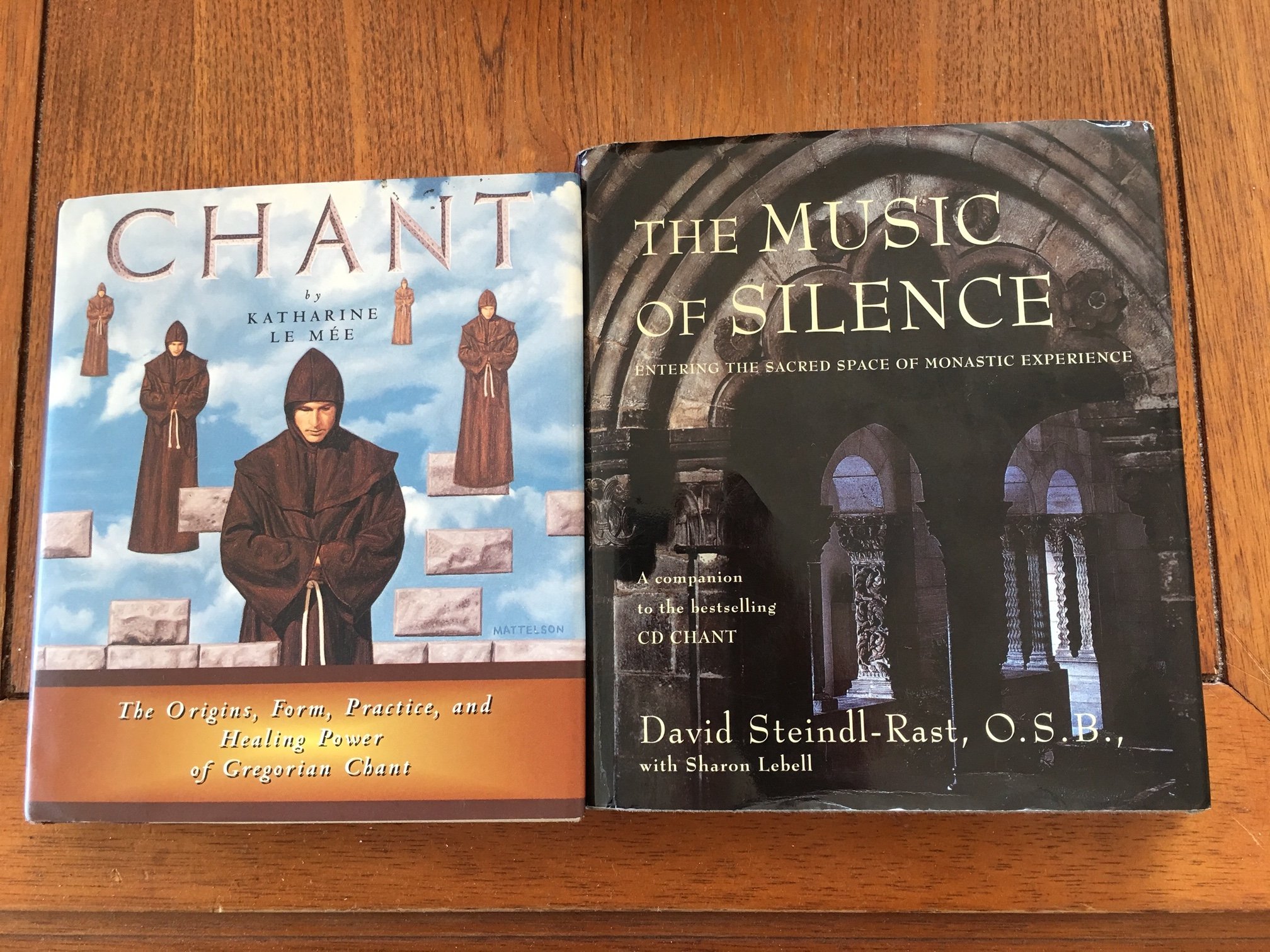
Another suggestion is waiting for the heartbeat of music, especially the “silence between the notes” of Gregorian chant. One of the earliest popular versions is CHANT by the Benedictine monks of Santo Domingo de Silos. If you get “hooked,” you may want to read their companion book, The Music of Silence, by Brother David Steindl-Rast, O.S.B., which may lead you to a desire to follow in some form the canonical hours or seasons of the day. Another book is simply called CHANT, by Katharine Le Mee, who tells you more about the origins, form, practice, and healing power of Gregorian Chant.

It is incredible where silence can lead us!

Joanna https://www.joannaseibert.com/


Benedictine Way of Life

Benedictine Life

“Listen carefully, my child to my instructions, and attend to them with the ear of your heart.”— Prologue to Rule of Benedict

In the 6th century, Benedict of Nursia tried to follow a spiritual path by himself, and realized he had to do this in community. From his awareness, we now have the Rule of Benedict, a way to find and follow God in community, balancing work, study, sleep, worship and prayers, and recreation. Members of Benedictine monasteries have used this rule for centuries. Today, people are developing ways to follow a rule as they live in the secular world, still connecting in community with spiritual friends and spiritual directors.  

This prologue to the rule is my favorite part of the rule. “Listen with the ear of your heart.” This is the call to the spiritual life, a way to live in the world still connected to God. First, we are to listen and pay attention. We are to use the ear of our hearts. We are to connect to something outside ourselves, hearing and loving. We hear and learn about love in a community outside of ourselves.  

There are many outstanding books about the Rule of Benedict. I will share three favorites, but I would like to hear from others about the books that have been most helpful as you try to find your rule of life. The Rule of Benedict, A Spirituality for the 21st Century by Joan Chittister, is used by the International Community of Hope to train lay pastoral caregivers, immersing them in Benedictine spirituality. Joan Chittister writes a short meditation after each part of the rule and applies it to everyday life.

 Always We Begin Again, The Benedictine Way of Living is a pocket-sized small book someone can carry daily. Memphis lawyer John McQuiston II wrote this modernization of Benedict’s Rule and included a sample rule of life.

 St. Benedict’s Toolbox is precisely what the author, Jane Tomaine, calls it in her subtitle, The Nuts and Bolts of Everyday Benedictine Living.

 All three books are outstanding to read together in community, learning and supporting each other.

Joanna https://www.joannaseibert.com/


Balance and Turns Lessons from The Labyrinth

Balance and Turns Lessons from The Labyrinth

Guest Writer: Gary Kimmel

“The mind can go in a thousand directions, but on this beautiful path, I walk in peace. With each step, the wind blows. With each step, a flower blooms.”–Thich Nhat Hanh

Labyrinth All Saints Episcopal Church Southern Shores North Carolina

One September, I joined our church’s Labyrinth Walk for the Fall Equinox and Racial Reconciliation. A word that caught my attention from the brief service bulletin was “balance.” And that is what I focused on.

As I walked the labyrinth, I noticed two things: the stones that lined the path and the turns at the end of each path section. 

The stones keep one “balanced” during their journey. You can’t go too far right or too far left without the stones reminding you that you will be leaving the path. I remember how my parents, teachers, and other mentors were my “stones” growing up—never insisting or forcing, just reminding and encouraging. As I left childhood, I had to find my “stones,” a journey unto itself. I have been blessed with a loving wife, close family, and friends who make that journey worthwhile. My faith journey has been filled with challenges that have shown me the limits of my path, while travels and experiences have shown me how wide my path can be.

The turns at the end of each labyrinth section change direction and require you to focus on staying balanced. Turn too quickly, and you may stumble or fall. In life, I am often challenged with turns and changes in direction. Many are uninitiated by me and often take me out of my comfort zone. Those turns can throw me off my straight-line balance. I must be particularly aware of listening for God’s intention at those times.

All this reminds me that I am not in control – God is. So, the challenge is to discern the limits of my path – what God intends, not me. I am comfortable with what I have been called to, not coveting what someone else has been called to, and being supportive. And especially for me, to welcome the “turns” in my life that set me on paths I had never dreamed of.

Gary Kimmel

Joanna. https://www.joannaseibert.com/