Lessons for the Great Fifty Days of Easter

Lessons for the Great Fifty Days of Easter

“I looked and saw a nurse, dressed all in white, standing by a bed in the improvised ICU. “Why do you seek the living among the dead?” she asked, and then she pulled back the curtain to reveal an empty bed. In my confusion, I turned and walked outside, leaving the hospital as if it were a tomb, and went into the streets. There were hundreds of people there, people laughing and talking, people strolling hand in hand, children playing in the parks, people hugging one another as they met on busy sidewalks. The shops were full. The streets were full. The city was overflowing with the sounds of life, joyous and unending, beneath a clear and sunny sky. I stood transfixed. Then I remembered: it was Easter Day!”—Steven Charleston Facebook Page, Easter 2020.
Easter Parade NYC

Just in case you did not see one of Bishop Charleston’s previous Easter Facebook pages, here it is! He tells us what the resurrection of our state, country, and world will look like. He constantly reminds us to look fear in the eye. He shows us what hope looks like. Reread the resurrection stories of Jesus. So often, he says, “Fear not. Do not be afraid; Peace be with you.”

During the pandemic and our recent tornadoes, I think Jesus’ message also was to care for ourselves and others. Trusting is not just meeting danger unprepared. Like David slaying Goliath, we must take the tools we know best to slay the viruses, prepare for disasters, and reach out to others who need help. David’s ammunition was a slingshot and a stone. Our weapons involved changing our social and hygienic behavior towards the enemy, preparedness, and caring for our neighbor.

Not being afraid means knowing God is beside us and caring about us. But I think God also wants us to be prepared with the tools God gives us against any danger. God walks beside us today so that we, again this year, can take the joy of the Easter Parade into our streets, shops, workplaces, and churches.

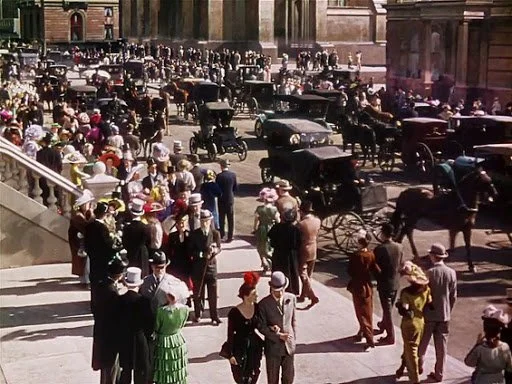
My Granddaughter Zoe and I often watch the movie Easter Parade on Holy Saturday. Later, on Easter Day, after lunch, I watched the Easter Parade with our oldest granddaughter, Langley, who had never seen it. That night, she showed me pictures of today’s Easter Parade in New York City. Very different from the past. We need something to remind ourselves of life in the past, but we also need to live in the present. We also need to remember the tools we have learned in this pandemic and recent disasters that we must continue to use so the future of our world remains brighter.

The joy of the great fifty days of Easter is an excellent time to celebrate being kinder to our bodies, more considerate to each other, more forgiving to our souls, and kinder to the planet.

chant Exsultet Easter

Chant Exsultet Easter

“Chant calls us out of chronological time, in which ‘now’ can never be located, and into the eternal now, which is not really found in time.” —David Steindl-Rast in The Music of Silence: Entering the Sacred Space of Monastic Experience (HarperOne, 1995).

David Steindl-Rast reminds us that when we use this ancient voice of praise and prayer to God, we are standing in the presence of ancient angel choirs. We are changing the way we address God and each other. The words become notes. The message we chant sounds different. The sounds of the chant are soothing and comforting. The music takes us to another place and another time. The sounds open our world to a new dimension. Chanting slows down the words of the message. The squirrels running in the cage in our heads slow down and become a bit quieter. Sometimes, time seems to stand still, and we feel at peace. We are home.

The chant that deacons most often sing is the Exsultet, which follows bringing the newly lighted Christ candle back into the church at the Easter Vigil. This music becomes part of my body long before Lent begins, even if I am not the deacon designated to sing this lengthy Canticle. Jason Pennington, the music director at one of my previous churches, describes the Exsultet as “one of the most difficult chants of the Church’s treasury of song, sung at the opening of the Great Vigil. It is the culmination of the events of the Holy Triduum, as the congregation holds their candles in the shadow of the one Paschal. The choir, not yet allowed into the stalls, stands in the nave with the faithful as that most beautiful of Canticles is intoned and promises us all the immeasurable gift of salvation.” 

I keep a note from Jason from our last Easter together, when I began having more mobility issues, and standing for a long time was more difficult. “She faced excruciating physical pain to stand for the lengthy Canticle as she drew each breath to acclaim its message of life. She paced it well, taking her time and savoring every single phrase as if it were the very first. This was a beautiful gift of ministry, a Holy Spirit gift that put ministry before self. And isn’t that exactly the lesson to have been learned at the Mandatum not two nights before: ‘I give you a new commandment, that you should love one another.’ Joanna’s lovely, quiet chanting voice was tremulous with pain yet was filled with joy. This was Easter.”

I keep Jason’s note to remind me and others that chanting is always an offering, never a performance.

Jason

A Memory Book of Past Easter Vigils

A Memory Book of Past Easter Vigils

“How blessed is this night when earth and heaven are joined, and man is reconciled to God.”  —Book of Common Prayer (Church Publishing 1979) p. 287.

I revisit this past Holy Week and remember especially some beautiful stories of the excitement of the Easter Vigil at each church where I served. I remember one priest telling us at his homily many years ago that our presence at the Vigil didn’t give us extra points with God. We weren’t getting more stars in our crown for being there. Being among the first ones at the empty tomb was a privilege to meet the risen Lord.

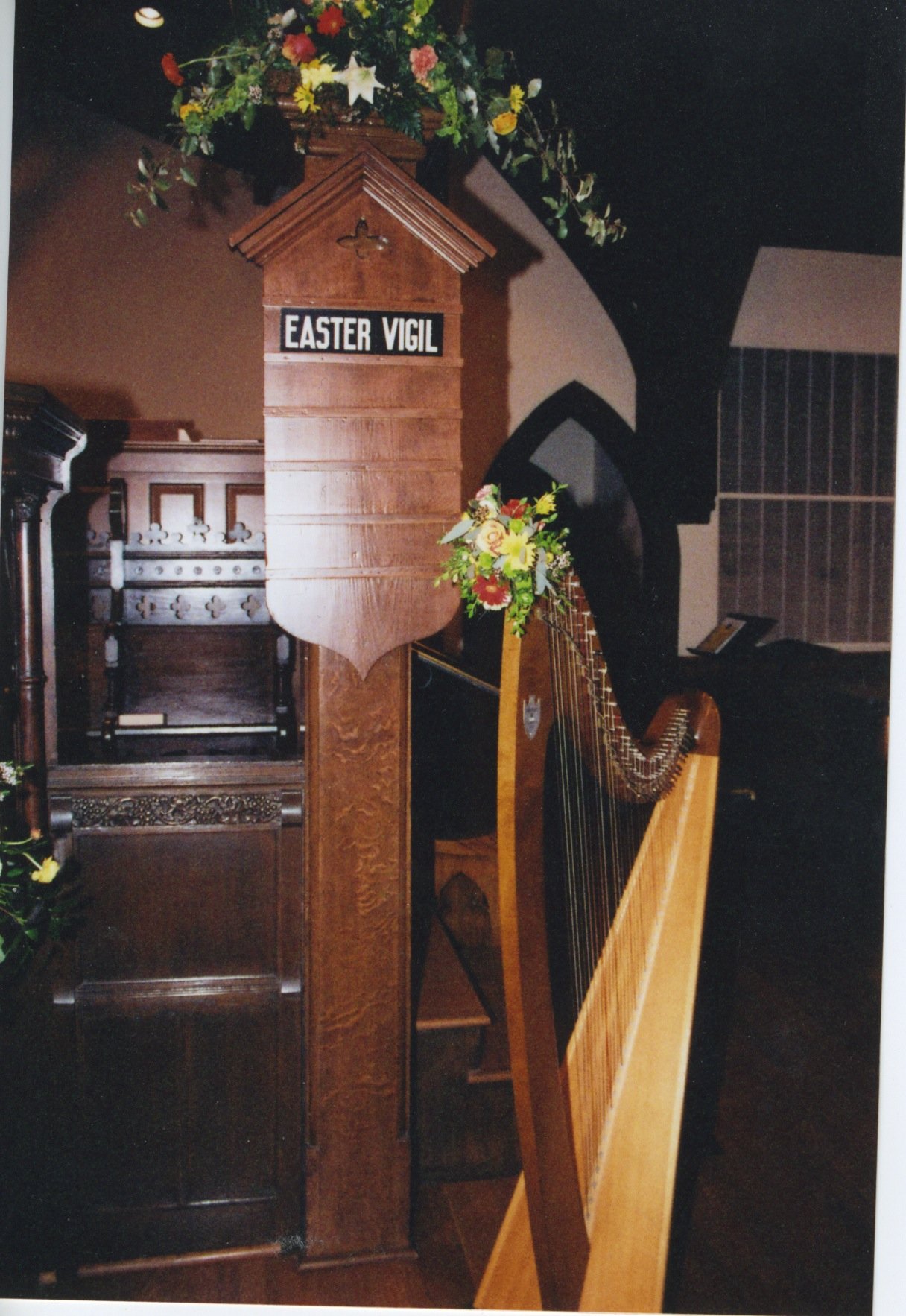
One of my favorite surprises was waiting to see how the Altar Guild would decorate my larger harp for the Easter Vigil.

Many congregations then follow the Vigil service with an elaborate reception or dinner late at night at church or someone’s home.

Once at Trinity Cathedral, as the deacon tilted the candle ever so slightly to light its wick from the first fire, oil ran out of the top of the candle, and the fire became surreal, like the tongues of fire described at Pentecost. At St. Margaret’s, we did the Vigil in the Columbarium garden, and I played a smaller lap harp as I sang the Exsultet to stay on key. I cannot describe the exhilaration of shouting in the great outdoors, “The Lord has risen indeed!”

At St. Luke’s, a lector reading one of the Old Testament Lessons had difficulty seeing in the dark. In the middle of the long reading, my dear friend put her candle closer to the microphone at the lectern, catching the microphone’s foam covering on fire. She so elegantly promptly blew out the fire and didn’t miss a beat in the reading. Also, at St. Luke’s, one of the fantastic teachers of the children’s ministries and her two children planned a flashlight egg hunt for older children after the Vigil. The young people searched outside around the church, which was a huge success as well as increasing the number who came to the service!

If you look online at a virtual Vigil during the pandemic at St. Mark’s Episcopal Church, the Easter fire looks like it is coming out of the air! Spectacular!

It is now more contained, but still very moving.

We recently handed out bells for people to ring during the Great Alleluia. At the end of the service, our other deacon, Susan, and our associate priest, Patricia, spontaneously began ringing their bells whenever there was an Alleluia at the closing hymn, “Christ the Lord is Risen Today, Alleluia.” The congregation soon joined in ringing their bells. It was incredibly moving, since we could not sing because of Covid restrictions! But we could ring!

The Vigil is so unusual that it is easy for clergy to get caught up in the many tiny details of this once-a-year liturgy and view it as a performance rather than an offering. The Vigil is a service to be enjoyed and celebrated.

We can always count on the Vigil to bring surprises, just as it did this year, just as it did that first Easter.

Joanna. joannaseibet@me.com