The Sacred Labyrinth

The Sacred Labyrinth

Guest Writer Patty Kohler

Praying

“It doesn’t have to be

the blue iris, it could be

weeds in a vacant lot, or a few

small stones; just

pay attention, then patch

a few words together and don’t try

to make them elaborate, this isn’t

a contest but the doorway

into thanks, and a silence in which

another voice may speak.”—Mary Oliver

Heber Springs

Mary Oliver’s simple poetry resonates with my soul because of its mere simplicity. This verse calls to mind the circuits of a labyrinth, so often made of a few small stones, evoking silence, beckoning the walker through a liminal doorway into another world composed of gratitude and thanksgiving, surrounded by the sweet music of silence. Within this in-between state, my monkey mind chatter falls away; each thought drops from my conscious mind, landing softly onto the earth’s receptive arms.

The labyrinth pathway is designed to provide a place to pause at its opening and begin a slow release of all that competes with our full presence. Stepping in, we let go of what has transpired earlier in the day, what is rolling through our heads, or even what might be coming up in the next few hours. For now, we begin the slow walk which leads only to the center. The path may veer closer to the middle or loop to the outskirts of the labyrinth. Still, it gently leads us to the middle, allowing us to discard, at least temporarily, all those ideas, worries, and concerns that plague our minds. Left with a quiet mind and the shuffling of our feet, we walk the circuitous route around and around, turning at unexpected places into the waiting center.

Thus emptied, when we reach the center, we stand, sit, or even gaze around us at the path that has led us here. In this spot, we open ourselves to receive whatever Spirit has to give us. We soak it in, gratefully gather Love, Peace, and Life to us, and receive with gratitude. Here, we remain as long as we are led to soak it in, filling us up silently.

As we prepare to leave the labyrinth’s center, our steps are retraced, and we gradually rewind our way to the labyrinth’s entrance. We reflect, sometimes with awe and wonder, on what has been received. We silently return, knowing that somehow, this brief pilgrimage has changed us in some subtle way. Again, we may walk nearer the center or the edge as we contemplate and return. The labyrinth, an ancient symbol of unity and wholeness, has fed us, and we are ready to step out and move back into our lives and the world.

Excerpt from In Circles

“Everywhere and ancient the circle

is repeated, shaping us to its original wisdom.

Give us each day or daily hunger,

to be more than we are now,

to be less solitary selves doubting our place,

to be more a circle of connection and acceptance,

spherical harmony of the heavens.

Each one a single voice, a sacred story,

but always in the larger circle of meaning and mystery.”—Gary Boelhower

World Labyrinth Day this year was May 4, 2024. It is always the first Saturday in May. To find a labyrinth near you, go to https://labyrinthlocator.com/

Patty Kohler, Ed.D.

Advanced Labyrinth Facilitator

St. Scholastica

Joanna Seibert joannaseibert.com

Ascension Day

Ascension Day

“Now the eleven disciples went to Galilee, to the mountain to which Jesus had directed them. When they saw him, they worshiped him; but some doubted. And Jesus came and said to them, ‘All authority in heaven and on earth has been given to me. Go therefore and make disciples of all nations, baptizing them in the name of the Father and of the Son and of the Holy Spirit, and teaching them to obey everything that I have commanded you. And remember, I am with you always, to the end of the age.’”—Matthew 28:16-20.

Ascension Window St. Thomas Menasha

Today, we celebrate the little-known Feast Day of the Ascension of Jesus to Heaven, 40 days after Easter. Barbara Crafton1 describes this as the feast of the “simultaneous presence and absence of Christ.”

Charles Chatham,2 a former priest at St. Mark’s, reminds us that the New Testament scholar Raymond Brown coined this helpful phrase about the Ascension: “the presence of the absent Jesus.”

There is an absence of the physical body of Christ, but in some mysterious way, he is still with us, inside of us, beside us, and inside our neighbors as well.

Barbara Brown Taylor3 often writes about our wanting to feel the presence of Jesus. We think he is absent. She tells us we should look around us instead of looking up to heaven. Look in our neighbors. Look inside of ourselves. Jesus is still here. Remember how God cared for us in the past. God has never abandoned us.

We know that the Ascension means Jesus took part of the world’s humanity to be forever part of God, the Holy. But Taylor describes the Ascension as if Jesus not only ascended, but exploded, with the holiness once concentrated in him alone flying everywhere, far and wide, with the seeds of heaven now sown in all the fields of the earth at that time and in the future. The body of Christ is not somewhere beyond our telescopes but here, beside, and inside of us.

We weekly celebrate this presence in the Eucharist. Christ’s presence is still with us, “always to the end of the age,” Mathew tells us. Jesus also promises that soon, in ten days, we will celebrate the promise of the presence of the Holy Spirit within each of us at the Feast Day of Pentecost.

Both feast days are a mystery.

Kate Alexander4 at Christ Church gives us a prayer attributed to the 16th-century Spanish mystic Carmelite nun Teresa of Avila, which may help explain what so many are trying to tell us:

“God of love, help us to remember

That Christ has no body now on earth but ours,

No hands but ours, no feet but ours.

Ours are the eyes to see the needs of the world.

Ours are the hands with which to bless everyone now.

Ours are the feet with which he is to go about doing good,

Ours are the eyes with which he looks

Compassion on this world. Amen.”

1Barbara Crafton, “Almost Daily Email from Geranium Farm,” Ascension, 2004.

2 Charles Chatham, “Presence of the Absent Jesus,” in Thinking Faith #172, 2012.

3Barbara Brown Taylor, “Looking Up to Heaven,” Gospel Medicine, pp. 72-78.

4The Rev. Kate Alexander, Feast of the Ascension, Year B, Christ Church, Little Rock, May 21, 2009.

Joanna Seibert https://www.joannaseibert.com/

Bless you for supporting the ministry of our church and conference center, Camp Mitchell, on top of Petit Jean Mountain, by buying this book in the daily series of writings for the liturgical year, A Daily Spiritual Rx for Lent and Easter. If you like this book, could you briefly write a recommendation on its page on Amazon? More thank-yous than I can say!!!


Living Paradox

Living Paradox

“The great paradox of life is that those who lose their lives will gain them. If we cling to our friends, we may lose them, but when we are non-possessive in our relationships, we will make many friends. When fame is what we seek and desire, it often vanishes as soon as we acquire it.”—Henri Nouwen, “April 30” in Bread for the Journey (HarperOne, 1997).

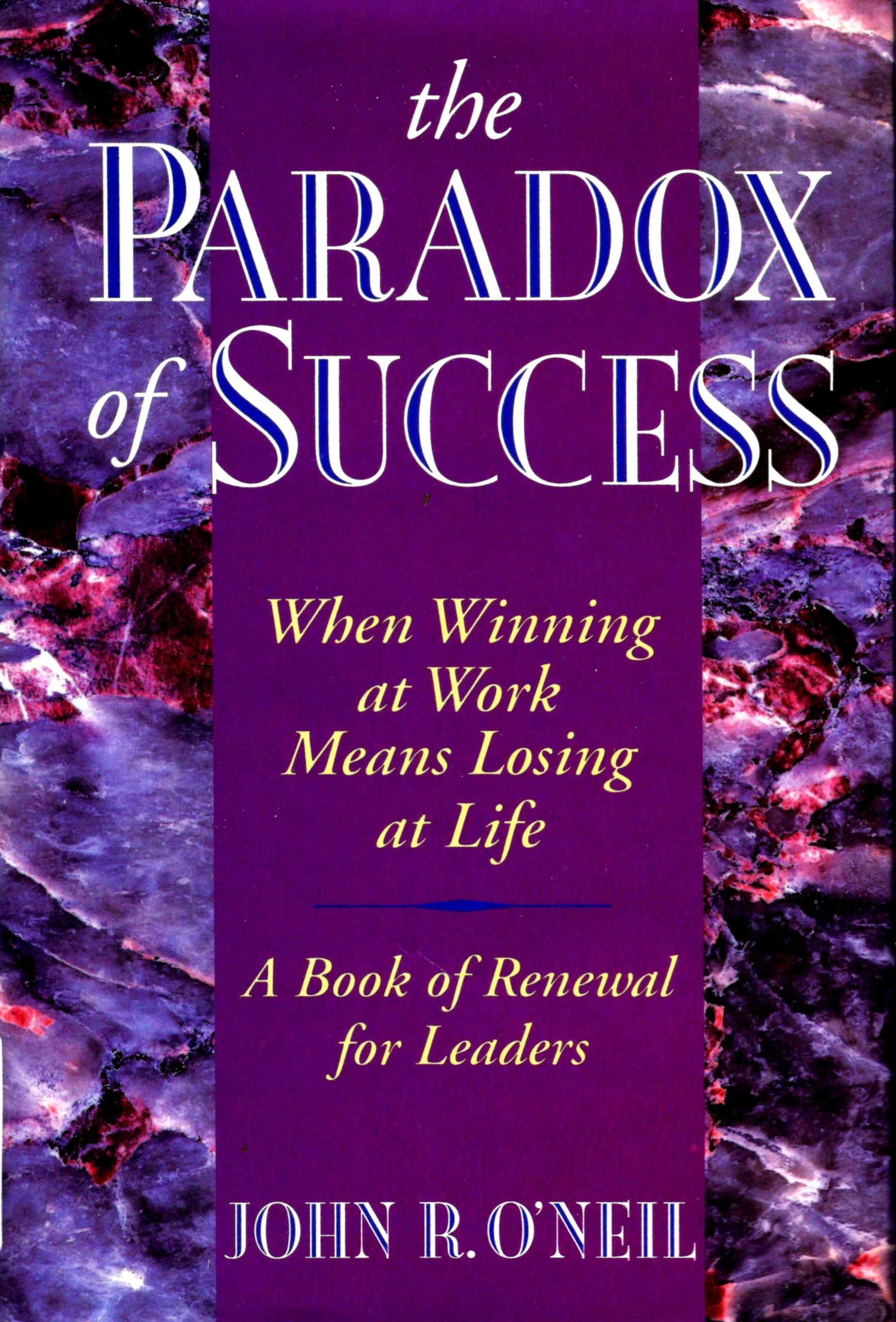
Nouwen again opens us up to an authentic truth: that we live and work with paradox, holding tensions. One of the best books I read during my work as a physician was John R. O’Neil’s The Paradox of Success: When Winning at Work Means Losing at Life. It is subtitled: A Book of Renewal for Leaders. O’Neil tells us how our excessive pride as leaders, when combined with the seductive perks of power, can become addictive. At some point, the wielding of power itself becomes even more important than its goal.

Power and the need to control our own fate can take over and sometimes become the end rather than the means. The paradox of success is the promise of renewal, as we can stand back, especially in a retreat, and see where we have gotten into trouble. There are obstacles to stepping back, such as our drive for perfection, as our path becomes a prison. Often, we let our clocks tell us what we should be doing, especially as we drive toward the dead-end of a substantial paycheck.

O’Neil believes that any amount of time spent away from our usual productive round of activities is renewing as long as it is time spent pursuing wisdom. For me, it entails exercising, watching birds at my window, being or sitting in nature, music, playing the harp, quiet, writing, talking and connecting with friends, visiting the sick, and some form of daily retreat, usually involving writing. He encourages us to become healed by pursuing a different situation, where we do not run the show and focus on relationships rather than goals or end results. Our difficulties stem from the very traits that make us winners. We will find unmined gold in dark places initially hidden to us .

The book includes a graph about success. We work hard to reach the top as we master our profession. However, we only stay at the top briefly, since there is always someone else or many who will soon surpass us. O’Neil suggests we stop to observe our situation as we approach the peak of a pursuit, and consider starting all over again in a new career. That can keep us humble, as we are back on a learning curve where we do not have all the answers. Then, as we get close to the top of that career or undertaking, he suggests we observe and again consider starting all over again. As Benedictines might say, “Always we begin again.”

My summer reading again includes David Brooks’ The Second Mountain. I think Brooks is discovering some of these same principles about life. For so many, our time during the pandemic was a period of discernment—learning how to live with the paradoxes in our lives.

Richard Rohr recently reminded us in his blog that our call is to hold the tension, not necessarily find a resolution or closure to the paradox. We must agree to live without resolution, at least for a while. He believes being open to this holding pattern is the very name and description of faith.

Joanna. Joannaseibert.com  https://www.joannaseibert.com/