The Trinity

The Trinity

“Trinitarian theology says that true power is circular or spiral, not so much hierarchical. If the Father does not dominate the Son, and the Son does not dominate the Holy Spirit, and the Spirit does not dominate the Father or the Son, then there’s no domination in God. All divine power is shared power.”—Richard Rohr in The Divine Dance: The Trinity and Your Transformation (Whitaker House), pp. 95-96.  

Robert Farrar Capon says when humans try to describe God, we are like a bunch of oysters attempting to describe a ballerina. But we can’t help but try, especially as we strive to understand the doctrine of the Trinity, perhaps one of the greatest mysteries of the Christian faith.

At a summer course at Oxford University, a Greek Orthodox bishop, Timothy Kallistos, introduced us to Andrei Rublev’s 15th-century icon, The Trinity, or The Hospitality of Abraham. It pictures the three angels who visited Abraham at the Oak of Mamre (Gen. 18:1-8) to announce the coming birth of his son, Isaac. We have interpreted it as a symbol to help visualize the mystery of the interrelationship in the Trinity of Father, Son, and Holy Spirit.

Each figure is in circular harmony with the other, humbly pointing to each other with mutual love. We miss the mark if we relate only to the Trinity in its separate parts. The Persons are in a community, transparent to each other, indwelling, and in love with each other. They have no secrets from one another, no jealousy, no rivalry. Instead, they teach us how to live in community. Barbara Brown Taylor describes their relationship as the sound of “three hands clapping.”

The doctrine of the Trinity calls us to a radical reorientation in our way of seeing and living in the world. We are what we are in a relationship with. The God of the Trinity is not an I, but a we; not mine, but ours. Our belief in and understanding of the Trinity can definitely make a difference in how we drive our cars, how we fill out our tax returns, how we relate to others of different faiths, colors, and political views; how we stand about war; how we treat the person sitting across the aisle from us, as well as those living across the Interstate and outside our country’s borders.

Richard Rohr’s and Barbara Brown Taylor’s thoughts are excellent to meditate on when we have a conflict with another person, when the Christ within us is having difficulty seeing the Christ in another. 

[See Barbara Brown Taylor, “Three Hands Clapping” in Home By Another Way (Cowley), pp. 151-154.]

Thank you for supporting our camp and conference center, Camp Mitchell, on top of Petit Jean Mountain, by buying this book in the daily series of writings for the liturgical year, A Daily Spiritual Rx for Ordinary Time: Readings from Pentecost to Advent. All proceeds from the books go to Camp Mitchell. If you like this book, could you briefly write a recommendation on its page on Amazon? https://smile.amazon.com/Daily-Spiritual-Ordinary-Time-Pentecost/dp/B08JLTZYGH/ref=sr_1_1?dchild=1&keywords=joanna+seibert+books&qid=1621104335&sr=8-1

 More thank-you’s than we can say!!!

Joanna https://www.joannaseibert.com/
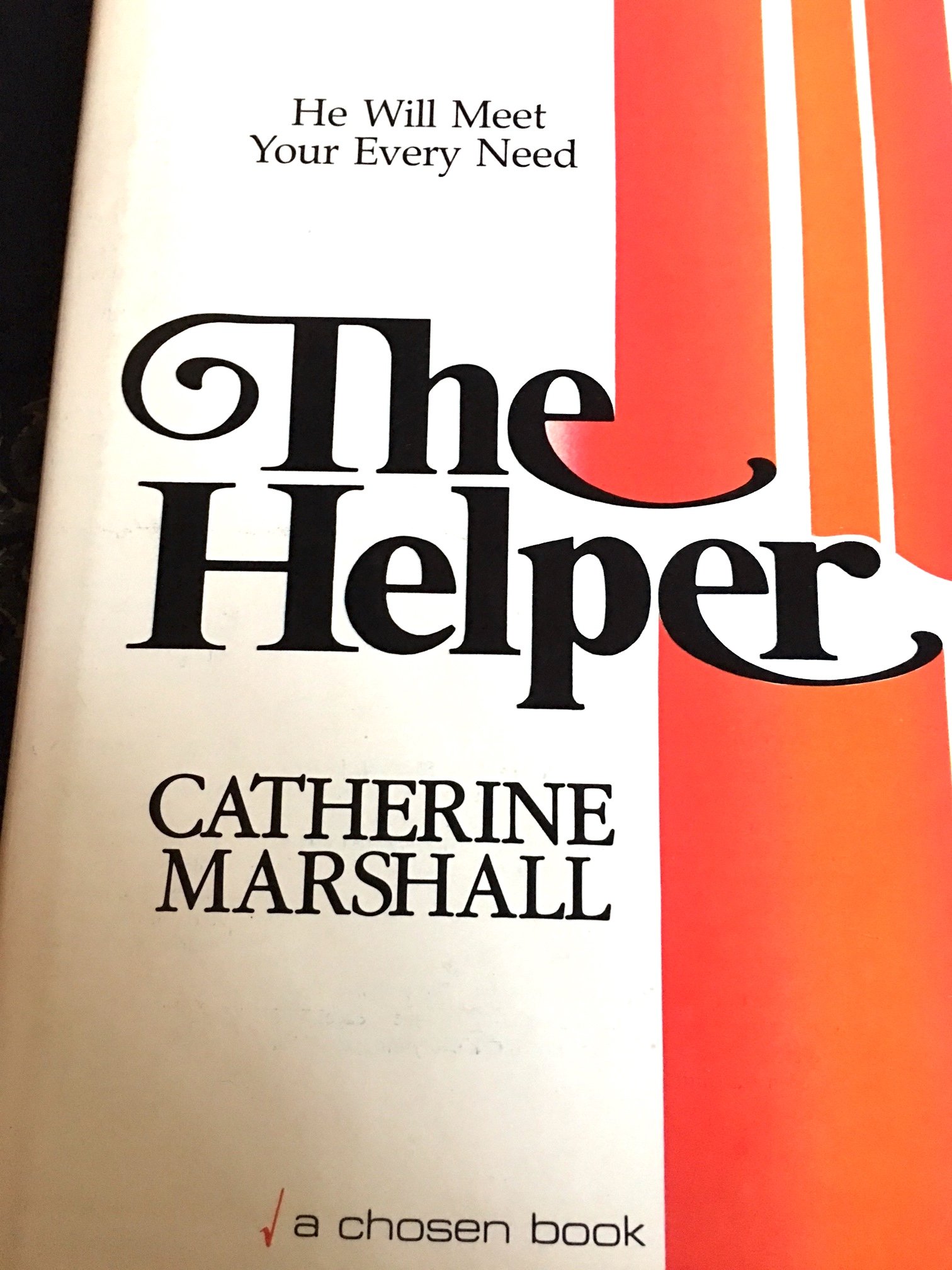


Catherine Marshall: The Helper

Catherine Marshall: The Helper

“When we try it on our own, we are seeking to usurp the Helper’s place. The result of attempting in the flesh to convict another of sin is wreckage—defensiveness, anger, estrangement, loss of self-worth, defeatism, depression—whereas, when the Spirit does this corrective work, it is “good” hurt, the kind that leaves no damage, that never plunges us into despair or hopelessness but is always healing in the end.”—Catherine Marshall in The Helper (Chosen Books, 1978), pp. 214-215.

Over forty-five years ago, when our medical practice at Children’s Hospital was just starting, my husband and I were not as busy and could go downtown for lunch—and then perhaps browse Cokesbury Bookstore before returning to the hospital. One day, I saw a book by Catherine Marshall, The Helper, on the front sales table for two dollars. I remembered that she had written A Man Called Peter about her husband, a Scottish immigrant who became the chaplain of the United States Senate, but died prematurely. I particularly loved the movie, so I could not resist the bargain. I paid the two dollars, and it changed my life.

I did not understand the Holy Spirit. Then, suddenly, I was presented with a part of God that I could relate to, who was always with me. However, I had great difficulty relating to God, the Father, and Jesus. One was a kind older man with a beard in the sky, and the other was some kind of television evangelist flipping through the Bible who wanted to save me. 

For years, I held on to the Holy Spirit, the Comforter, the Helper, always beside me, guiding me if I chose. This sustained me for a long time until I could have a deeper relationship with the other two parts of the Trinity. I am constantly amazed by how God, the Holy Spirit, works: a Presbyterian minister’s daughter I would never meet who grew up in Keyser, West Virginia, with my father, the son of the Methodist minister in the area, a slow-time in our practice; a Methodist bookstore; a bargain table; a New York Times bestseller; a movie; and two dollars.

My favorite story by Catherine Marshall was about answered prayer. She prayed for patience, and God gave her the slowest possible housekeeper. I wept when I heard of Catherine Marshall’s death at age sixty-eight in 1983, just before Holy Week.

Thank you for supporting our camp and conference center, Camp Mitchell, on top of Petit Jean Mountain, by buying this book in the daily series of writings for the liturgical year, A Daily Spiritual Rx for Ordinary Time: Readings from Pentecost to Advent. All proceeds from the books go to Camp Mitchell. If you like this book, could you briefly write a recommendation on its page on Amazon? https://smile.amazon.com/Daily-Spiritual-Ordinary-Time-Pentecost/dp/B08JLTZYGH/ref=sr_1_1?dchild=1&keywords=joanna+seibert+books&qid=1621104335&sr=8-1

 More thank-you’s than we can say!!!

Joanna. https://www.joannaseibert.com/

One Race

One Race

Guest Writer Mary Ann Stafford

Stafford. We Are One Race

There is only one race on this earth – the human race.

We’re all human beings created by the same true God.

We may have different kinds of hair, eye color, skin color,

Speech, customs, religions, but we are more alike than different.

Our bodies work the same way – digestion, senses, pain.

We feel in the same ways – love, fear, anger, humiliation.

Differences are because of location, climate, culture, condition,

And these are what happens to us after birth.

At our birth, we are the same tiny creatures.

Our parents look upon us with either love or disgust,

We could be born into wealth and grandeur and

Never have a financial worry in the world, or

We could be born into severe poverty with no stable home

In a war-ravaged world, and never able to feel secure.

These differences are of the world, of the devil, of circumstances

Over which we have little or no control.

So why do we look down on others who are not as fortunate as us?

We disrespect them, consider them inferior or unwelcome?

We turn against them, fight them, despise them, and enter groups

To work against them, hurt them, commit genocide.

They are our brothers and sisters, and we should treat them as such.

We are all part of the human race, God’s creation

No matter shape, ability, circumstances, or appearance.

But then, our hubris gets in the way.

Mary Ann Stafford pastelanne@sbcglobal.net

Joanna Seibert joannaseibert.com https://www.joannaseibert.com/