Morning Prayer

Morning Prayer

“But as for me, O LORD, I cry to you for help;

In the morning my prayer comes before you.”—Psalm 88:14.

Saint Mark’s Chapel

Many people use a spiritual discipline, beginning and sometimes ending the day, by reading and meditating on Holy Scripture. Many denominations follow a daily lectionary of Scripture readings. Over a certain period, the reader has studied significant parts of the whole Bible.

In the Episcopal tradition, the Book of Common Prayer lists a two-year cycle of daily lessons taken from the Psalms, the Hebrew Scriptures, a New Testament letter, and one of the Gospels for each morning and evening. By the end of each seven weeks, the reader has digested the entire Book of Psalms. After the two-year cycle, the reader has been exposed twice to all the New Testament and once to pertinent portions of the Hebrew Scriptures.

We can also do the Scripture readings as part of a structured morning and evening prayer service, read alone or with others. These Daily Offices provide a contemplative framework for regular use and offer a pattern for regular reading of the Bible. In addition, some people use a daily meditation book containing Scripture readings; others use publications such as the Methodist The Upper Room, the Episcopal Forward Day By Day, and Catholic resources The Catholic Moment, The Word Among Us, and Being Catholic. Some of these meditations are available online for reading or listening.

The Daily Offices of Morning and Evening Prayer are also online. One of the most popular office sites is The Mission of St. Clare, www.missionstclare.com. I use the Daily Office  https://dailyoffice.wordpress.com/ online because of their additional artwork.

I am part of a group of people continuing Community of Hope training for pastoral care, who read daily meditations from Joan Chittister’s book on The Rule of Benedict. I had forgotten what a treasure it is to read myself and then read what others have said. I learn so much more from others. God speaks much more clearly in community.

Morning Prayer is offered Monday through Friday in this beautiful chapel at Saint Mark’s. Noon day prayers are offered on Saint Mark’s Facebook Page (Love St. Mark’s https://www.facebook.com/stmarkslr ) Monday through Friday.

I hope to hear from many others about their use of other daily meditations and ways of structuring daily Scripture readings.

Joanna https://www.joannaseibert.com/

Thank you for supporting our camp and conference center, Camp Mitchell, on top of Petit Jean Mountain, by buying this book in the daily series of writings for the liturgical year, A Daily Spiritual Rx for Ordinary Time: Readings from Pentecost to Advent. All proceeds from the books go to Camp Mitchell.  If you like this book, could you briefly write a recommendation on its page on Amazon? https://smile.amazon.com/Daily-Spiritual-Ordinary-Time-Pentecost/dp/B08JLTZYGH/ref=sr_1_1?dchild=1&keywords=joanna+seibert+books&qid=1621104335&sr=8-1

 More thank-you’s than we can say!!!


Fox-Walking

Fox-Walking

Guest Writer: Eve Turek

“Come, follow Me…” -Jesus (Mt. 4:19)

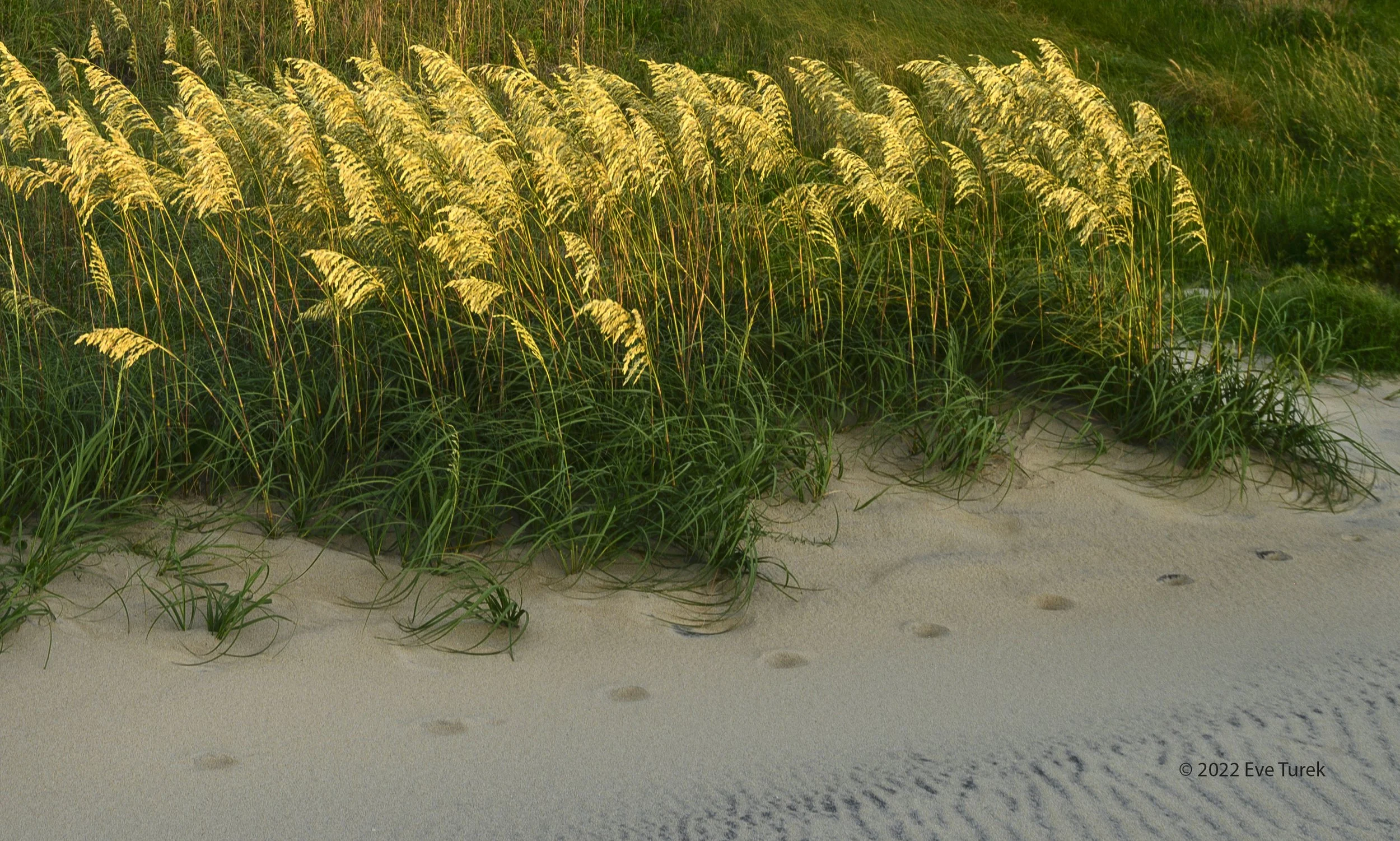
Fox tracks and sea oats

I have always defined “Christian” for myself as “Christ-follower.” I think of that phrase literally as well as spiritually.

In the mid-1980s, I became interested in animal tracks. I practiced identifying the tracks I saw in the sand. I tried to imagine how the animal might have moved, and where it paused or lengthened its stride from its footprints. I quickly learned obvious tracks like rabbit and mouse and raccoon. I puzzled over bug trails. I marveled at all the different tracks fanning out from a single ghost crab hole. But my favorite tracks belong to my favorite animal: fox.

Fox tracks have the unusual characteristic of almost always occurring in a straight line. Foxes’ normal gait exhibits a “perfect register” – their back paws land precisely where their front paws do, creating a single line of tracks. Their footprints speak to me of purpose and direction. I have tried to walk in a perfectly straight line. It’s not easy, especially in rough or uneven terrain. “Fox-walking” takes focus, concentration, and balance in the natural. “Christ-walking” takes all of that in the spirit.

So, what stride, direction, and pace do I strive to follow?

Simple, but not easy. Challenging and demanding both focus and balance, no matter the surrounding terrain of circumstance.

Love is what I strive to follow. The kind of love that says love God with all you are and have. Or use Bible words with all your heart, soul, mind, and strength.

Love. The kind of love that says, love your neighbor as you would love yourself. And then, just so we don’t misunderstand, Love Himself gave us a story about “neighbor” being the least like us, the one we might more naturally despise or feel superior over. Love THAT one.

Love. The kind of love that says, love your enemies. (Really? You have got to be kidding! How does an ordinary person do that?!?) Yes, those parenthetical sentences sum up the arguments I have tried to have with God many times. Over the decades, I have found an answer: I ask for healing. I ask for a blessing. I ask for forgiveness, restoration, and better choices. I ask to see as God sees, as a loving parent sees, who wants only and always the best for every child. 

I don’t, I’m sorry to say, always think in a perfect register. And I don’t always speak or walk in perfect register either. But I’m grateful to say I am very aware when I “step out of line.” The idea of “fox-walking after Jesus” informs every conversation I have, every decision I make, and all my choices. It will direct my vote in the upcoming election. I will not vote for hatred or division. Or for any candidate who advocates despising others for whatever reason. Are there perfect people, perfect candidates, a perfect nation? No. But I am determined to fox-walk, as best I can, in the life I have been granted, and for my part, that means trying with focus and balance to walk the walk of being a Christ-follower, not just talk the talk.

Eve Turek

Joanna Joannaseibert.com https://www.joannaseibert.com/

Kairos Time

Kairos Time

“Music helps us to “keep time” in the sense of keeping us in touch with time, not just time as an ever-flowing stream that bears all of us away at last, but time also as a stream that every once in a while slows down and becomes transparent enough for us to see down to the streambed the way, at a wedding, say, or watching the sunrise, past, present, and future are so caught up in a single moment that we catch a glimpse of the mystery that, at its deepest place, time is timeless.”—Frederic Buechner in Beyond Words.

Buechner writes that artists who paint work with space, while time is the medium for musicians, the changing sound of one note following another in different time intervals. I hear each bird singing outside my window with an identifying rhythm. Even the silent wind makes a variable sound as it moves through nearby trees. The rain as well sounds at regular and irregular beats on our bedroom roof, often like an alarm clock in the early morning. Our grandchildren once loved to lie in our bed and hear the beating of rain on our roof as we watched movies together.

Each day, we awaken to a new gift of time. Buechner goes further to say that the movements of a symphony teach us about the movements of our daily lives, streaming from one sound, one instrument to another, often in repetition. Our favorite musicians and nature’s constant sounds help us keep time for these movements to flow through our lives. Sometimes, this stream of music in our lives slows down just enough for us to see clearly the bottom of the stream and live in the present moment at sunsets, graduations, births of our children, weddings, funerals, and sacred liturgies, and realize the mystery of how time is timeless. This is living is Kairos time, God’s time, eternity.

I had this experience in writing my last book, Letters from my Grandfather, as I responded to letters to me from my grandfather written fifty and sixty years ago. I experienced an absence of linear time between us. Here, it was not music, but writing where time became timeless.  

Joanna joannaseibert.com https://www.joannaseibert.com/