New Day

New Day

Waking up this morning, I smile.
Twenty-four brand new hours are before me.
I vow to live fully in each moment
and to look at all beings with eyes of compassion.” 
—Thich Nhat Hanh in The Heart of the Buddha’s Teaching (Broadway Books, 1998), p. 102.
Richard Rohr compares Christians and Buddhists in his daily email. “Christians are usually talking about metaphysics (‘what is’), and Buddhists are usually talking about epistemology (‘how do we know what is’). In that sense, they offer great gifts to one another.” 1

Buddhist monk Thich Nhat Hanh’s writings often speak to me. What a marvelous idea to wake up in the morning and say, “We have twenty-four brand new hours before us. I don’t want to waste a second, a minute, an hour. It is a new day.”

Yesterday is past. We went over what we had done and left undone the night before when we prayed God would forgive us of wrongdoing, also called sins. We remembered where we found joy, often where we least expected it. We recalled where we found love. We remembered the day’s experiences in which we saw God working in our lives.

This is an extra day, a new beginning. We can no longer regret the past. If we have harmed others, we will make living amends where we need to, but today, we are offered a fresh start. We hope we have learned from the past. We will not continue doing the same thing every day and expect different results. Instead, we will look for synchronicity, moments, or serendipity in which we make connections and see how events are related.

I write about the Eucharist one morning, and someone unaware of that later confides in how important the Eucharist is in his life. We receive a message from a friend we have been thinking about that day. We think about someone we have not seen for some time. Later, that person calls. She tells us what we did or said was precisely what she needed at the time. That is synchronicity. These are God connections, constantly around us each new day.

1 Richard Rohr, Center for Action and Contemplation, Meditation: Mindfulness, cac.org, August 24, 2018.

A New Spiritual Practice

A New Spiritual Practice

"Here's a suggestion for you today. At some point, stop. Gaze at something God has created. Take in its shape and form, its color, its movement, its intricacies. It could be a single bud on an autumnal flower, an animal or bird, shapely fruit, or flowing water. Gaze at something long enough until you can see through it to its source: God - so majestic, infinitely creative, and miraculously generous to share these traces of God's glory with us."—Br. Curtis Almquist. Society of Saint John the Evangelist.

mary anne seibert

Brother Almquist gives us a new spiritual practice. He asks us to gaze at something in creation: a tree, a flower, a bird, a river, the rain, the snow until we see the Creator in it. We might name it Observo divina. This will be a new practice for today. It all started yesterday when we saw two fawns of different ages with a single doe in our backyard. We were mesmerized by the fawns' awkward gait, curiosity, and seemingly delight in a new world at every turn.

Today, as I write, a lone male deer with huge antlers passes by my window. He takes my breath away. Multiple deer once passed my window, but now a visit is infrequent. The buck is probably headed across the street to meet many other deer living in the woods behind our son and his wife's house. There I know he will be just as welcomed as he was here. As he majestically walks by, I think of a scene from the movie, The Queen, when Elizabeth II encounters such a beautiful deer. They just look at each other and admire each other. They seem to see the beauty of creation in the other.

This is also what we do for each person we meet today. We look into their hearts to see Christ, God, and Spirit within them. Our task is to see the Creator in all creation, to praise and give thanksgiving for this creation.  

We start with lovable things until we can finally see creation in those with whom we have difficulty. Take heart. Sometimes, it may take more than a lifetime. But God never gives up on us.. or on them!

mary anne seibert

The Family of Man

The Family of Man

“The purpose of these pages is twofold.

To serve as a remembrance of our happy times in the past and of our own search for ourselves.

To serve as a message of hope for a successful life in every respect in the future.

A past and a future—both tied together by the present—not only the present, but love—without which neither the past nor the future would exist.”— Judy Rand and Sue Latham, inscribed in The Family of Man, probably written in 1963, giving the book to me as a gift.

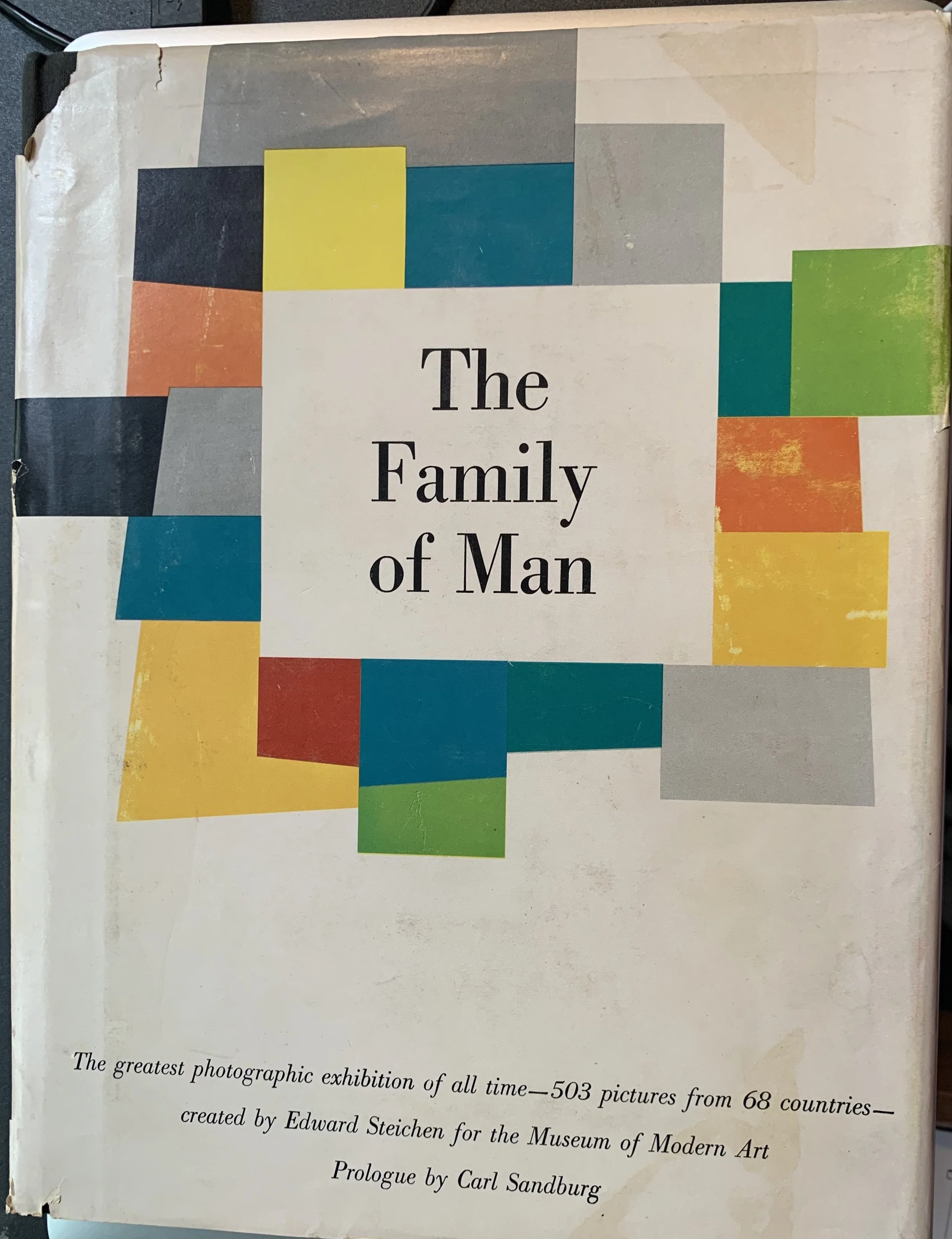
The Family of Man was a photographic exhibition of 503 pictures from 68 countries created by Edward Steichen for the Museum of Modern Art in 1955. The exhibit then toured the world for eight years to record-breaking crowds. The book from the exhibit became an instant success and has never been out of print.

My husband directs the archaeology of our past memories and recently brought to me this photographic book from The Family of Man exhibition to consider giving to one of our granddaughters.

It is the perfect gift to pass on. Zoe will not know Judy Rand and Sue Latham, who gifted the book to me. But the book will always carry the inscribed love of these two dear college friends from my dorm. Unfortunately, in the mounting years, I have lost touch with Judy and Sue. However, my hope is that the above inscription from Judy and Sue in the book will carry the love of friends who changed my life, and may also bring meaning to Zoe at a similar age in her adventures more than a half-century later.

We all have a call: to continue to treasure the love we received from friends and pass that love on as best we can. This copy of The Family of Man is a treasured, visible tradition that allows this to happen. Discussing the photographs in the book with my granddaughter and talking about the friends who gifted it will be another way—simply spending time together in the present moment, remembering the past, and looking to the future. A sacred time.

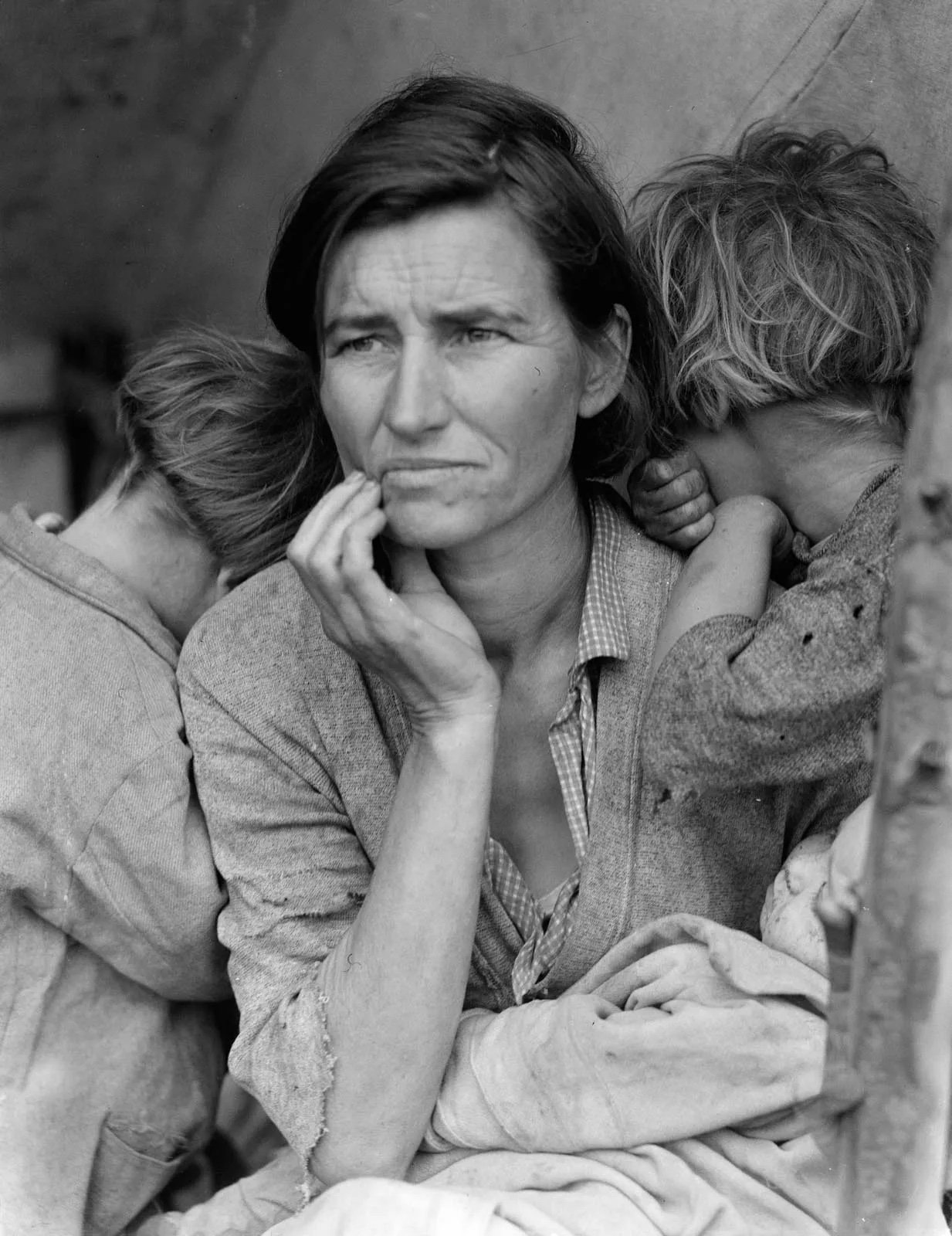
Migrant Mother Lange 1936

Joanna joannaseibert.com