Painting as a Spiritual Practice

                                Painting as a Spiritual Practice

Guest Writer: Ken Fellows

  Watercolor Painting

     Before I took up watercolor painting, I was a radiologist who spent decades contemplating black/white images. My grayscale discrimination is pretty good, and perhaps that’s why my paintings feature light and shadow. A doctor colleague observed at one of my shows, “Well, I see you’re still dealing in shadows.”
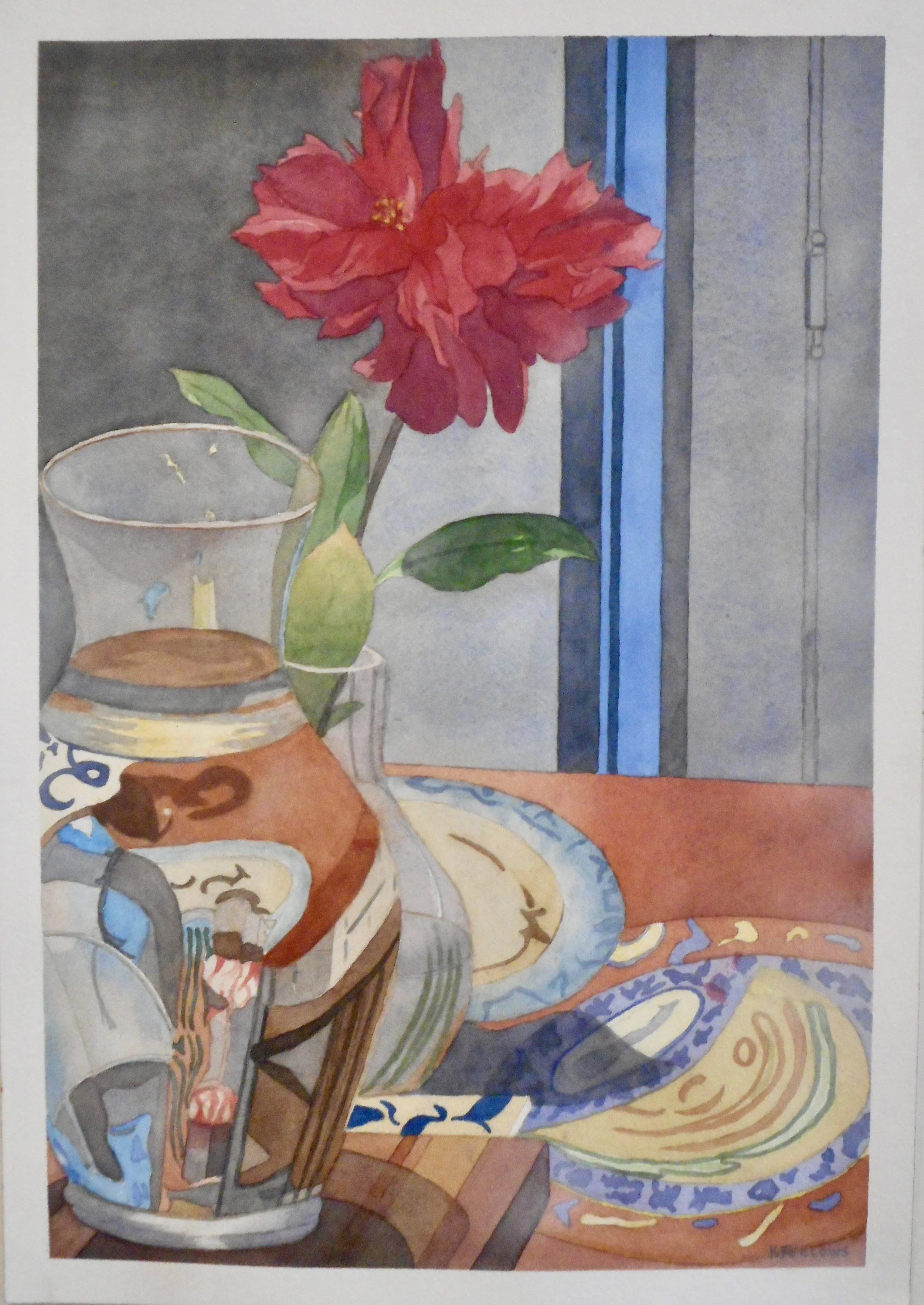
Interpreting X-ray images also requires subconsciously rejecting what’s unimportant or extraneous and focusing on the unusual, the variant, and the arresting. The same holds true for watercolor art. When I paint, I do the same thing: I try to extract the essential and defining elements of a scene and leave out those that are mundane or distracting. Art teachers stress that what’s left out of a painting is as important as what is included. Sometimes, deciding that can be difficult; it complicates the start of every painting.

     Dewitt Hardy was my best teacher. He painted locally and was known nationally as a master of watercolors. His early criticism of my own work was that my paintings were “too photographic.” Other people have observed, not always admiringly, that “your work looks like a photo.” I offer no defense, unintentional as ‘the look’ may be.

     I often use personal photos as a reference for painting, but I usually study and sketch the scene on-site before attempting a final rendition. Photos taken on-site help me recall the ambient light and shadows when I return to my studio. Everything else –the objects, shapes, proportions, and colors –are all candidates for change and innovation.

     Whatever viewers think about my work, if it’s in a show, it has already passed my severest critics— my artist/wife Kristin, photographer/daughter Hannah, and young granddaughter Ella (who always recommends, “Grandpa, there’s not enough color”). They have discerning eyes and good judgment. If they disapprove, the painting is never on display. My paintings have been selected for approximately 65 shows over the past 22 years. I’ve been fortunate to have the support and encouragement of my family, and to have found this ‘2nd act’ in life.                                                                             

    In any case, I paint for pleasure, not for critical approval. I see more things I want to paint than I can ever accomplish. I choose what I like and paint what I see. There’s no message in my work –no karmic meaning, no philosophical intent. When a painting pleases me enough to hang on a wall, and my in-house jury approves, I dare to exhibit it publicly. I am satisfied if anyone else finds the effort either pleasing or interesting. 

   “I’ve been drawing all my life, just as a hobby, without really having shows or anything. It’s just an agreeable thing to do, and I recommend it to everybody. I always say to people, practice an art, no matter how well or badly, because then you have the experience of becoming, and it makes your soul grow.”—Kurt Vonnegut

Ken Fellows

Joanna joannaseibert.com


Visio Divina

Visio Divina

"The experience of praying with icons and other images is quite different than praying with words."—Christine Valters Paintner in Illuminating Mystery: Creativity as a Spiritual Practice, Reflections in Word and Image (Abbey of the Arts Press, 2009).

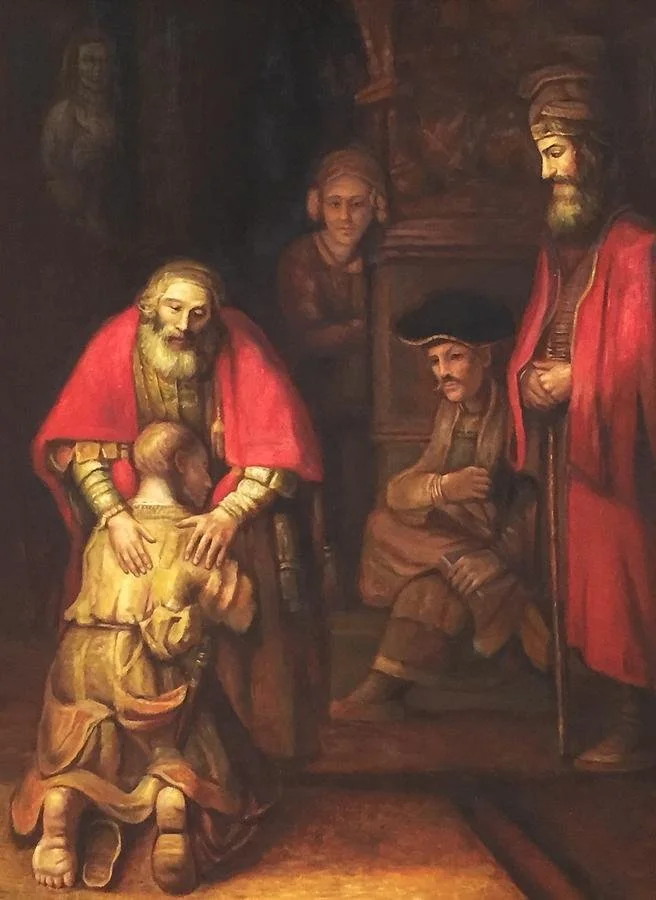
Return of the prodigal son Rembrandt

God speaks to us in many ways—through relationships, our experiences, sacred texts such as the Bible, and other avenues. Visio divina, Latin for "divine seeing," is a form of prayer that involves meditating with images to listen to God's words. It is similar to Lectio divina, Latin for "divine reading," in which we pray using sacred texts such as Holy Scripture. There are four steps we can follow to practice Visio divina:

1. Sit quietly, close your eyes, and be aware of your breathing. Practice a body scan. Open your eyes and look at the image of art slowly, taking in the colors, people, places, and things. Stay with the image for one to two minutes. You may want to jot down a few words about the image.

2. Close your eyes and take a deep breath. Open your eyes. Take another, deeper look. Is there movement? Are there relationships? Use your imagination. What is the story? Can you place yourself in the story and the image? Do you see deeper meanings than what is on the surface?

3.  Respond to the image with prayer. Does the image take you to an experience or remind you of a person or issue for which you want to offer thanksgiving or intercession? Then, offer that prayer to God.

4. Find your quiet heart center. Stay connected to your body. Breathe deeply. Relax your shoulders, arms, and legs. Rest in this quiet. Imagine God praying in you. God prays beyond words.

Nouwen has written about his profound experience of praying and meditating on Rembrandt's painting, "The Return of the Prodigal Son." This image is an excellent starting point. Then, read what Henri Nouwen has written in The Return of the Prodigal Son: A Story of Homecoming.

Henri Nouwen was a Dutch Catholic priest who died in the Netherlands in 1996 at age 64.

—From Kathyrn Shirey, "How to Pray with 'Eyes of the Heart' Using Visio Divina" at www.KathrynShirey.com.

Joanna. https://www.joannaseibert.com/


Praying With Icons

Cushman:  Praying with Icons

Guest Writer Susan Cushman

“I have chosen icons because they are created for the sole purpose of offering access, through the gate of the visible, to the mystery of the invisible. Icons are painted to lead us into the inner room of prayer and bring us close to the heart of God.”—Henri Nouwen in Behold the Beauty of the Lord: Praying with Icons (Ave Maria Press, 1987).

In the 1980s, Henri Nouwen spent four years at a spiritual retreat in France. Each year, someone placed an icon in the room where he would be staying. At the end of these visits, he wrote a book about his experiences with these icons, titled Behold the Beauty of the Lord: Praying with Icons. He gazed at these four icons for hours at a time, and, after patient, prayerful stillness on his part, they began to speak to him. As a man who loved the art of Michelangelo, Rembrandt, and Marc Chagall, he could have chosen any of these Western treasures for his meditations. But he chose icons.
When I became an Orthodox Christian, I embraced icons as “windows to heaven,” and have prayed before them for many years. As an iconographer, I have written many icons—some commissioned, some as gifts, and some that I have kept in our home—and found the process similar to a prolonged prayer. These images of Christ, the Mother of God, and various saints and angels draw my heart to God in a way that nothing else does. In addition to the “set” prayers I pray in the morning and evening, sometimes I pray specific prayers to saints depicted in the icons. Here is one to the Mother of God:

“Forasmuch as thou art a well-spring of tenderness, O Theotokos, make us worthy of compassion; Look upon a sinful people; Manifest thy power as ever, for hoping on thee we cry aloud unto thee: Hail! As once did Gabriel, Chief Captain of the Bodiless Powers.”

—St. John of Damascus, quoted in “Icons Will Save the World” in First Things (12/20/2007) by Susan Cushman.

Susan Cushman

Joanna joannaseibert.com