The Longest Night

The Longest Night

“The light shines in the darkness, and the darkness did not overcome it.” (John 1:5)

            Guest Writer: Paula Franck
The contrast between light and darkness is a familiar theme in spiritual life – especially during Advent and Christmas. Darkness represents sin, ignorance, and the absence of God, whereas light calls forth life-giving images of God’s glorious presence. In the Gospel of John, Jesus proclaims, “I am the light of the world.” (Jn 8:12).

However, there is a natural rhythm of light and darkness, night and day, and, as Barbara Brown Taylor explains in Learning to Walk in the Dark (HarperOne, 2014), much we can learn from the dark. “Darkness is shorthand for anything that scares me – either because I am sure I do not have the resources to survive or because I do not want to find out. If I had my way, I would eliminate everything from chronic back pain to the fear of the devil from my life and the lives of those I love. At least, I think I would.

The problem is this: when, despite all my best efforts, the lights have gone off in my life, plunging me into the kind of darkness that turns my knees to water, I have not died. The monsters have not dragged me out of bed and taken me back to their lair. Instead, I have learned things in the dark that I could never have learned in the light, things that have saved my life over and over again, so that there is only one logical conclusion. I need darkness as much as I need light.”

Much happens in the dark. In Genesis, “darkness covered the face of the deep” (1:2) until God separated the light from the dark. Seeds germinate underground; babies grow in the darkness of the womb; the Resurrection happened in the darkness before sunrise on Easter morning. Thus, no matter how dark circumstances in our lives may seem, there is the potential for new life to spring forth out of that darkness. Madeline L’Engle reminds us: “Maybe you have to know the darkness before you can appreciate the light.”

December 21 is the Winter Solstice – the longest night of the year and the beginning of winter. But just when we experience the darkest night, the days once again begin to become longer. This rebirth of the sun has been celebrated since ancient times across cultures worldwide. On the Julian calendar, the winter solstice was always observed on December 25. Thus, the early Christian church chose that date to commemorate the birth of God’s son, who would be a “light to the world.”

Thus, in all life circumstances, we can rely on the promise inherent in the Incarnation: “In him, there is no darkness at all. The night and the day are both alike.” (Hymnbook 1982, The Church Pension Fund, 1985).

Paula Franck

Longest Night Service

Saint Mark’s observed a special healing Holy Eucharist last night on Saturday, December 20th, at 6:00 p.m., for all those who are experiencing grief, suffering from mental or physical illnesses, or are simply less than jolly around Christmas.

Joanna. joannaseibert.com


Learning to Walk in the Dark

Learning to Walk in the Dark BBT

“Our light bulbs have burned out, and the fixtures are hanging from the ceiling by a bare wire. Before we get more artificial light, see if there is a message in the dark. God has done some of his best work in the dark, including resurrection.” Barbara Brown Taylor, Festival of Homiletics, Nashville 2013, from Learning to Walk in the Dark.

 I have learned so much from Barbara Brown Taylor. I read her first book of sermons on the gospel of Matthew, The Seeds of Heaven, in a book group in the 1980s. She magnetized all of us by her use of words and her intimate gospel message. She taught me how to be a narrative preacher, seeing God at work in the stories of the Bible, and how these stories are true in our lives. I attended every conference she led for years about preaching and writing, especially at the College of Preachers at the National Cathedral and Kanuga. I have read almost everything she has published that I could get my hands on. In recent years, she has taught me to see God in the world, to embrace pluralism, to see God in people of other faiths, and to see God in the dark.

Finally, she has taught me to be me, not a Barbara Brown Taylor copy, but to find my own voice and be the person God created me to be. Likewise, as spiritual friends, it is our job to help each other become the person God created us to be, not what we think our parents, children, or spouses want us to be, not even the person we most admire. However, a person we admire may give us a clue to qualities hidden within us, part of the person God created us to be. We are called daily to thank people like Barbara Brown Taylor for this insight.

The darkness of Advent, with shorter sunlight, and the darkness of those pandemic times taught us much about being the person God created us to be.

The days are shorter.

We are starkly aware of the possibility of a short life.

Now is the time to take off the masks we have worn for so many years and become the true selves God created us to be.

Joanna   joannaseibert.com  https://www.joannaseibert.com/

Lessons From The Last Leaf

Lessons From The Last Leaf

“Everyone whom I allow to touch me in my weakness and help me to be faithful to my journey to God’s home will come to realize that he or she has a gift to offer that may have remained hidden for a very long time. To receive help, support, guidance, affection, and care may well be a greater call than that of giving all these things, because in receiving I reveal the gift to the givers, and a new life together can begin.”—Henri Nouwen in You are the Beloved (Convergent Books 2017).

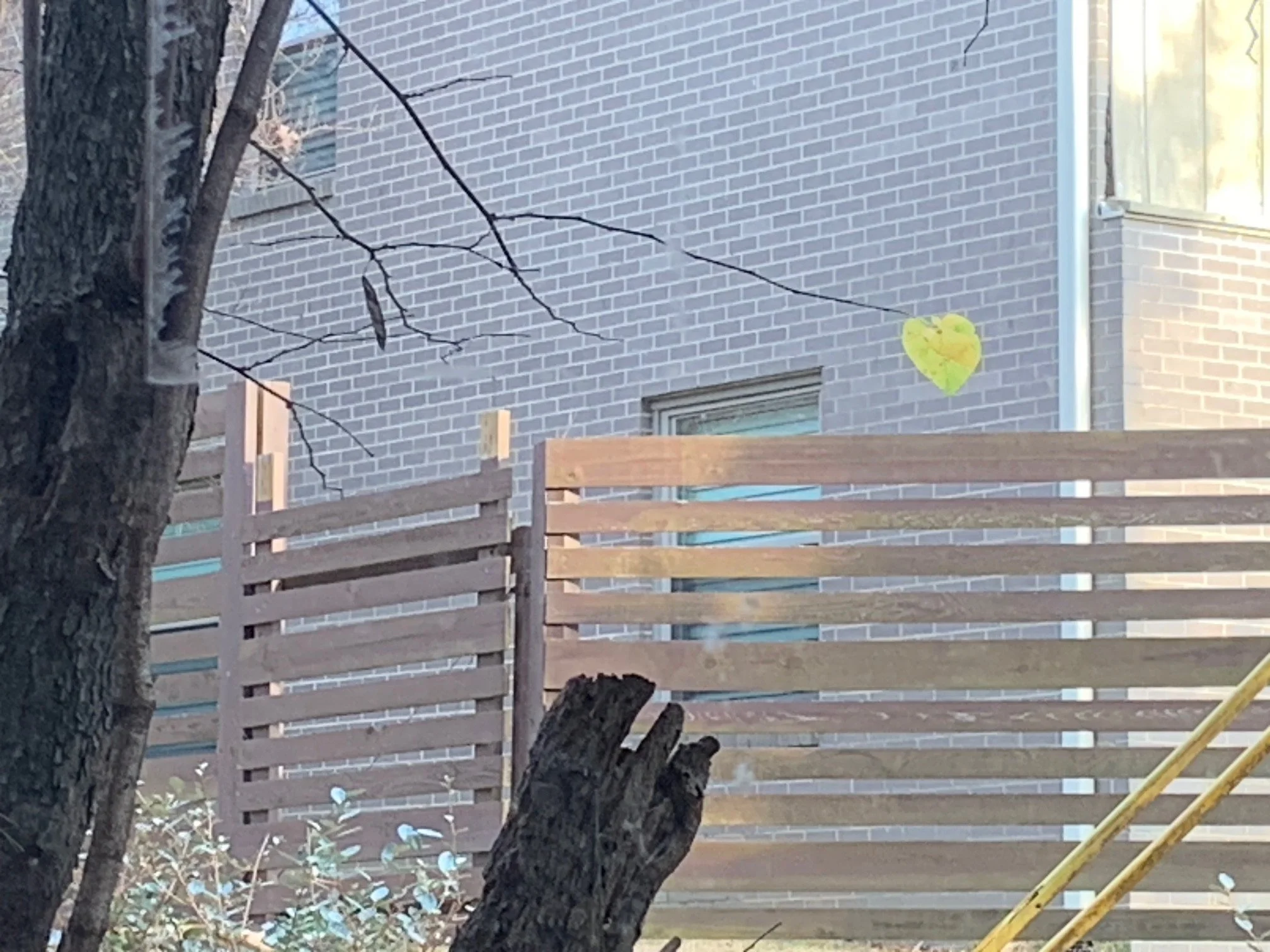
 A single autumn leaf has been clinging to the wood frame of my office window for weeks. It is the first and last thing I look for as my day begins and ends. It reminds me of one of my favorite O. Henry short stories, “The Last Leaf.”

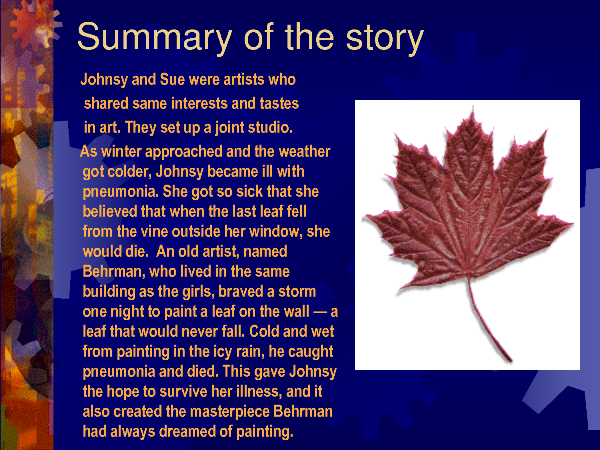
A young artist in New York’s Greenwich Village at the turn of the last century loses her will to live and succumbs to pneumonia. She watches from her window as the cold winter wind blows leaves from a tree branch growing along the side of an adjacent building. She decides that when the last leaf falls, she will die.

She eventually watches the last leaf miraculously remain on the tree until she regains her will to live. Later, she discovers that an older artist in her building, whose realistic paintings rarely sell, has heard her story. He spends a night in the cold and icy rain while she sleeps, painting a leaf on the wall of the building. Shortly after he paints “his masterpiece” to save her life, he also dies from the pneumonia epidemic.

Of course, the story is one of sacrifice and love for another human being, reminiscent of the Good Samaritan story. It is also a story of hope. How do we offer people the hope that they will not remain in despair? There is a promise of Easter after every Good Friday experience.

But that promise of light in the darkness can be difficult without the help of others. The darkness forgets what light is like. We see and read about this hope from others. The story of old Simeon and Anna at the temple in Jerusalem at Jesus’ presentation reminds us of the promise that the Christ Child will always come to us as we wait.  

I also see this story about the use of our gifts and talents. We may think our abilities are minor compared to others, maybe even worthless. But there will be a time when what we offer is precisely what someone else needs. We will be called to use our talent at the right time when others may not be there to help.

Advent is a time to watch, wait, and pray that we will be open to offering what we consider our “insignificant masterwork,” which will make a difference in another person's life.

Joanna. joannaseibert.com