Bishop Hibbs: The Jesus Prayer

 Bishop Hibbs: The Jesus Prayer

“Lord Jesus Christ, Son of God,

Have mercy on me, a sinner.”

I remember being at Camp Allen in Texas for the first time at a Community of Hope International meeting with Mary Earle as the keynote speaker. As I look over her books, I find this newly published 20th-anniversary edition of An Altar in Your Heart: Meditations on the Jesus Prayer by Bishop Robert Hibbs with a Foreword by Mary Earle.

The Jesus Prayer has been my mantra in the early morning and at bedtime. I pray the words during any time of anxiety, fear, or temptation during the day or night, especially during medical tests or procedures for my family and me. It is my feeble attempt to pray without ceasing.  

I have known Bishop Hibbs for years through work with the Episcopal Recovery Community, but I was not aware of his work on the Jesus Prayer. As I share my connections with Bishop Hibbs with Mary, I learn he died a year ago in April. Mary preached the homily at his service.

I thank and honor him for the support he gave me and so many others in recovery by sharing this book with you. An audio CD of his lectures at a retreat is included in the book. The Cajuns call this a lagniappe, a little something extra. For years, Bob Hibbs was the primary voice for recovery in the Episcopal House of Bishops.

Saying the Jesus Prayer is like using a prayer rope or beads in our heads. Bishop Hibbs relates the story of Cardinal Mindzenty and Father Eschmann, who survived torture and solitary imprisonment by staying connected to God with the Jesus Prayer.

The first words of the Jesus Prayer, “Lord Jesus Christ, Son of God,” remind us of Jesus’ divinity and his humanity. Hibbs believes this is essential in keeping us in a relationship with Jesus. These first words of the prayer, with Jesus’ name, express Easter, the Alleluia part of the prayer.
The last phrase about mercy expresses the meaning of Good Friday. At this same conference, Sister Carol Perry reminds us that in this request for mercy, we ask for God’s mercy rather than God’s justice for how we have lived. Hibbs believes we always live in the tension between Easter and Good Friday.

Bishop Hibbs reminds us that this is an oral prayer that can be said aloud whenever possible, making the Jesus Prayer part of our being. He cautions us not to be discouraged, as we become distracted while we say it.

Instead, we gently return to the prayer without judgment on ourselves. Treat distractions in the same way we encounter in centering prayer. We might see them as barges moving down the Mississippi or any favorite river. We are to let them pass on down without interacting with them.

Eventually, the prayer develops a rhythm in our lives. It becomes a gift from God, closely related to the beating of our heart, a constant, habitual recollection or awareness of God’s presence. Hibbs also reminds us that when we pray the Jesus Prayer, we attempt to connect to Jesus, God, the Trinity above and beyond us, and to Christ in our neighbor and ourselves.

For people in 12-step recovery, this is where the steps intersect with the Jesus Prayer, as we “sought through prayer and meditation to improve our conscious contact with God.” (Step 11, Chapter 5, “How it Works,” Big Book of Alcoholics Anonymous, 2016, p. 85)

Sometimes, I modify the prayer to the Agnus Dei, the fraction anthem, after breaking the bread in the Eucharist. “Lord God, Lamb of God, that takest away the sins of the world, have mercy on me.”

While we meet with someone for spiritual direction or with spiritual friends, we give them our utmost attention. However, having the Jesus Prayer running through our mind and body is a way to stay connected to the Spirit, speaking to Christ in both of us.

Joanna  https://www.joannaseibert.com/


Seeing and LIving in the Present Moment

   Richard Rohr, Poe: Seeing and Living in the Present Moment

  “Most people do not see things as they are, because they see things as they are!” Which is not to see at all. Their many self-created filters keep them from seeing with any clear vision.”

—Richard Rohr, Center for Action and Contemplation, daily Rohr Meditation.

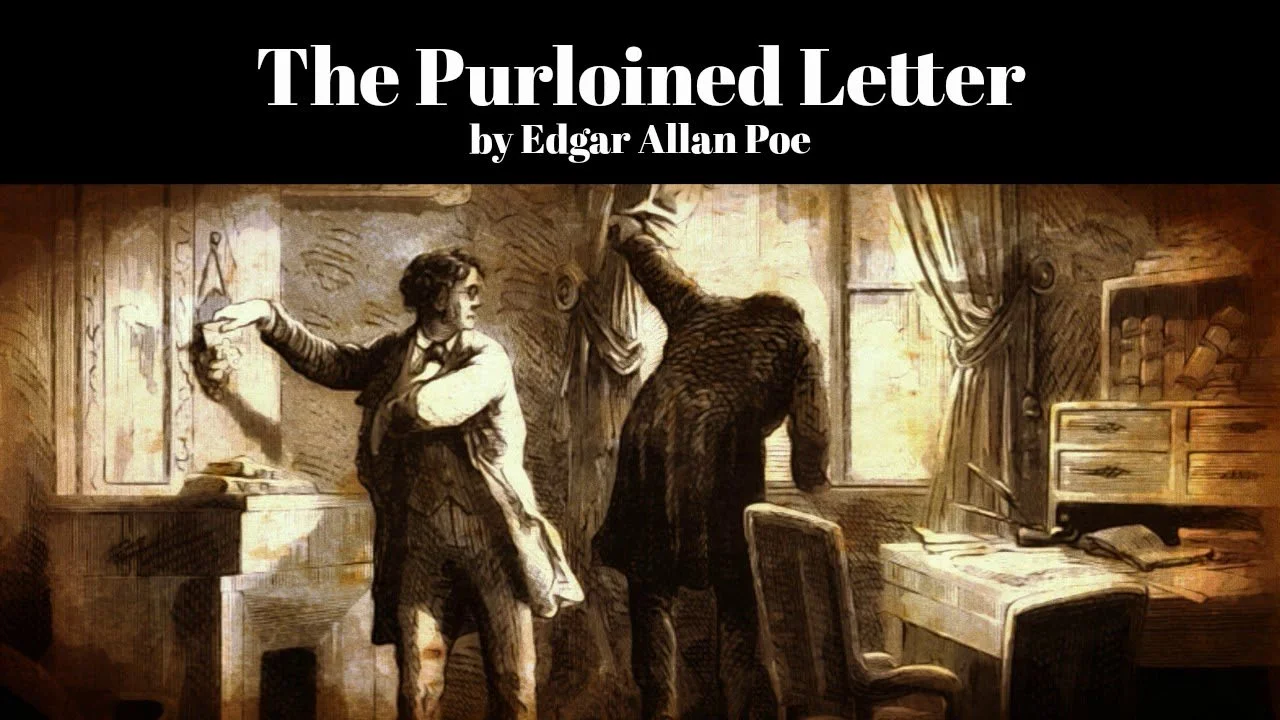
Edgar Allan Poe also gives us more clues about having a clearer vision in “The Purloined Letter.” The Paris police chief asks a famous amateur detective, C. Auguste Dupin, to help him find a letter stolen from the boudoir of an unnamed woman by an unscrupulous minister who is blackmailing his victim. The chief of police and his detectives have combed the hotel where the minister lives, behind the wallpaper, under the carpets, examining tables and chairs with microscopes, probing cushions with needles, and found no sign of the letter. Dupin gets a detailed description of the letter and visits the minister at his hotel.

Complaining of weak eyes and wearing green spectacles, he disguises his eyes as he searches for the note. Finally, he sees it in plain sight, in a cheap card rack hanging from a dirty ribbon. He leaves a snuffbox behind as an excuse to return the next day, and switches out the letter for a duplicate.

Rohr is calling us to put on a new pair of glasses, perhaps 3-D glasses, to see the depth of what is in plain sight immediately around us in the present moment.

Guides and friends in our community, and especially children, remind us to meet God in the present moment. They remind us to listen to God’s call to live in the present moment, especially as we heard together the stories of the season after Epiphany in our Sunday Lectionary readings.

Epiphany means an illuminating realization.

 The season after Epiphany has called us to see more clearly and live in the present moment. We have a few more days to ponder this before Lent.

St. Francis: Hoeing, Gandhi: Dying

St. Francis: Hoeing, Gandhi: Dying

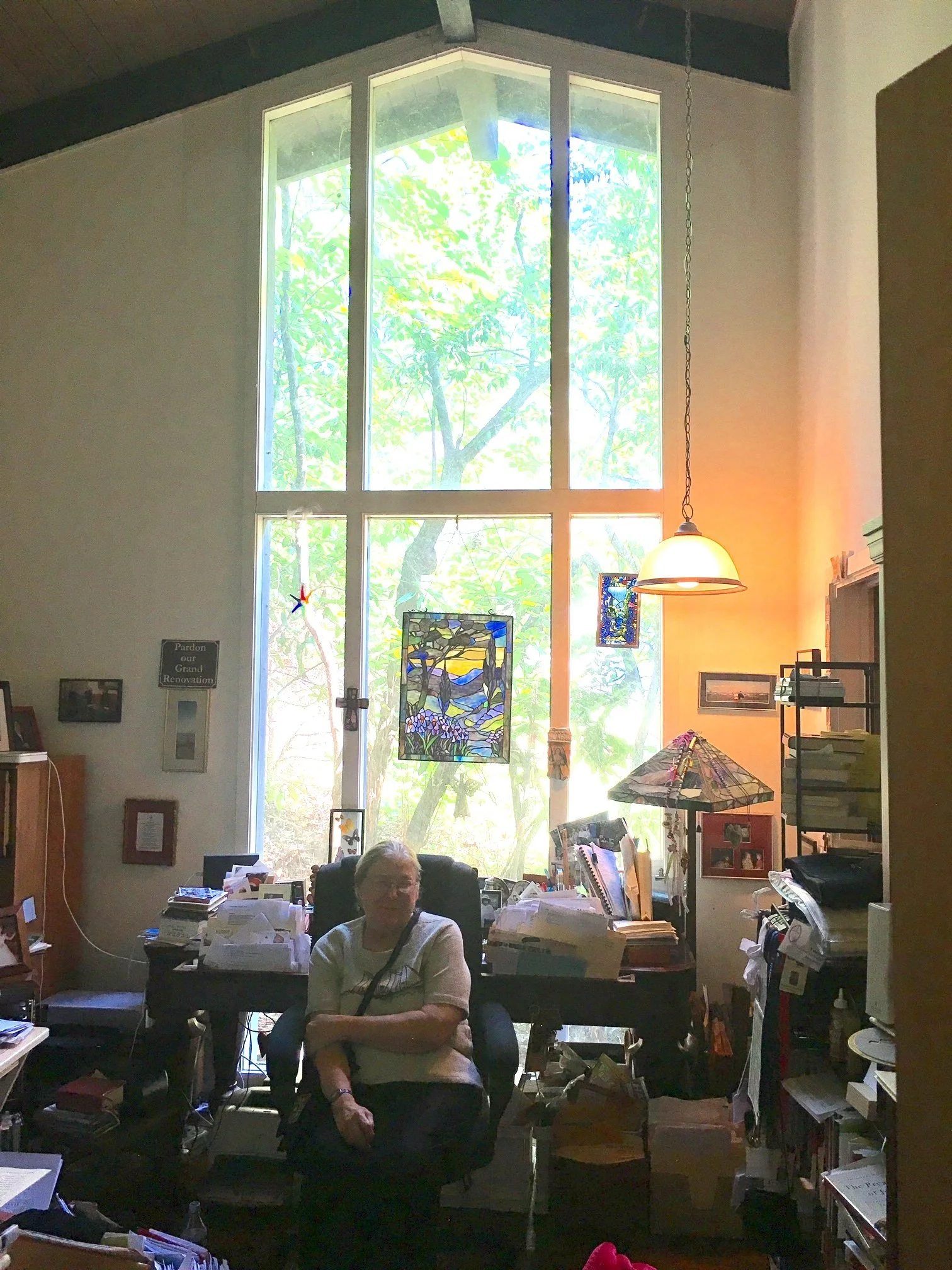
my office

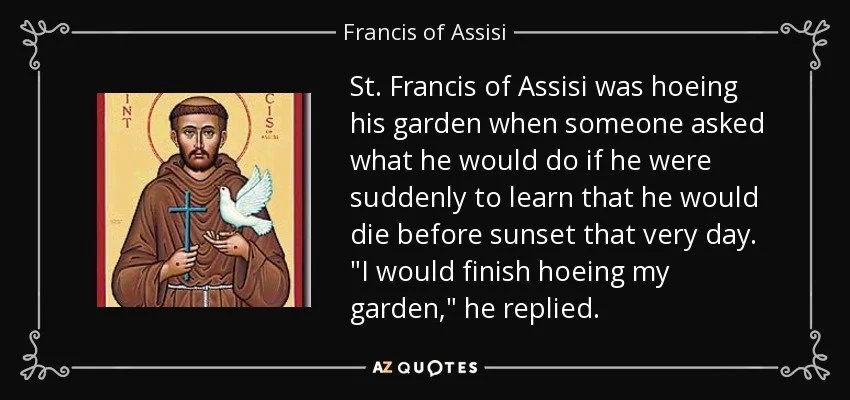
“Saint Francis, hoeing his garden, was asked what he would do if he knew the world would end tomorrow. ‘Continue hoeing my garden,’ said the saint.”—Suzanne Guthrie, Synthesis Today, Quote for June 15, 2018, attributed to St. Francis.

I have often heard this phrase attributed to St. Francis and wondered what I would do if I knew I was about to die.

I have made writing a daily discipline for several years. But would I keep writing? Writing has become one of my best spiritual practices. As I look outside at trees, birds, and sky from the floor-to-ceiling window in my office, and my fingers hit the keyboard, I feel the peace that I hope is God’s presence.

My sacred space at home is in front of a large window at my desk in my office, which was once our daughter’s room when she was growing up. There, I write surrounded by family pictures, icons, and remembrances of days of joy. I would ask for prayers for the good pray-ers I know, especially the women in the Daughters of the King. I would also pray at other sacred spaces if I could visit them.

 I certainly would spend as much time as possible in my last days with my family. I might entice my grandchildren to watch a movie with me and then secretly watch them. I would want to be with my husband as much as possible. I want my family and friends to know how much I love them through my actions and words. I would like to have a meal with my family and friends. I would look at old pictures to keep memories with me.

Of course, if everyone else knew the world was ending, seeing how our paths might cross would be interesting!

So, what does all this mean?

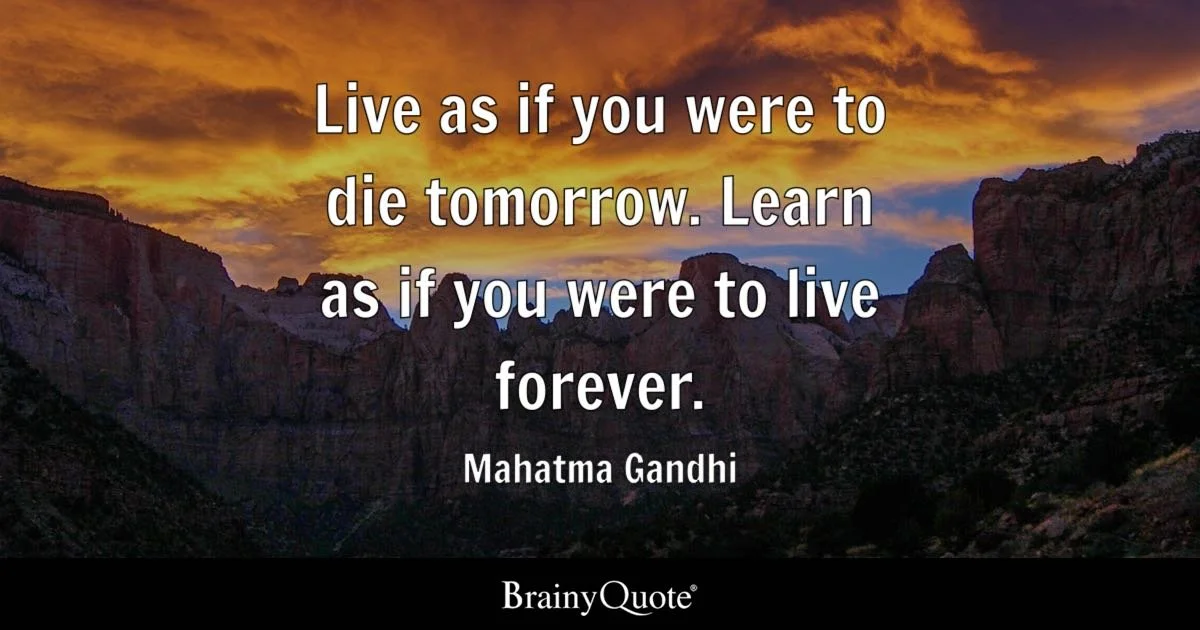
“Live as if you were to die tomorrow. Learn as if you were to live forever,” is attributed to Mahatma Gandhi.

I carry these quotes from Gandhi and St. Francis daily and share them with spiritual friends. The quotes are an excellent daily benchmark for assessing whether we are doing the practices that bring us closer to God.
Gandhi’s quote is a paradox, an anchor metaphor for our life, a constant, ambiguous paradox.

Each day, I try to spend more time meditating on quotes from authors like these, who help us connect with God, our true selves, our neighbors, family, and friends.
Of course, often, the connections lead us to other places, and we pray to stay open to these new adventures.