Earth Day Again

Earth Day Again

DOK Western Missouri

“Oh, Earth, you’re too wonderful for anyone to realize you. Do any human beings ever realize life while they live it—every, every minute?”— Thornton Wilder, Our Town.
Emily speaks these memorable lines in the play Our Town after she returns to earth for one day in Grover’s Corners following her young, untimely death at age twenty-six. In the Thornton Wilder play, she chooses to revisit her twelfth birthday and soon returns to her grave—when she can no longer bear watching the people she loves barely interact with one another. They seem unable to appreciate the joy and wonder of each new day together, and fail to see the Christ in one another.
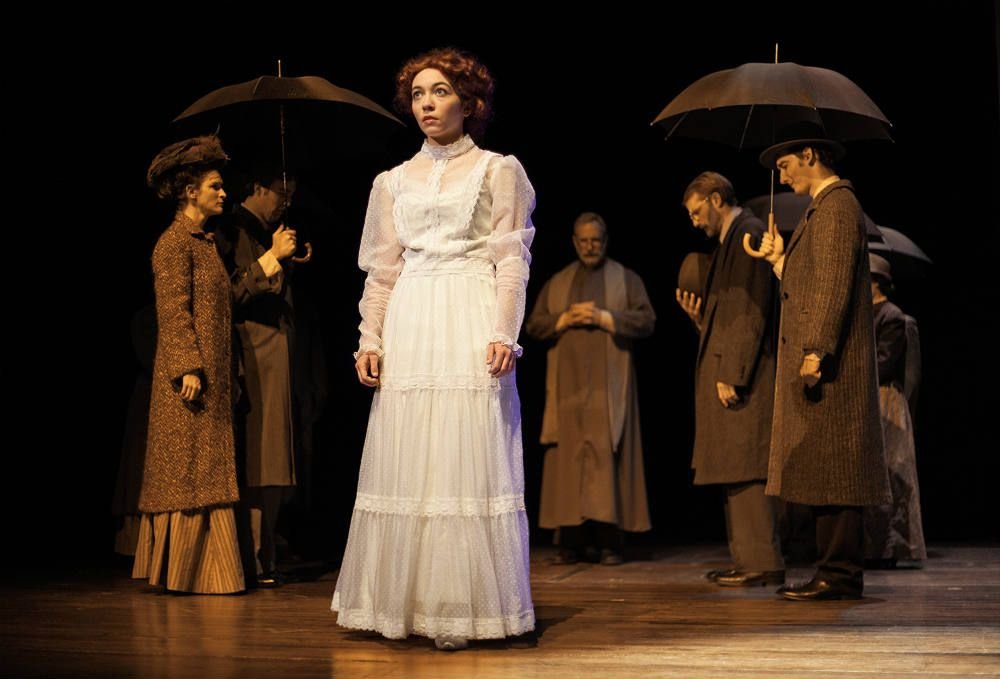
Emily in Our Town

I am reminded of a past Earth Day when I listened to music about the earth, such as Beethoven’s Sixth Pastoral Symphony, as we traveled from a reunion in Virginia to the Gulf Coast. Hearing this symphony immediately brings back memories of our four years in Iowa City. The music served as the backdrop for a visual production of Iowa’s outdoors called Iowa, A Place to Grow, a reminder to bloom where we were planted and to appreciate the beauty of the earth and the people of that state.

I remember the first Earth Day in 1970. It was the day my husband of six months left for Vietnam for a year. I was pregnant with our first child and felt sorry for myself. I spent the day watching the Earth Day celebration on our small black-and-white television and stripping the wax from our kitchen floor. I knew I had to channel the energy generated by Robert’s departure into something useful. I wish I could write here that I planted trees, but my kitchen floor was as far as I got. 

I do remember one Earth Day trip when we drove through a gentle rain. The car radio played American composer Alan Hovhaness’s tribute to a beloved tree on his uncle’s farm that was struck by lightning, “Under the Ancient Maple Tree.” The best I could do that day was enjoy the ride, give thanks for the rain, and be grateful for the bountiful green trees keeping us alive along Interstate 85. Today, that Earth Day, feels even more meaningful because lightning recently struck a tree in our backyard, so close to our house. We hope to care for that tree, knowing it took a hit for us.

I wish I could say I participated in extraordinary events to care for and thank our Earth, especially its trees, on the other fifty-five Earth Days since that first one. Still, I honestly cannot remember many Earth Days.

I think of my father, a forester who led hundreds of expeditions to plant pine seedlings. I remember, on trips, how he often pointed out the tall trees he had planted. Now, many years later, I thank him for his plantings. I know he would be proud of our daughter, Joanna. She also has a master’s degree in forestry, taught wilderness classes at the University of Montana, and is a master outdoors lover.

From my father and daughter, I have learned that our environment, the outdoors, and especially trees, keep us grounded in the present moment. I think Emily in Our Town speaks to this present moment, where we learn to appreciate each precious gift of time, especially time with those we love.

My experience is that I live most consciously in the present moment when I am outdoors, seeing the trees and plants. I realize that something more significant is happening than the past and future, with which I am so preoccupied.

I am reminded of Parker Palmer’s thoughts that, as trees photosynthesize light into chemical energy, they also photosynthesize, transforming our energy when we are outdoors.

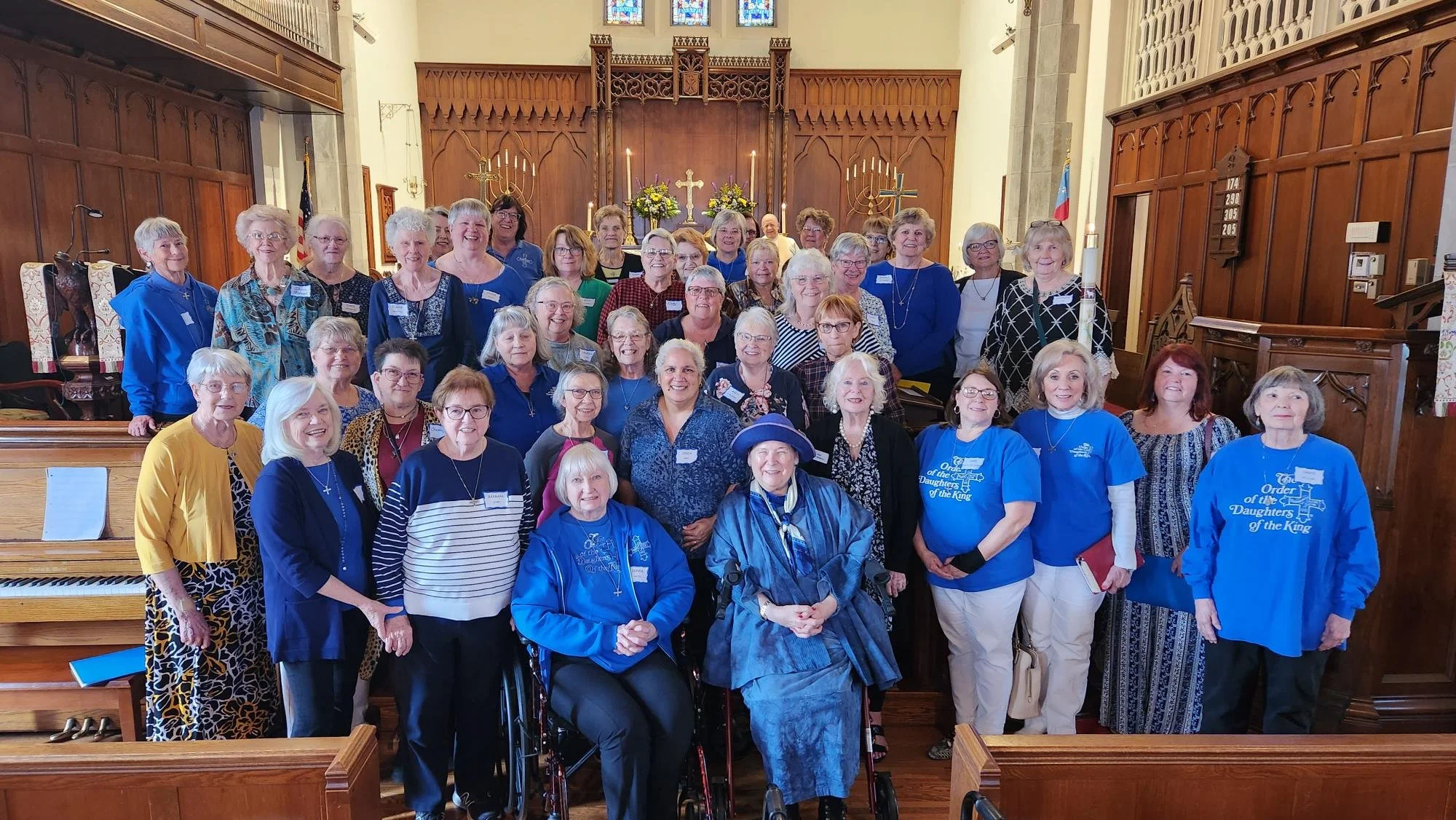
On a recent Earth Day, we drove through northwest Arkansas and western Missouri to meet with more than fifty Daughters of the King from the Diocese of Western Missouri. The trees, especially the cedars, along with the rolling hills, creeks, and bridges, were stunning, as were these extraordinary women. We talked a lot about living in the present, and we experienced it that day as well.

C. S. Lewis, so many others, and now Emily all remind us that the present moment, not the past or the future, is where we meet and recognize God in ourselves, in each other, and in nature. Caring for and being in nature is one of the best ways to know the Creator, the God of Love.

I hope that if we can live as much as possible in the present moment, savor it, and let love be our guide, we may be able to overcome our social and warring unrest better than before.

Joanna. Joannaseibert.com https://www.joannaseibert.com/
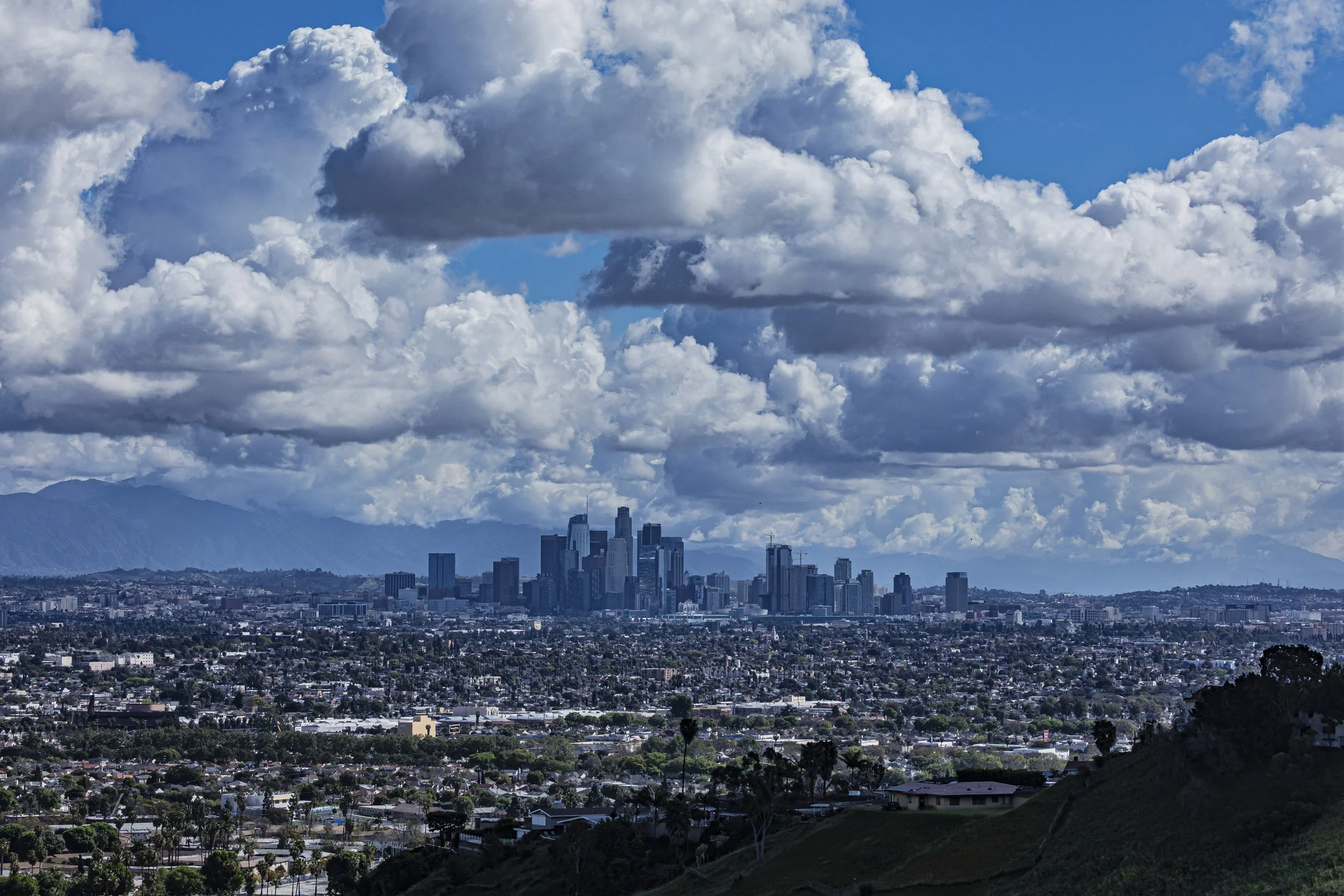


Return of Blue Sky on Earth Day

Charleston: Return of the Blue Sky on Earth Day

ted soqui NBC News

"Did you notice any stories about the return of the blue sky? Unfortunately, there were not many, and they were usually tucked away behind other news reports that seemed much more critical. But they were there: the return of clear skies above cities like Los Angeles, which had not been seen for generations. As traffic levels declined, pollution fell, and the clear sky appeared like a sign from heaven. It is a visual reminder that positive change is possible on the other side of COVID-19, not just for the environment but for our whole society. The blue skies can return for us in many ways if we have the courage to change."—Bishop Steven Charleston's Facebook Page.

Today, we celebrate the 56th anniversary of Earth Day. During the pandemic, Bishop Charleston reminded us that efforts to stop the pandemic had given our planet a rest. As a result, pollution and greenhouse gas emissions fell worldwide. For example, India's capital, New Delhi, is one of the world's most polluted cities. Yet its skies were blue, and many could see the Himalayas for the first time. 

Researchers found a 5 to 10% decrease in air pollutants, such as carbon dioxide, in New York. Carbon monoxide emissions dropped by 50%. Grounding flights, reducing cars on the road, and shutting down businesses and factories brought about the change. Some predicted we might reach the Paris Climate Accord goals even sooner. In Venice, canal water was so clear that fish were easily visible. This may be because there are no boats and people in its waters. But environmentalists warn that all this could be temporary. 

Today, all of this has come at a great cost—the deaths of more than one million people in our own country and more than 7 million worldwide. We can only guess what tomorrow will bring if another flare-up of infections occurs.  

Bishop Charleston tells us to give thanks for the blue sky, honor its presence, imagine ways to keep the skies blue, and never forget the cost in the lives of so many who died. There must be another way to save our planet that is less costly.

Joanna. Joannaseibert.com. https://www.joannaseibert.com/


A Memory Book of Past Easter Vigils

A Memory Book of Past Easter Vigils

How blessed is this night when earth and heaven are joined, and man is reconciled to God.”—Book of Common Prayer (Church Publishing, 1979), p. 287.

I revisit this past Holy Week and especially remember beautiful stories about the excitement of the Easter Vigil at each church where I served. I remember one priest telling us in his homily many years ago that our presence at the Vigil didn’t earn us extra points with God. We weren’t getting more stars in our crown for being there. Being among the first at the empty tomb was a privilege to meet the risen Lord. 

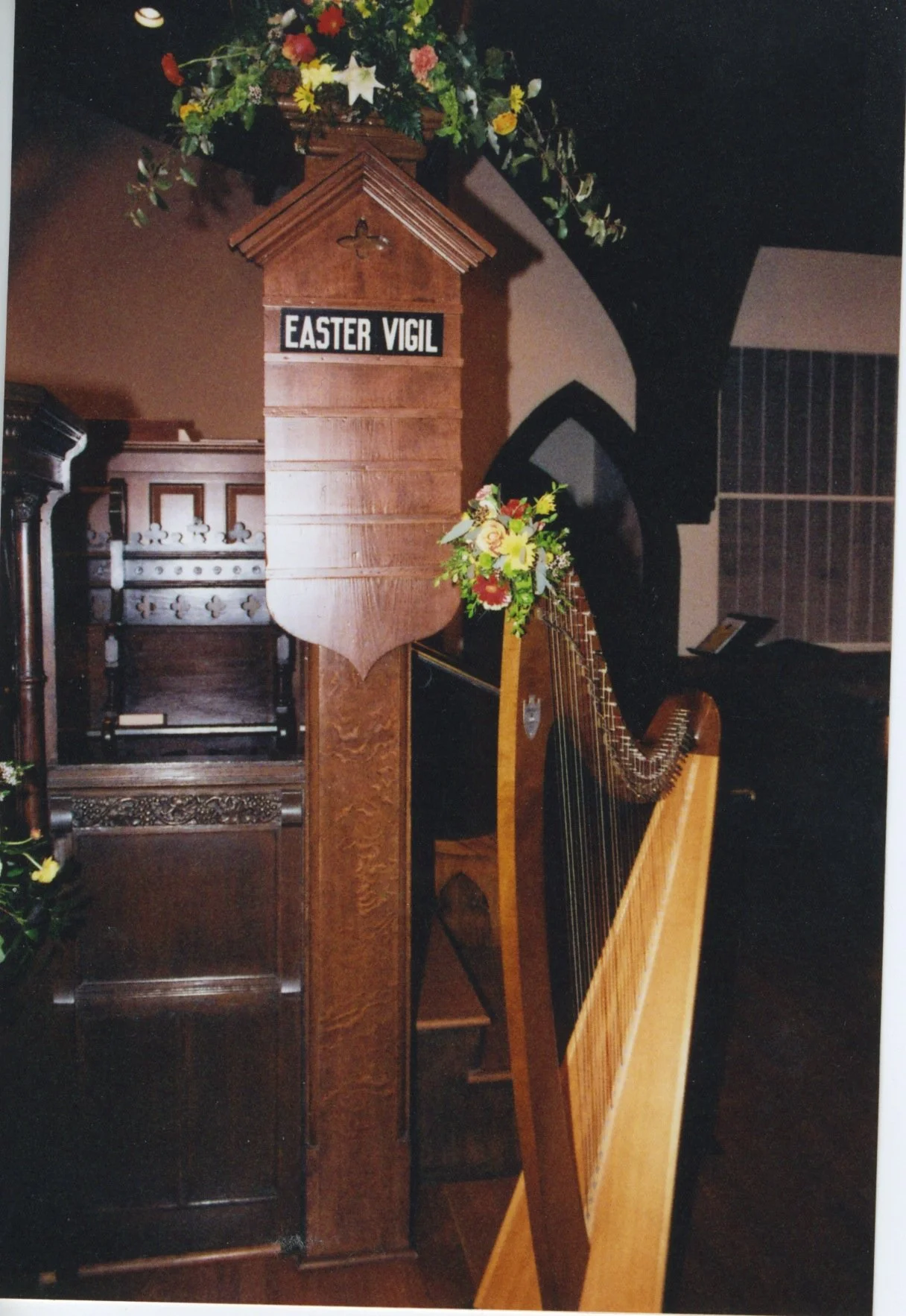
One of my favorite surprises was watching to see how the Altar Guild would decorate my larger harp for the Easter Vigil.

Many congregations then follow the Vigil service with an elaborate reception or dinner late at night at church or someone’s home.

Once at Trinity Cathedral, as the deacon tilted the candle ever so slightly to light its wick from the first fire, oil ran out of the top of the candle, and the flames took on a surreal quality, like the tongues of fire described at Pentecost. At St. Margaret’s, we held the Vigil in the Columbarium garden, and I played a smaller lap harp to keep the Exsultet on key as I chanted. I cannot describe the exhilaration of shouting in the open air, “The Lord has risen indeed!” 

At St. Luke’s, a lector reading one of the Old Testament lessons had difficulty seeing in the dark. In the middle of the long reading, my dear friend moved her candle closer to the lectern microphone, which set the microphone’s foam covering on fire. She promptly and elegantly blew out the fire and didn’t miss a beat in the reading. Also, at St. Luke’s, one of the fantastic teachers in the children’s ministries and her two children planned a flashlight egg hunt for older children after the Vigil. The young people searched outside around the church, and it was a huge success that increased the number of people who came to the service! 

If you look online at a virtual Vigil during the pandemic at St. Mark’s Episcopal Church, the Easter fire looks like it is coming out of the air! Spectacular!

It is now more contained, but still very moving.

We recently handed out bells for people to ring during the Great Alleluia. At the end of the service, our other deacon, Susan, and our associate priest, Patricia, spontaneously began ringing their bells whenever the closing hymn, “Christ the Lord is Risen Today, Alleluia,” reached an Alleluia. The congregation soon joined in ringing their bells. It was incredibly moving, since we could not sing because of COVID restrictions, but we could ring!


The Vigil is so unusual that it is easy for clergy to get caught up in the many tiny details of this once-a-year liturgy and to view it as a performance rather than an offering. The Vigil is a service to be enjoyed and celebrated.

We can always count on the Vigil to bring surprises, as it did this year and at that first Easter.

Joanna. joannaseibet@me.com