Guides Along Our Spiritual Journey

Prayer and Temperament: Guides Along Our Spiritual Journey
Myers-Briggs Personality Types

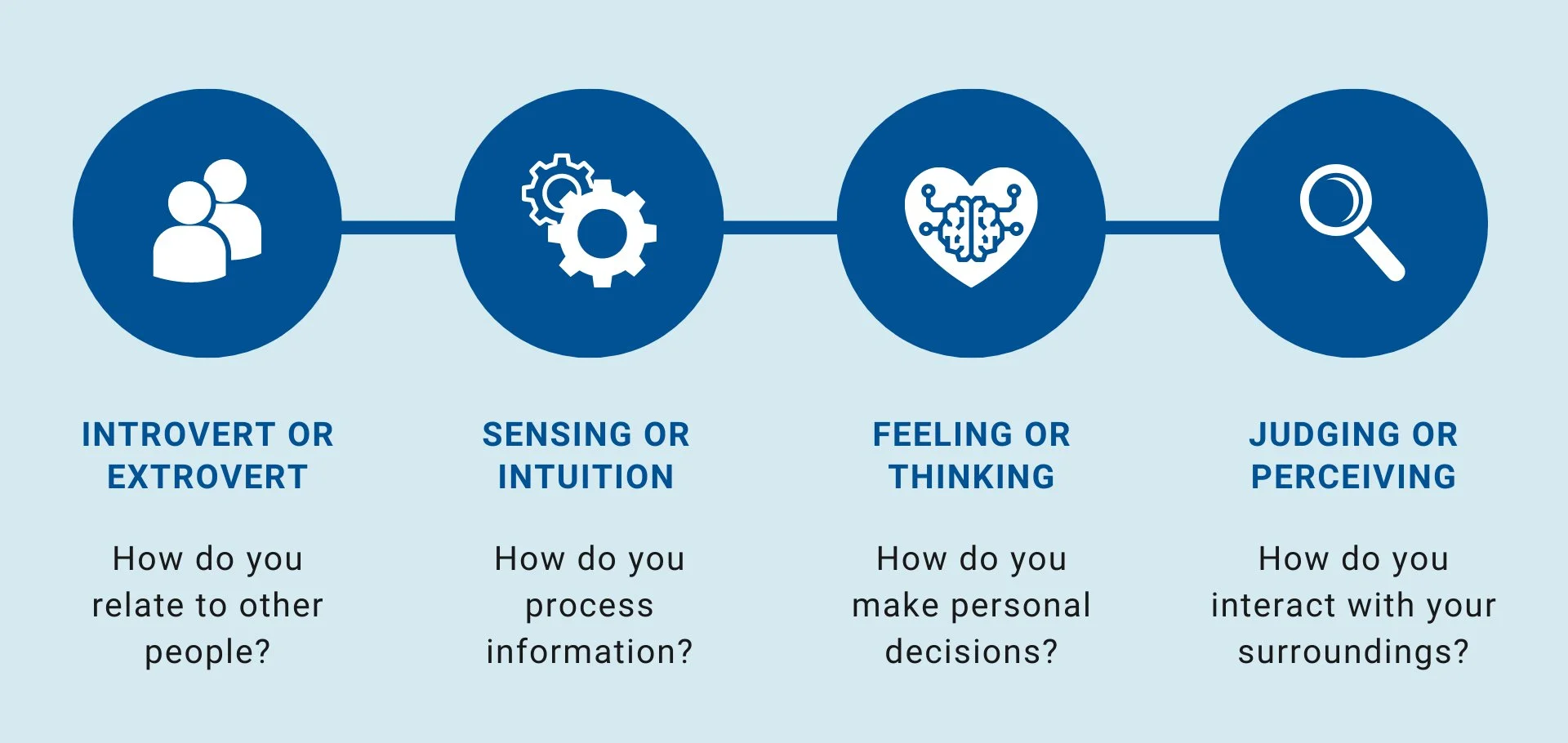
The Myers-Briggs Type Indicator is based on Carl Jung’s theory of psychological types, which describes personality preferences in four areas.

1 How do you get your energy, and where do you focus your attention? Introvert (I) vs. extrovert (E). Do you get your energy from within or from outside yourself?

2     How do you gather information? Sensing (S) or intuition (N)? Do you gather factual data, or do you consider possibilities?

3     How do you make your decision? Thinking (T) or feeling (F)? Do you decide based on logic or on relationships, and what is of value?

4     How do you deal with the world? Judging (J) or Perceiving (P)? Do you approach the world in a planned, organized way, or are you more flexible and spontaneous, keeping options open? When a problem arises, do you seek closure or keep gathering data?—David Keirsey and Marilyn Bates in Please Understand Me, Character and Temperament Types.

The Myers-Briggs Indicator test has been so helpful in understanding myself, my family, and those I work with. The above is, again, a brief, very basic summary. There are also many books about it and tests you can use. When I talk to spiritual friends, I suggest they connect with a group or therapist who uses the indicator.

I remember how helpful this was in my medical practice. We soon learned that we needed all types in our group. We needed Js who wanted closure in solving problems, and Ps who tried to look at all the possibilities before deciding on an answer. We needed Ts who wanted our group to look at what was logical, but we needed Fs who looked at what was of value. We needed partners who were Is in our practice, who did not speak until they had processed an answer, but we needed Es who solved a problem by thinking outside the box and vocalizing their thought process. Finally, we needed Ss who looked at concrete data, but also Ns who looked at possibilities. 

So, the indicator can help us live life on life’s terms, both personally and in community. But how does it help our spiritual journey? Stay tuned. Knowing our type can help us choose the prayer practice that best connects us to God.  

Joanna. https://www.joannaseibert.com/
 

Carrying Heavy Burdens and Listening to the Rain

Charleston: carrying heavy burdens and listening to the rain

Spotify

“I know you carry a heavy burden, one you do not often share. I see its weight, even behind your hopeful smile. Let me hold it for a while, trusting it to my safekeeping. I would like to see how high you can fly without it, how far and how wide. High enough to see a path before you. Wide enough to give yourself options. Long enough to let you breathe the clean air of an open sky. Take your time. There is no hurry. I will be here, praying for you when you return, holding something that suddenly seems lighter.”—Steven Charleston

I hear the gentle rain on our roof as I read Bishop Charleston this morning. I imagine my worries being washed away as the rain rolls off our roof. I think of the third step in 12-step recovery, “turning our lives and our wills over to the care of God.” We often forget the last part of that sentence. God is taking care of all our concerns. Caring for them. As I imagine this, as I pray it, for seconds, I feel free. I do not have to be in charge of the world any longer.

Of course, it is our custom to keep taking our concerns back, as if God were not able to handle them. Amazing that we do this. This morning I have a little “taste” of freedom to become the person God created me to be, instead of worrying about the rest of the world. I am embarrassed to say that I once believed that if I worried about something enough, it would never happen! Another example of how our amazing minds can trick us.

This morning, I am listening to the rain.

Pinterest

Joanna joannaseibert.com


Charleston: Learning to Read Spiritual Signs

Charleston: Learning to Read Signs in a Spiritual Life

“You have seen the signs around you for some time now. You are beginning to understand which way the wind is blowing. The spiritual life is not an exercise of imagination but of interpretation. We see the signs. Understanding them as a coherent message requires skill. The handwriting on the wall tells us nothing unless we have learned to read.”—Bishop Steven Charleston, Facebook Page.

“Learning to read the signs on the wall.” Bishop Charleston offers us a helpful metaphor for living and discerning the spiritual life. As spiritual friends, we help each other see where God works in our lives. We have friends who help us connect the dots, suggesting that a storm may be coming when we miss the signs. We are called to remember how God led us in the past. We have seen the signs. When one of us cannot presently see the signs of God alive in our lives, those who can see them help each other. 

This is why God calls us to community. We cannot do this alone. Our spiritual practices, including prayer, contemplation, study, Centering Prayer, the labyrinth, praying the Rosary, and intentional walking, help us interpret the handwriting on the wall—the hand of God caring for us, leading us, and never abandoning us. We practice some spiritual disciplines by ourselves; others, such as corporate worship, we practice together. Whether we experience these disciplines alone or together, we are called to share what we learn with one another. Discernment about where to go or what action to take next is most effectively realized in community.

I have friends who sit alone to meditate and say they perceive the direction God calls them to in their lives. By listening, they discover what they should do. All the better for them. I could never do this except on rare occasions.

My experience is that others notice signs I have missed, and the course of action I should take is readily apparent to them. All of this, of course, requires much trust and life in a community.

I was continually amazed at how our children, grandchildren, and some older adults learned to stay connected during the pandemic—Zoom, Facebook Live, game apps such as Kahoot and Scrabble GO, watching movies together via Watch2gether and Netflix Party. But, of course, this is just the tip of the iceberg! Isn’t it wonderful that we learn to do all these things from our younger generation!

Joanna. joannaseibert.com.  https://www.joannaseibert.com/