Watercolor Painting: A Quest
Guest Writer and Artist: Ken Fellows
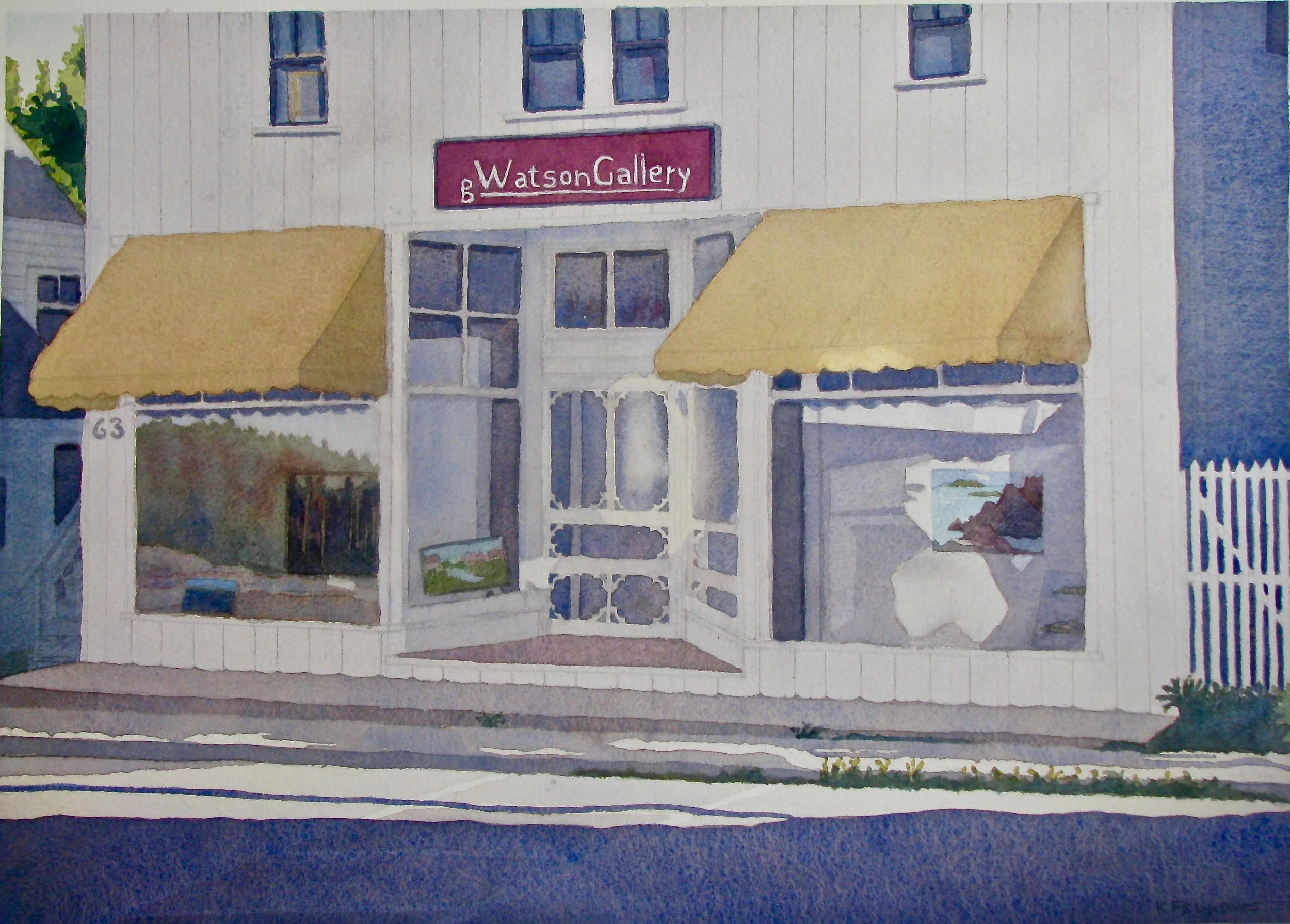
Years ago, I developed an interest in watercolor art. Trying on my own, I wanted to paint more than anything, and I did.
I’ve now been painting for over 25 years. Before I started painting, I was a radiologist who spent nearly 40 years contemplating black-and-white images. My gray-scale discrimination is pretty good, and perhaps that’s why my paintings feature the effects of lighting (a doctor colleague observed at one of my shows: “Well, Ken, I see you’re still dealing in shadows.”)
Interpreting X-ray images requires subconsciously rejecting what is unimportant or extraneous and focusing on the unusual, the variant, and the arresting. The same holds true for painting. When I paint, I strive to isolate the essential and defining elements of a scene, leaving out the mundane or distracting. Art teachers instruct that what is left out of a painting is as important as what is included. Sometimes, deciding what to leave out can be difficult; it complicates the pursuit of every new piece of art.
A revered local artist, Dewitt Hardy, was my favorite teacher. He was a master watercolorist. His criticism of my work was that my paintings were often “too graphic.” Others have observed, not always admiringly, that “your work looks like a photo.” I offer no defense, even if my style is unintentional.
I often use personal photos as references for a painting, but I’ve studied and sketched most scenes on-site before attempting the final rendition. Photos are only helpful when I’m back in my studio, to recall the ambient light and shadows. Everything else – the objects, shapes, proportions, and colors – is a candidate for exclusion or change.
Whatever viewers think of my work, if it’s in a show, it has already passed my severest critics—my artist/wife Kristin; my photographer/daughter Hannah; and my grandchild Ella (who invariably recommends, “Grandpa, not enough color”). They have discerning eyes and good judgment. If they disapprove, the public never gets to see the work. More than 70 of my paintings have been invited to public shows. I’ve been very fortunate to find this a gratifying ‘2nd act’ in my life. Even though many of my paintings have sold, I’ve never kept track of how many. It’s also been a pleasure to gift a number to friends, family members, and fellow artists. Like most artists, I live with the fact that after I’m gone, a number of my creations will eventually be relegated to scrap piles.
The real joy and contentment I derive from my painting come from the satisfaction it provides and the mindfulness and contentment the process creates. Most painting sessions are as mentally beneficial as the best times of meditating or the hours spent with good friends and loved ones.
How fortunate I’ve been to stumble upon the joys and rewards of painting with watercolors.
Ken Fellows
Joanna Seibert joannaseibert.com