X-Ray as Art
Guest Writer: George Taylor
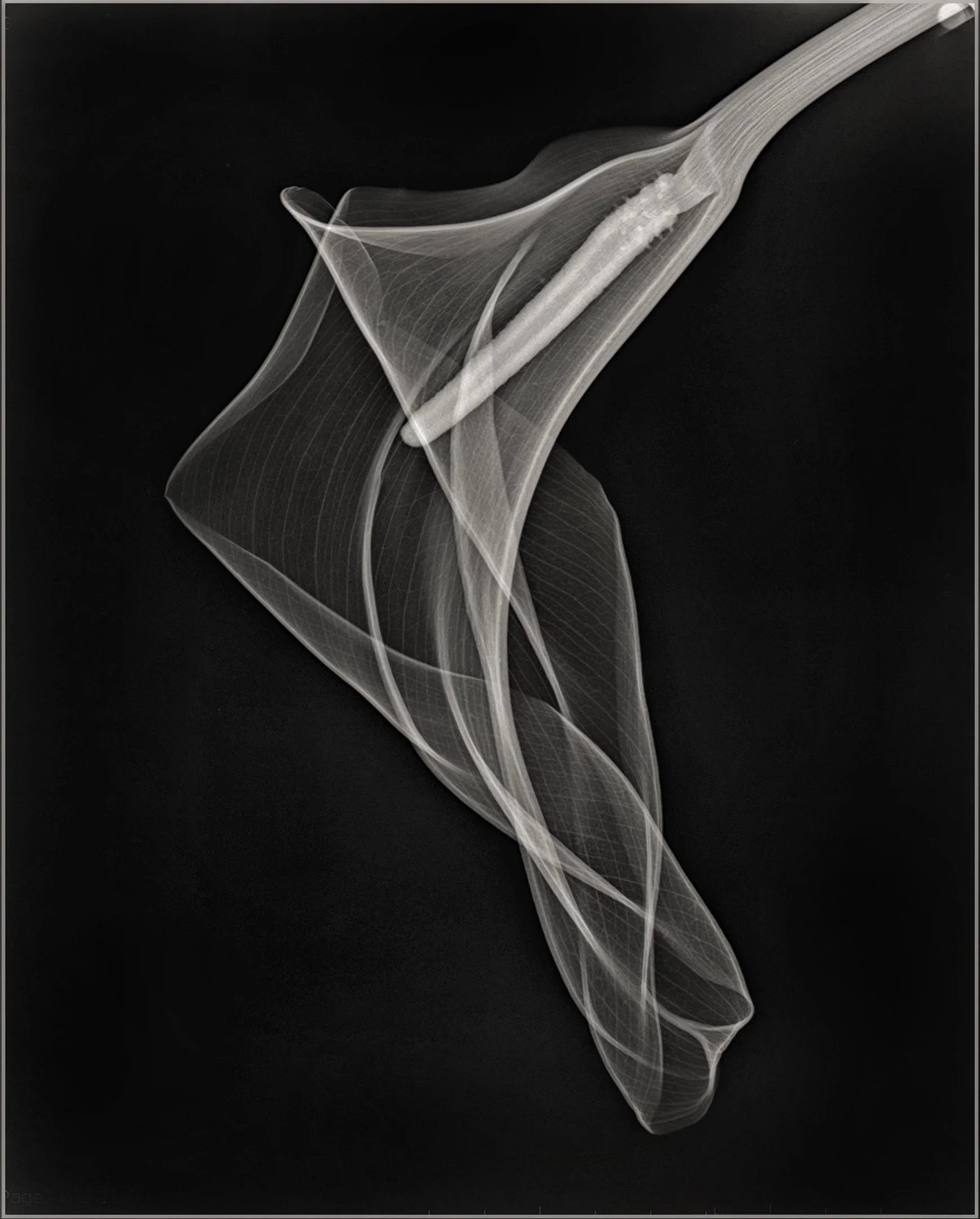
white Calla Lilly
In 2002, my “photography” took another unexpected turn when we acquired a digital fluoroscopy unit (a device that captures still and video X-ray images). We needed a moving target to simulate blood flow in the arterial system, so we put two fish in a bowl and took an X-ray movie of them swimming around. The resulting image was a lovely translucent yin-yang pattern formed by the two circling fish.
I became fascinated by the potential of radiography as art and began experimenting. X-rays allow us to use highly sophisticated technology to create a photogram, one of the oldest and simplest methods of reproducing an image.
I began to image flowers on a whim. Whatever the underlying drive, one thing is for sure—I had an epiphany that day. When the first image appeared on the computer screen, I immediately recognized the haunting similarity between the plant and animal kingdoms. Radiographic images reveal, in stunning detail, the archetypal structures and patterns repeated with elegance and precision across every living organism, from the radial symmetry of the human brain to the unfurling splendor of a fiddlehead fern.
I began a single-minded campaign to image just about everything I could fit under the X-ray machine—from endless varieties and configurations of plants and flowers to seashells. In a sense, I became obsessed with identifying and cataloging how structure, texture, color, and function move fluidly across boundaries, from plant to animal, from animate to inanimate—all with incredible grace, continuity, charm, and captivating beauty. Their inner structures, hidden from view in visible light, become their most striking features.
At times, these ordinary objects take on a new identity. A flower becomes a puff of smoke or an underwater creature, swirling with its partners in an aquatic ballet. A sand dollar becomes a delicate piece of lace, and an old handmade lace mantilla resembles the X-ray tracings of subatomic particles in a linear accelerator.
Finally, X-ray art has enabled me to use the same technology I have used for 40 years to detect diseases in children and to transform it into a means of revealing the inner beauty of nature.
To see more X-ray art, I invite you to visit my website <taylorimaging.net>, à browse à X-ray Art.
George Taylor, MD
Joanna joannaseibert.com