Three things you can do with a feeling. Two of them don't work.

Guest Writer Dr. Lara Patriquin
Part of an ongoing series on the transcended mind — what it is, what it isn't, and how to spend more time there.
One Small Thing
Ever notice how fast your energy can change?
You wake up feeling good. Coffee's right, the morning's easy, you're looking forward to the day. Then one small thing happens — a curt email, a certain tone in your spouse's voice, a driver who cuts you off — and the whole weather system flips. Ten seconds ago you were fine. Now you're tight, irritated, replaying it.
Here's the strange part: the small thing wasn't big enough to explain the shift. It didn't create all that energy. It released it. It brushed against something already stored — something older, heavier, waiting. In my language: it knocked on the Bunker.

Because everything you feel is energy. Not metaphorically — literally. An emotion is a surge of energy moving through your system, designed to rise, peak, and resolve on its own. But the experiences we couldn't let all the way in — the criticism, the loss, the embarrassment we pushed down instead of feeling — that energy never resolved. It went into storage. And stored energy doesn't sit quietly. It waits under pressure for anything out there that resembles it.
That's what a mood is. That's why the reaction is so often bigger than the moment in front of you. The size of the reaction belongs to what's underneath.
Here's the part worth memorizing — I first heard it framed this way in a talk by Michael Singer, and it may be the single most useful teaching I know. When a feeling comes up, you have exactly three options.
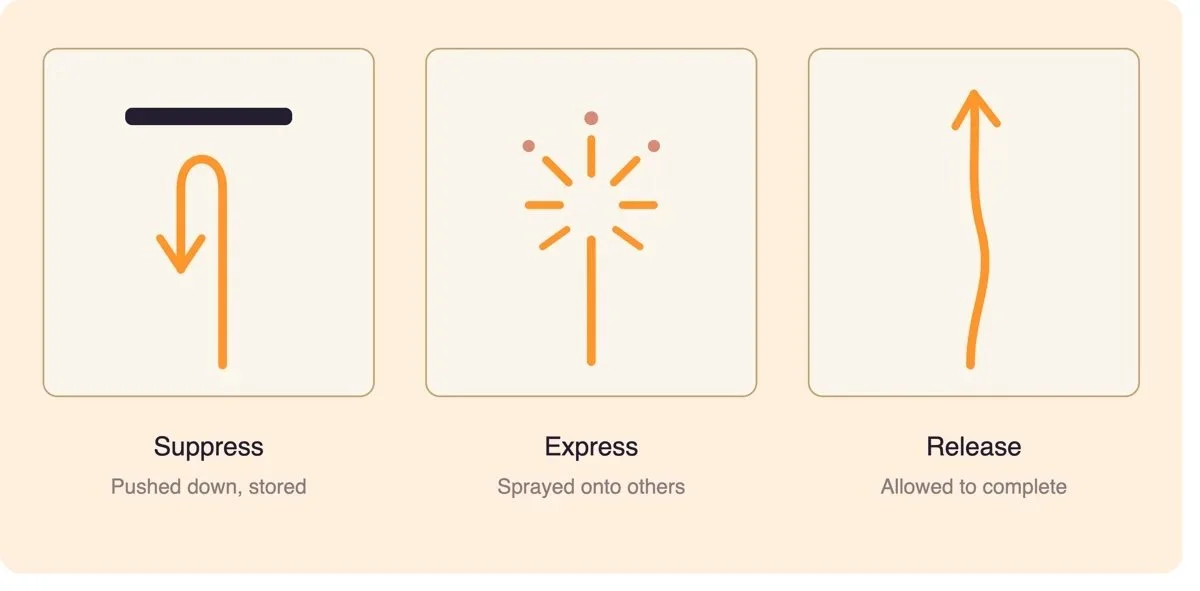
Suppress it. Push it back down. This is the reflex — I don't want to feel this. It works for about a minute. But nothing suppressed goes away. It goes into the Bunker, and from the Bunker it runs your life. You don't deal with it anymore. It deals with you.
Express it. Vent it. Snap at the driver, fire off the email, say the thing. This feels better than suppressing — briefly. But expression doesn't empty the Bunker either. It just sprays the pressure onto the people around you, and creates new material to store.
Release it. This is the one nobody taught us. When the energy comes up — even the old, painful stuff — you relax. You don't push it down and you don't act it out. You let it be there, and you let it finish. Emotions are self-completing. They rise, peak, and resolve on their own. The only thing that stops them is our interference.
And that's the reframe worth sitting with: when old stuff surfaces, it's not a malfunction. It's your inner system trying to clean itself, the way the rest of your body does. The stored energy rises on its own schedule — a slow driver, a certain tone of voice, a smell — because it wants out.
You couldn't handle it when you were eight. You can handle it now.
Here's the smallest version of the practice. Next time a feeling rises — irritation in traffic, a knot before a hard conversation — try this: take one slow breath. Unclench whatever just clenched. And say to yourself, I can handle this — because you totally can. Then let the sensation be there, as raw energy, without naming it or explaining it. No thinking; you can think later. Just stay, and let it finish. It usually takes about ninety seconds.
That's the seed of a skill I call not closing. It's the foundation of everything I do with coaching clients — and it doesn't take years to learn. If you'd like help making it your default instead of your exception, just reply to this email. I'd love to hear from you.
So the whole practice fits in two words: don't close. Relax. Let it through. One feeling at a time, the Bunker empties.
There's a whole book about this!
Thrive Mind - A Parable of the Subconscious
The bunker is the subject of my book — how we build it, what it quietly costs us, and the glitch in the nervous system that lets it seize the controls: the mechanism that convinces us we’re small and under threat, when our real nature is joyful and brilliant.
It’s in my editor’s hands now, out in the next few months. Here’s an early look at the bunker itself:
What working with me looks like
We go into the bunker together, calmly, and take inventory — questioning the beliefs that keep you defended, and changing your relationship to the emotions you’ve been bracing against. Less a discipline, more like clearing out a room you forgot had a window.
Curious what’s in yours?
Thinking 2.0, 961 S. McClelland, Salt Lake City, Utah 84105, United States
Unsubscribe Manage preferences
Lara Patriquin, MD
Associate Professor of Radiology
School of Medicine, University of Utah
Speaker and Coach at Thinking2.0
(505) 269-4097
Book your complimentary call here.
joanna. joannaseibert.com