August 14: Jonathan Daniels Pilgrimage and the Song of Mary
“I knew then that I must go to Selma. The Virgin’s song was to grow more and more dear in the weeks ahead.”—Jonathan Daniels, quoted in The Jon Daniels Story, William J. Schneider, ed. (The Seabury Press, 1967), p. 67.
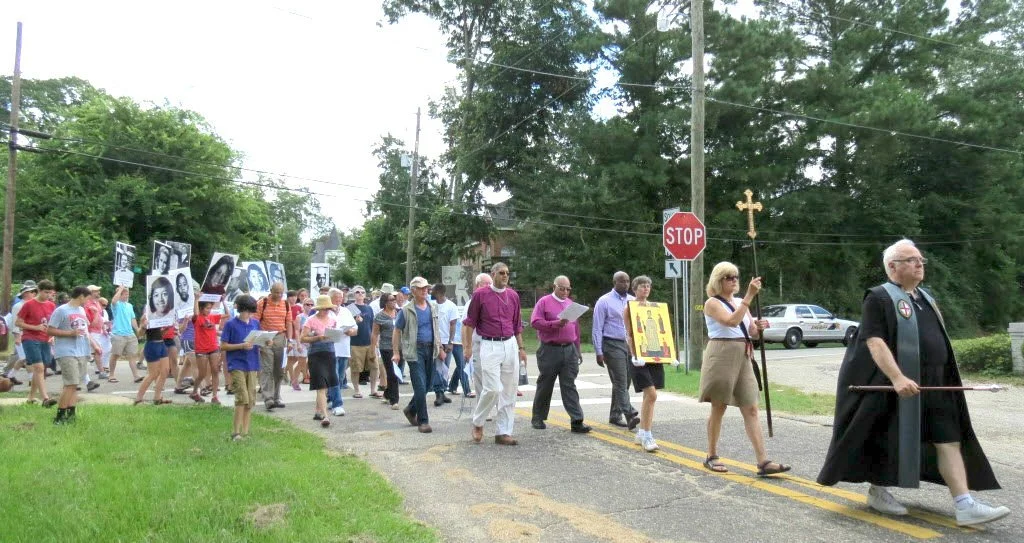
On the second Saturday in August, people from across the country will gather at 11:00 a.m. Central Time in Hayneville, Lowndes County, Alabama, to remember the death of Episcopal seminarian Jonathan Myrick Daniels. On August 20, 1965, Daniels died while protecting an African American teenage girl, Ruby Sales. 2025 marked the 60th anniversary of his martyrdom.
The pilgrimage begins at the courthouse, where a trial lasting less than an hour found the man who murdered Daniels “not guilty.”
Next, it moves to a small country store where Jonathan was killed. The pilgrimage then returns to the courthouse for Eucharist, where the bread and wine are consecrated on an altar that was once the judge’s bench for that 1965 sham trial, lasting less than an hour, which found the man who murdered Jonathan not guilty. Previously, the Right Reverend Phoebe Roaf, the Bishop of the Diocese of West Tennessee, was the preacher. In 2025, the Right Reverend Michael Curry was the preacher.
Bishop Russell Kendrick of the Diocese of the Central Gulf Coast recently reminded us that this march, commemorating the death of the twenty-six-year-old Daniels, occurred on the same day as the disastrous white supremacist march in Charlottesville, Virginia, in 2017. The similarities are sometimes too much to bear, reminding us that we seem no further advanced in race relations than we were three-quarters of a century ago. As a nation, we seriously lack the ability to secure human rights. We all need continued growth to recognize who our neighbor is.
Daniels took a leave from the Episcopal Seminary in Cambridge, Massachusetts, after hearing Martin Luther King, Jr.’s call for students to join him in his march in Selma, Alabama, to support the Civil Rights movement. He had been moved by singing the Song of Mary, the Magnificat, at Evening Prayer, especially by the words: “He hath put down the mighty from their seat and exalted the humble and meek.”
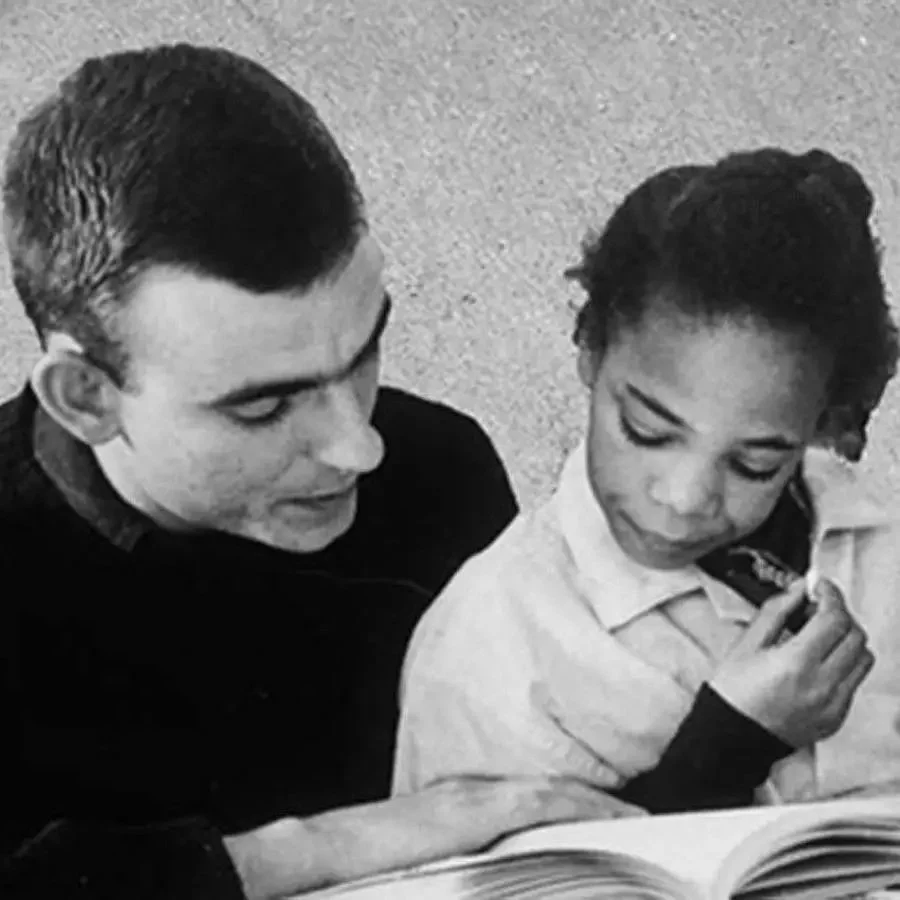
Jon devoted many Sundays in Selma to bringing small groups of black high school students to services to integrate the local Episcopal church. They were seated, but many in the congregation scowled at them. Many parishioners openly resented their presence, putting their priest squarely and uncomfortably in the middle of the controversy.
Jon returned to the seminary in May to take examinations and complete other requirements. In July, he returned to Alabama, where he helped compile a list of helpful local, state, and federal agencies and other legally available supportive resources for people of color.
On Friday, August 13, Jon and others went to Fort Deposit to join picketing at three local businesses. On Saturday, they were arrested and held in the county jail in Hayneville for six days before posting bail. After their release on Friday, August 20, four of them went to buy sodas at a local country store and were met at the door by a special county deputy with a shotgun who told them to leave or be shot. After a brief confrontation, the part-time deputy aimed the gun at a seventeen-year-old black girl in the group, Ruby Sales. Jon pushed her out of the way, took the bullet, and was instantly killed.
Ruby attended the same seminary as Daniels and now heads the SpiritHouse Project in Atlanta. This program uses art, spirituality, and education to bring about racial, economic, and social justice.
Our senior associate rector, Michael, reminded me that at the School of Theology, Sewanee, Tennessee, all first-year students are loaded onto a bus and taken on the Jonathan Daniels pilgrimage during seminary orientation. He describes it as a very moving experience for many who are visiting the site of a martyr for the first time.
When we sing or recite Mary’s song, The Magnificat (Book of Common Prayer, p. 119), together, let us remember Jonathan Myrick Daniels and Ruby Sales and how this Canticle transformed their lives. Is there something in that song that also resonates with each of us?
Daniels died on August 20th but is remembered on the day of his arrest, August 14. The march will also be live-streamed from the Diocese of Alabama at these two sites:
Their website: www.dioala.org/jonathandaniels
Their Facebook Page: www.fb.com/dioala/live