Love

Love

“Hatred stirs up strife,

   but love covers all offences.” Proverbs 10:12.

langley child mission trip.jpg

We are all banking on this being true. I think of all my offences, the evil I have done, the harm I have done consciously or unconsciously, the friends, the family members I have hurt. I make amends when I can for the harm I have done, but mostly I try to make living amends. I hope to learn to love the way my granddaughter, Langley, is doing to this young child on her mission trip. I want to hold closely the Christ in others and let them know what a treasure they are. I want to be able to see the Christ in them. This is what spiritual friends do for each other. They affirm, stand by each other.

More often now I am paying it forward. For many reasons I cannot make amends to the person I have harmed, but instead I try to show the love I wish I could now give to them to someone else. Paying forward is showing love to someone else that has done nothing for us, especially someone we do not know and often someone who feels loveless.

I try, I judge, I make mistakes, I mess up, I hurt others, I make amends, I try to show love that has been so often unconditionally given to me, and the cycle seems invariably to start all over again. It is a circular path. It is the human condition. I try to stay connected to this circular pathway of others who know more than I know how to love and hope to learn from them. I can so easily see Christ in them and occasionally they can see the Christ in me which guides me back onto the path of love.

Today, I now learn most about how to love from my grandchildren. What a circular life, for I first learned about love from my own grandparents many years ago.

Joanna  joannaseibert.com
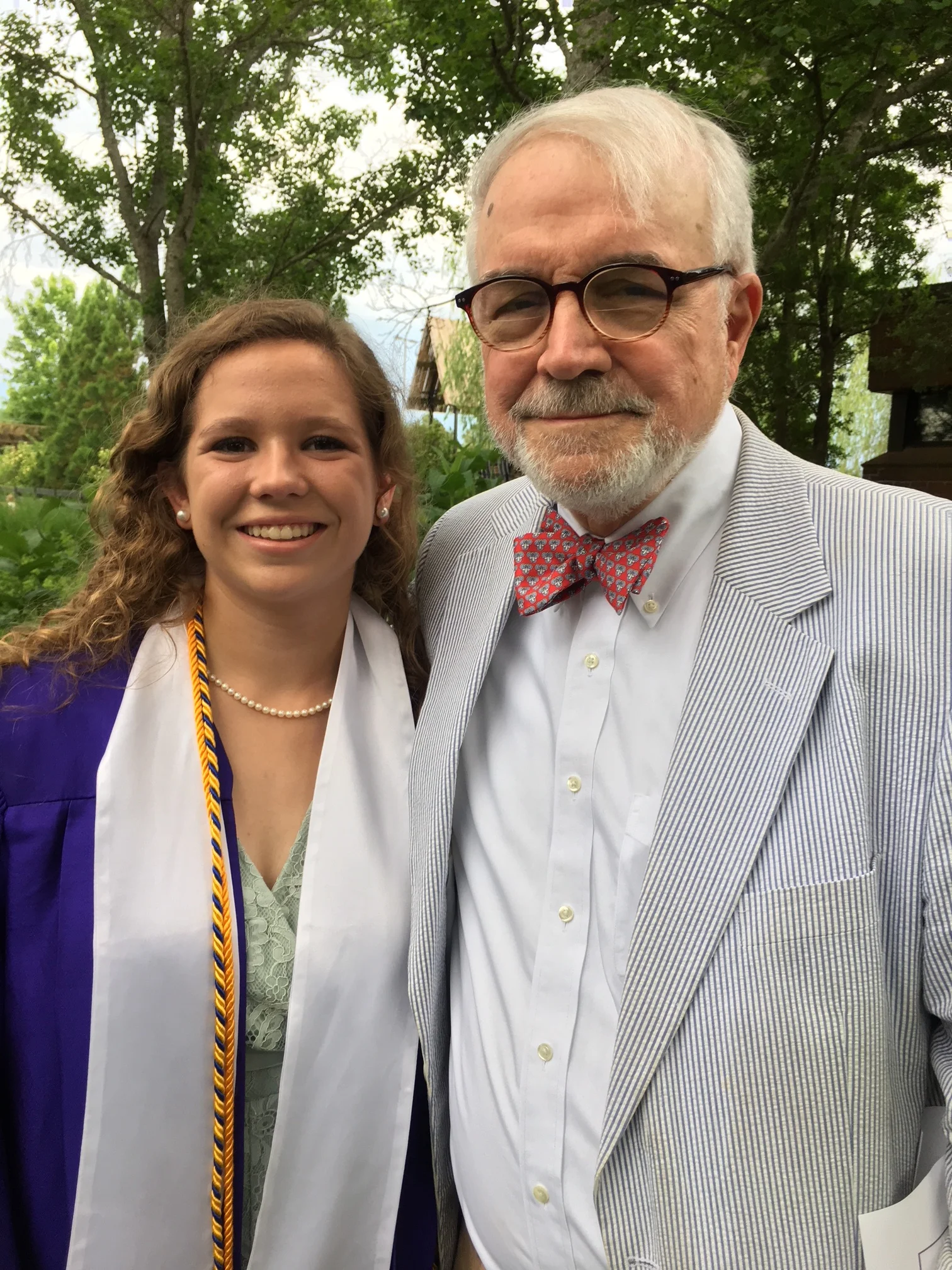
 

what Langley knows

What Langley knows

“Call to me and I will answer you and tell you great and unsearchable things you do not know.” Jeremiah 33:3

IMG_2454.JPG

This past weekend at our oldest granddaughter’s high school graduation, a scripture verse was read as the graduate walked across the stage to receive his or her diploma. The verse had been chosen by the student’s high school advisor. This was read as Langley received her diploma. What an amazing verse to hold onto for the rest of her life.

We only need to call to God, and God will answer, and God will tell us unimaginable things that we need to know. Calling on God can mean praying for God’s presence, but it also can mean sitting in silence and waiting for God’s presence inside and outside of us to be manifested. It can mean being open to seeing God, Christ, in others. It can mean seeing God in all of creation and learning how to protect it and care for it.  It can mean being open to receiving the love of Christ from another.  I have mentioned only a few ways of many that God offers to us to make that call.

The second part, the answer, comes in so many different ways and means as well. If we expect to hear a voice or receive a sign a few minutes after we make our dial up to God, we may be disappointed. The access and connections to God are beyond our comprehension. Answers come at the most unexpected times and often use the most unexpected people. Sometimes answers even come from those we barely know and even people we consider our adversaries. Sometimes our bodies give us the answer with more or less energy for a calling. Sometimes the answers only come years later. Our only job is to be open and receptive to an answer.

How do we know the answer? Jeremiah tells us it will be knowledge we never expected to know. The 12 step promises can be helpful in realizing the answer. “We will know a new freedom and a new happiness. We will intuitively know how to handle situations which used to baffle us. We will suddenly realize that God is doing for us what we could not do for ourselves.” (Big Book of Alcoholic Anonymous, pp. 83-84.)

Feeling and knowing the fruit of the Spirit in Galatians 5:22-23 is another means of realizing we have received an answer. We become aware that we are living in “love, joy peace, forbearance, kindness, faithfulness, gentleness, and self-control.”

I know I am not telling Langley anything she does not already know. This verse indeed was already written on her heart.

Joanna  joannaseibert.com

Jefferts Schori: Fear

Jefferts Schori: Fear

“If we're going to keep on growing into Christ-images for the world around us, we're going to have to give up fear. When we know ourselves beloved of God, we can begin to respond in less fearful ways. Our invitation, both in the last work of this Convention, and as we go out into the world, is to lay down our fear and love the world. Lay down our sword and shield and seek out the image of God's beloved in the people we find it hardest to love. Lay down our narrow self-interest and heal the hurting and fill the hungry and set the prisoners free. Lay down our need for power and control and bow to the image of God's beloved in the weakest, the poorest, and the most excluded.” The Right Rev. Katharine Jefferts Schori, first woman presiding bishop in the Episcopal Church of the United States,  Homily preached at the General Convention's Closing Eucharist, Wednesday, June 21, 2006 after her election.

schori copy.jpeg

Recently we made a stop on our way to the gulf at a predominately white town in Mississippi for some supplies we had forgotten. As I walk through Walmart looking for the items we need, I look into the faces of those wandering the massive store as we are. What I see is fear. I see a little love and kindness but mostly fear, fear written in the tattoos on their bodies. Fear in the headlines in the magazines they are reading. Fear in the eyes of the children being pulled beside them. This is a segment of our country that has felt neglected, the working poor, those who worked and lost their jobs and never found another skill, those who were not taught or were not given the opportunity to the education which can be the key to life.

When we arrive at the gulf in Alabama, we go to a favorite restaurant. Those who are doing well are eating here. I hear talk of individualism, isolation, and nationalism. People here are also fearful. They have worked hard and fear they will lose what they have because of people who are different than they are. I hear them say that if others worked hard, they would be able to care for themselves as they did.  They may be here to forgot about their fears. They may have been taught a zero-sum outlook, that there is only so much abundance to go around.

It’s getting more complicated.  Fear is at every level of our society. We have lost our connection to each other. As I see myself becoming more “political,” I wonder how can I not be when every spiritual writing I read and hear in my lifetime has been about Christ’s call to us to serve others, and I fear our country is beginning to stop serving those in need.

Is this what Dietrich Bonhoeffer is talking about in The Cost of Discipleship? I think of Karl Barth telling us to preach with the Bible in one hand and the newspaper in the other. I am trying to stay informed, be active, but stay true to my connection to God. It is too complicated. My experience in spiritual direction reminds me that our fears block us from that connection to God. My previous spiritual readings remind me that I must at some point stop looking outside of myself and start looking inside at my own fears in order to consider making changes.

 As we are called to discern, pay attention, and respond to the fears of others, we also need to become aware of what and where are our own individual fears. We actually can more easily see fear in others, but the harder task is to see what is the core of fear in ourselves which we have so masterfully disguised. This is where having  spiritual friends to talk to can make all the difference.

Joanna  joannaseibert.com