Bishop Hibbs: Jesus Prayer

Hibbs: Jesus Prayer

“Lord Jesus Christ, Son of God, Have mercy on me a sinner.”

hibbs jesus.JPG

We are at Camp Allen in Texas for the first time at a Community of Hope International with Mary Earle as the keynote speaker. As I look over her books I find this newly published 20th anniversary edition of An Altar in Your Heart, Meditations on the Jesus Prayer by Bishop Robert Hibbs with a Foreword by Mary Earle. The Jesus Prayer has been my mantra in the early morning and at evening as I go to sleep and during any time of anxiety or fear or temptation during the day or night especially during medical tests for me and my family. It is my feeble attempt at praying without ceasing.  

I have known Bishop Hibbs for years through work with the Episcopal Recovery Community, but never knew about his work on the Jesus Prayer.  As I share with Mary my connections with Bishop Hibbs, I find out he died a year ago in April, and Mary preached the homily at his service. I want to thank and honor him for the support he gave me and so many others in recovery by sharing this book with you. Also included is an audio CD of his lectures at a retreat producing the book, which the Cajuns would call a lagniappe,  a little something extra. For years Bob Hibbs was the major voice for recovery in the Episcopal House of Bishops.

Saying the Jesus Prayer is like using a prayer rope or beads in our heads. Bishop Hibbs relates the story of  Cardinal Mindzenty and Father Eschmann, who survived torture and solitary imprisonment by staying connected to God with the Jesus Prayer.

The first words of the Jesus Prayer, “Lord Jesus Christ, Son of God,” remind us of both Jesus’ divinity and his humanity which Hibbs believes is  an important constant message in keeping us in relationship with Jesus. These first words of the prayer with Jesus’ name express Easter, the Alleluia part of the prayer. The last phrase about mercy expresses Good Friday. Sister Carol Perry at this same conference reminds us that in this request for mercy, we are making the choice to ask for God’s mercy in our lives rather than God’s justice for how we have lived our lives.  Hibbs believes we always live in the tension between being in Easter and always connected to Good Friday.

Bishop Hibbs reminds us that this is an oral prayer to be said out loud as much as possible especially as we begin to make the Jesus Prayer a part of our being. He cautions us not to be discouraged as we become distracted while we say it. We are gently to return to the prayer without judgment on ourselves. We might consider treating distractions similar to those we encounter them in centering prayer. We might see them as barges moving down the Mississippi or any favorite river. We are to let them pass on down without interacting with them.

Eventually the prayer develops a rhythm in our lives and becomes a gift from God closely related to the beating of our heart, a constant, habitual recollection or awareness of God’s presence. Hibbs also reminds us that when we pray the Jesus prayer, we are attempting to connect to Jesus, God, the Trinity above and beyond us but also to the Christ in our neighbor and in ourselves.

For people in 12 step recovery this is where the steps intersect with the Jesus Prayer as we “sought through prayer and meditation to improve our conscious contact with God.” (Step 11, Chapter 5, “How it Works,” Big Book of Alcoholics Anonymous, 2016, p. 85)

Sometimes I modify the prayer to be similar to what is called Agnus Dei, the fraction anthem said or sung after breaking the bread in the Eucharist. “Lord God, Lamb of God, that takest away the sins of the world, have mercy on me.”

While we meet with someone for spiritual direction or with spiritual friends, we give them our utmost attention, but having the Jesus Prayer running through our mind and body is a way for us to stay connected to the Spirit speaking to the Christ in both of us.

Joanna  joannaseibert.com


Kelsey: The Ballard of Judas Iscariot

Kelsey: The Ballard of Judas Iscariot

 “We forget that the real task is to bring the totality of our psychic being to God and not just to repress and split off those parts of ourselves that we cannot change.” Morton T. Kelsey, The Other Side of Silence, a Guide to Christian 1976, Paulist Press, p. 105.

other side of silence.jpg

Theologian, Morton Kelsey wrote a very practical book over fifty years ago called The Other Side of Silence, a Guide to Christian Meditation to remind Christians that meditation was not just for those in Eastern religions.  His revised edition twenty years later is called The Other Side of Silence, Meditation for the Twenty-first Century has more of his writings and wisdom in a time when Christian meditation now is more well-known. Kelsey believes that meditation is simply the way we set up the conditions to prepare for the God who is seeking us and breaks through to us particularly in silence. “Doing meditation” involves using Biblical stores, dream images, poems, images from other sources.

Included in Kelsey’s book is a moving poem,” The Ballad of Judas Iscariot,” by the Scottish poet, Robert Buchanan, which I always read and meditate on every Easter season, reminding us that no one is lost or not forgiven or not loved by God.  I was reminded about  the story by Sister Carol Perry, a speaker at the recent Community of Hope International meeting at Camp Allen last weekend. The ballad must have been powerful to hear it sung. The story is of Judas wandering through regions of darkness when he spies a light from a lantern at a doorway.  Jesus is holding up the light as he beckons to Judas to come in and join his fellow disciples getting ready to eat. Jesus tells Judas they were just waiting for him before pouring the wine.

 I offer the poem also to spiritual friends who feel they have done something unforgivable or that God no longer loves them, and of course I meditate on it myself when that darkness of guilt or shame or a poor self-image surrounds me as well. Judas is a reminder and icon of times when we cannot accept that we might be forgiven or loved or might be open to God’s Grace continuously offered to all of us through dark and light times in our life. In all honestly, was Judas’ betrayal of Jesus really worse than denying Jesus or abandoning him as the others did? Judas simply could not ask for or accept forgiveness and had forgotten that the God of his understanding was a loving and forgiving God.

Joanna joannaseibert.com


Praying Lectio Divina

Praying Lectio Divina

 “Lectio Divina means Divine Reading. It is a prayerful way to read scripture or any spiritual writing.
 Read -- Read Deeply
 Read a scripture passage slowly and hear deeply the sound and meaning of every word. Imagine that God is speaking to you through these words. Listen attentively to see which word or phrase catches your attention and speaks to you and your life.
 Meditate – Think, imagine Deeply
Take what caught your attention from your reading and think deeply about it using your imagination. Imagine what  it meant to those at that time who first heard it? Why is this important to you and your tradition and your experience and your life today? What about it particularly moves you.
Pray -- Pray from the Heart
If your heart is moved or your emotions touched, go with the feelings and offer what you are feeling to God in prayer.
 Contemplate -- Rest
Fall into the love of God and the love from God that was generated. Rest in the silence. Just be.
Finally, memorize or copy the thought that moved you and try to remember it from time to time during the day.
Journal if possible about what happened during the prayer.”

Modified from the Community of Reconciliation at Washington National Cathedral and the Friends of St. Benedict

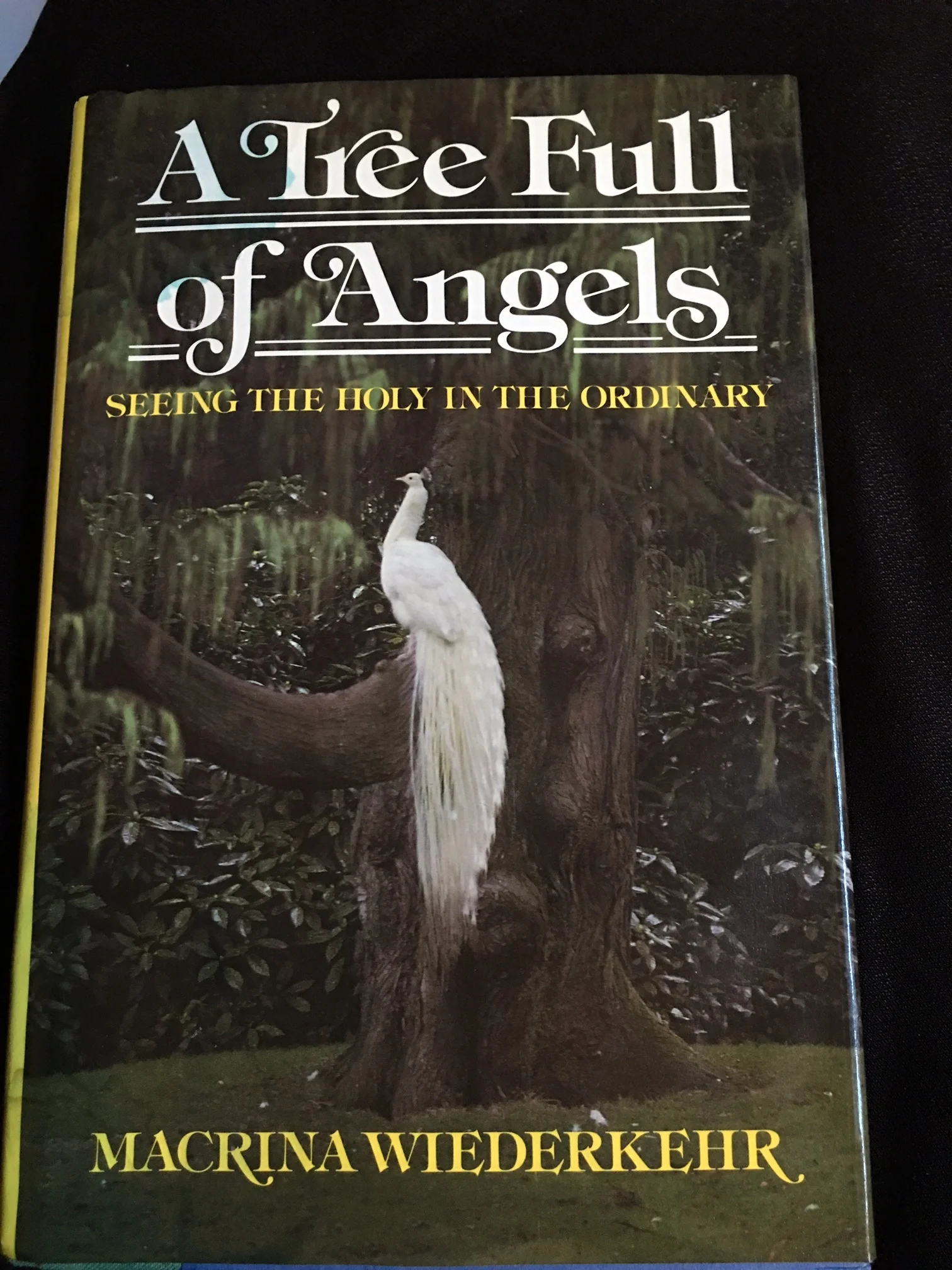
treeful of angels.JPG

 Lectio Divina is an ancient Benedictine practice of reading the scriptures, which similar to centering prayer cultivates contemplative prayer. It was practiced in community in monasteries during the time of St. Benedict. This is a time-honored way to try to connect to God through reading scripture, prayer, meditation, and contemplation or listening for God. If your tradition has fixed lectionary readings for Sunday, this is an excellent way to prepare for Sunday by practicing Lectio Divina with one or all of the readings daily as your personal discipline or  in a group.

Macrina Wiederkehr in her book, A Tree Full of Angels, Seeing the Holy in the Ordinary, writes extensively about Lectio Divina, calling it “plowing up the field of the soul.”  She uses as her guide a quote from the Benedictine Abbot Marmion, “Read under the eye of God until your heart is touched, then give yourself up to love.” She uses imagery in the process, and waits for a mantra, a holy word, a phrase, a sentence that may stay. She then carries that word or phrase with her during the day. She describes giving yourself to God as surrender, melting into God.

Joanna    joannaseibert.com