Two Spiritual Approaches

Two Spiritual Approaches

“Darkness is not dark for you, and night shines as the day. Darkness and light are but

one.” —Psalm 139:12

contemplating

contemplating

Richard Rohr in his daily emails1 describe light and dark as the main two types of spiritual traditions we use to seek our connection to God. One is the more thinking, formal, theological approach called the kataphatic way where we reach God by learning and studying about God, an ascent to the sacred, reaching for the light. This has been the most used approach to God since the Protestant Reformation and the Age of Enlightenment. It could be described as the study of knowledge or knowing God.

The other approach is the apophatic way where we move beyond words and rational knowing into silence to seek God. This is the contemplative approach to the mystery, the unknowing or not-knowing. This is a descent into to the dark, into the unknown sacred within.

Rohr emphasizes how important both ways of seeking God are needed in our spiritual life. Those whose personality type involves more thinking and sensing where they make decisions on what is rational or reasonable and what are the concrete facts will be drawn to the kataphatic or ascent approach. Those whose personality involves more feeling and intuitive functions where they make decisions on relationships and value and considering many connections and patterns may be more drawn to the apophatic or descent or inward approach.

Many involved in spiritual direction suggest during Advent and in especially in Lent to try the opposite approach to God from what we are most accustomed. For example, if we are a thinking and sensing person, we are to try some form of contemplative prayer. If we are a feeling and intuitive person, we are to put our toe into the water of study of the words of our tradition, sacred scripture, or writings of older and newer theologians.

Just a suggestion to think or wonder about.

1Richard Rohr, Center for Action and Contemplation, Richard Rohr’s Daily Meditation, “Darkness and Light,” adapted from Richard Rohr, Things Hidden: Scripture as Spirituality (Franciscan Media: 2008), 115-116.

Joanna. Joannaseibert.com
Humility

Humility

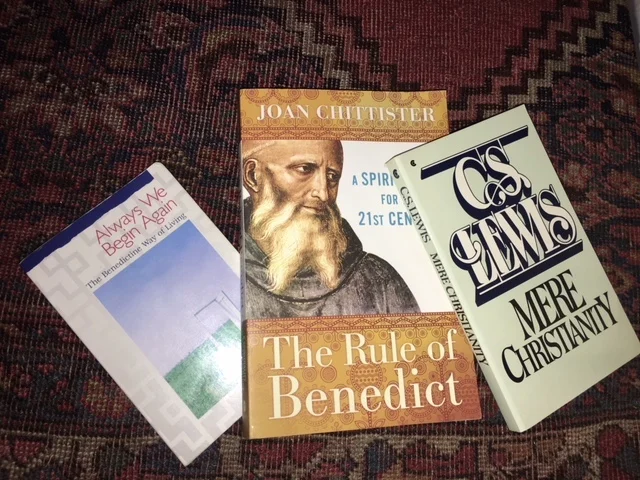
“Do not imagine that if you meet a really humble man he will be what most people call ‘humble’ nowadays: he will not be a sort of greasy, smarmy person, who is always telling you that, of course, he is nobody. Probably all you will think about him is that he seemed a cheerful, intelligent chap who took a real interest in what you said to him.”

-C.S. Lewis, Mere Christianity, inwardoutward.org, Daily Quote, October 2, 2018.

books on humility.JPG

. Frederick Buechner in Beyond Words (pp. 161-162) also talks about humility as not thinking ill of ourselves but simply not thinking that we are more important than others. We are not more significant or less essential than our neighbor in God’s eyes. This definition of humility does not devalue ourselves but values ourselves and others on a same plane. The humble person is genuinely interested in others and their wellbeing because he or she also has a strong sense of self and does not need accolades from others to survive.

John McQuiston II in Always We Begin Again, his modernization of the Rule of Benedict describes Benedict’s twelve stages of humility. (pp. 39-45). If we are to follow the Rule and to have humility we are to realize the sacredness of each moment, to know that being guided only of our own self-will can lead us astray, to accept our limitations, to be patient, not to hide our faults, to be content, not to judge, not to be joyful over the problems, disappointments, and losses of others, and to speak gently and briefly.

Three writers from different ages keep telling us that humility is important in our life in community as well as in our own individual life development.

This understanding of humility is different from the trait that has often been described to us.

Joanna joannaseibert.com

Feminine Wisdom

Wisdom

To the disciples who were always asking for words of wisdom, the Master said, "Wisdom is not expressed in words. It reveals itself in action." But when he saw them plunge headlong into activity, he laughed and said, "That isn't action. That's motion." Anthony de Mello, Synthesis Today Quote, August 19, 2018.wwwsynthesispub.com.

Manet Fainting Couch

Manet Fainting Couch

There is a Greek myth about Psyche and Eros that many people doing Jungian work use to describe the conscious development of women. The story is the basis for She by Robert Johnson and Till We Have Faces by C.S. Lewis. In order for Psyche to reunite with her lover, Eros, she is given several tasks. At the beginning of each task, Psyche collapses and weeps as she sees the task so insurmountable.

My image is Psyche lying on one of those old-fashioned fainting couches that every woman of means possessed with her hand turned palm up on our forehead, her eyes closed, and her head leaning backwards on or off the couch. It is the feminine body language of surrender and stillness. Instead of plowing directly into a difficult task she has been given, the feminine waits, rests. In the waiting, answers come that are completely out of the box. They are truly answers to prayer. Some would say the answers come from the Spirit of God within her. Help comes from places she never imagined.

This is wisdom, the action of waiting, stillness, especially before we are asked to do something we do not think we are capable of doing.

I remember waiting in an outer office before a difficult meeting with other physicians. At first I was upset that I, this important person, had to wait! Slowly I realized the waiting was a gift, wisdom from a mysterious source, a time to quiet myself, to surrender to the moment, and to be still before taking on a meeting that might be difficult. When I was able to do this, I often took into the meeting the feminine energy of staying in relationship that could make all the difference in what happened.

Joanna joannaseibert.com