Bourgeault: New Glasses

“If you wear glasses, you likely often forget that they’re even there! Only when you take the lenses off do you realize how much your capacity to see is informed by the lens through which you are seeing, or as Richard Rohr often says, ‘How we see is what we see.’”

—Cynthia Bourgeault in The Shape of God: Deepening the Mystery of the Trinity (CAC, 2004), disc 2.

dc glasses.JPG

Here Cynthia is using an analogy to teach us about the Trinity; but we can apply this also to our everyday life. If you or the person you are meeting with for spiritual direction wears glasses, try this exercise:

Take off your glasses. Try to see at a distance or read a passage of text. Perhaps you will “see” or realize that what you “see” actually depends on the lenses of your glasses. Often our lens, or how we see the world, is through the filter of our work, our family, or our position. We might be experiencing a need for prestige; a desire for money or control or power; a longing to be in the spotlight, or successful; or we could be obsessed with beauty, clothes, food, alcohol, drugs, or controlled by other addictions. When our world or the sun is too bright, we need to put on sunglasses such as Zoe and Turner are wearing. At other times if we are depressed or grieving, we truly may be seeing the world through dark glasses.

Meditate, pray about, and write down a description of the lenses you use to view your family, friends, enemies, the world. In our attempt to stay connected to God individually and in community, our hope is that we will connect to the Christ in ourselves and the Christ in our neighbor. Let us learn to see ourselves and the world and others through the lens of the fruit of the spirit: love, joy, peace, forbearance (patience), kindness, goodness, faithfulness, gentleness, and self-control (Galatians 5:22-23).

Some say spiritual direction is helping someone become awake. Spiritual direction can also be putting on a new pair of glasses.

Joanna joannasebet.com

adventfront copy.png

Release party!!!!!!!!!!!

Come and get a signed copy of the new book

Just in time for the holidays

A Spiritual Rx for Advent Christmas, and Epiphany

The Sequel to A Spiritual Rx for Lent and Easter

Both are $18

All Money from sale of the books goes either to Camp Mitchel Camp and Conference Center in Arkansas or Hurricane Relief in the Diocese of Central Gulf Coast

Seibert’s, 27 River Ridge Road, Little Rock, Arkansas 72227

10 to noon, Saturday September 14, 2019

RSVP joannaseibert@me.com


Gerald May V: Willingness and Surrender

“The gentlest form of spiritual narcissism is the idea that one can accomplish one’s own spiritual growth. ‘I can do it’.’”

—Gerald G. May in Will and Spirit (HarperOne, 1982), p. 115.

prodigal son138 copy.jpg

In Will and Spirit, Gerald May writes about struggles in our world today as well as our many battles within ourselves. We are likely to have issues with will, willingness, control, and surrender in our spiritual lives. Whenever we start our spiritual journey with willingness, as soon as we become aware of some spiritual growth, we become vulnerable to spiritual narcissism: the unconscious use of spiritual practices to increase our self-importance. We find ourselves trying to become holy, under the assumption that we can accomplish our own spiritual growth. This becomes willfulness masquerading as willingness.

When we acquire an awareness of our own self-interest as to why we are participating in charitable works, these actions and gifts will be better given and received. Sin occurs when self-image and personal willfulness become so important that one forgets, represses, or denies one’s absolute connectedness and grounding in the God within us, the power who creates and sustains the cosmos and who placed in us that yearning.

May encourages us to allow attachments to come or go rather than constantly clinging to them. We must be aware of our need for self-importance; and thus he cautions us about immediately leaping to shore ourselves up. He places less emphasis on coping and mastery, and more on waking up to whatever is happening in the present moment.

As we surrender some of our self-importance, we begin to make friends with mystery. Even though we may not necessarily always find God when we sacrifice our self-importance, May believes that as we lose our need for self-importance, we will realize that God has already found us. We will experience more spontaneity and awareness when we are not driven to perform and can let things flow: when we no longer need to be defined through self-judgment or evaluation of our own actions.

May reminds us that spirituality cannot be a means to end our discomfort.

Spiritual growth has to be a way into life, not an escape from it. We are called to be in the world, not of the world—and unfortunately this of the world side may be uncomfortable.

This statue of the Return of the Prodigal Son in the Bishop’s Garden at the National Cathedral can be an icon for surrender and willingness.

Joanna. Joannaseibert.com


The Liesborn Prayer Wheel

“Sometimes returning to ancient sources is exactly what we need to renew our spiritual lives.” —Payton Dodd, Jana Riess, and David Van Biema in “Foreword,” The Prayer Wheel: A Daily Guide to Renewing Your Faith with a Rediscovered Spiritual Practice (Convergent, 2018).

Week-1-highlighted-path.png

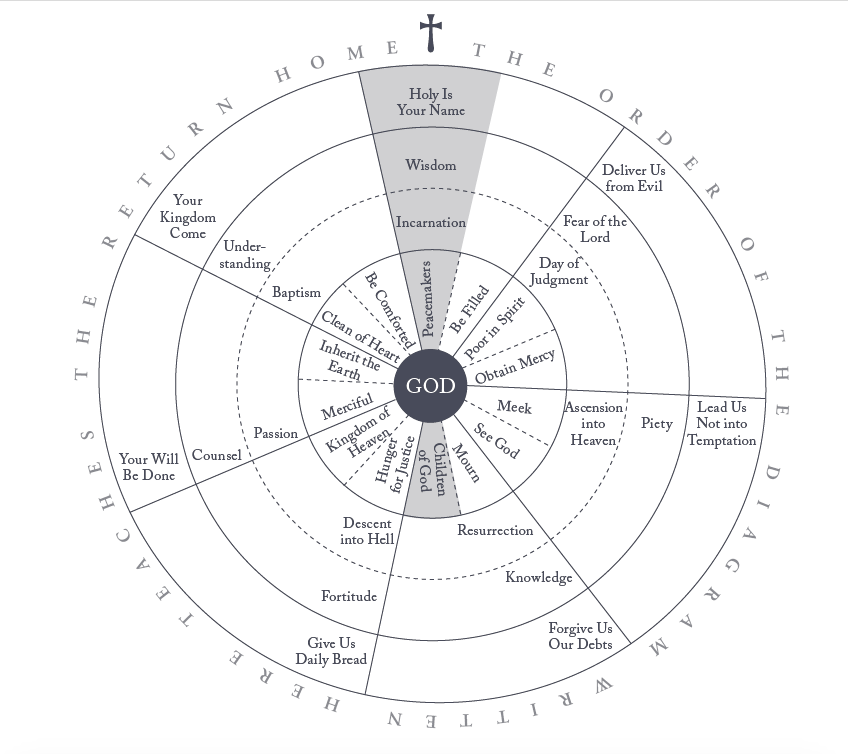
Three well-known religion writers join forces to present a meditative method using the ancient practice of the prayer wheel. The medieval Liesborn Wheel consists of four concentric bands containing the Lord’s Prayer; the Old Testament Gifts of the Spirit from Isaiah; Events in the Life of Jesus; and the Beatitudes. Each of these four texts is divided into seven stepping-stones. Together these texts comprise a complete vocabulary of faith.

The seven phrases or petitions or stepping-stones are spiritual tools or disciplines to put us in position to connect to the God within us. The authors suggest journeying around the wheel as a daily prayer practice. The wheel can also be used topically for special needs, in times of grief, when offering gratitude, or when praying for others. Its use is appropriate in times of joy, discernment, or needing forgiveness. The wheel can aid prayers for healing, hope, praise, and achieving calmness. It also can be a guide for Bible study. There are endless possibilities.

The invitation to return to this ancient source is an opportunity for all of us who would like to learn new ways to experience contemplative prayer.

Joanna. Joannaseibert.com

adventfront copy.png

Release party!!!!!!!!!!!

Come and get a signed copy of the new book

Just in time for the holidays

A Spiritual Rx for Advent Christmas, and Epiphany

The Sequel to A Spiritual Rx for Lent and Easter

Both are $18

All Money from sale of the books goes either to Camp Mitchel Camp and Conference Center in Arkansas or Hurricane Relief in the Diocese of Central Gulf Coast

Seibert’s, 27 River Ridge Road, Little Rock, Arkansas 72227

10 to noon, Saturday September 14, 2019

RSVP joannaseibert@me.com