Movie date

Movie Date

“I have a theory that movies operate on the level of dreams, where you dream yourself.”—Meryl Streep.
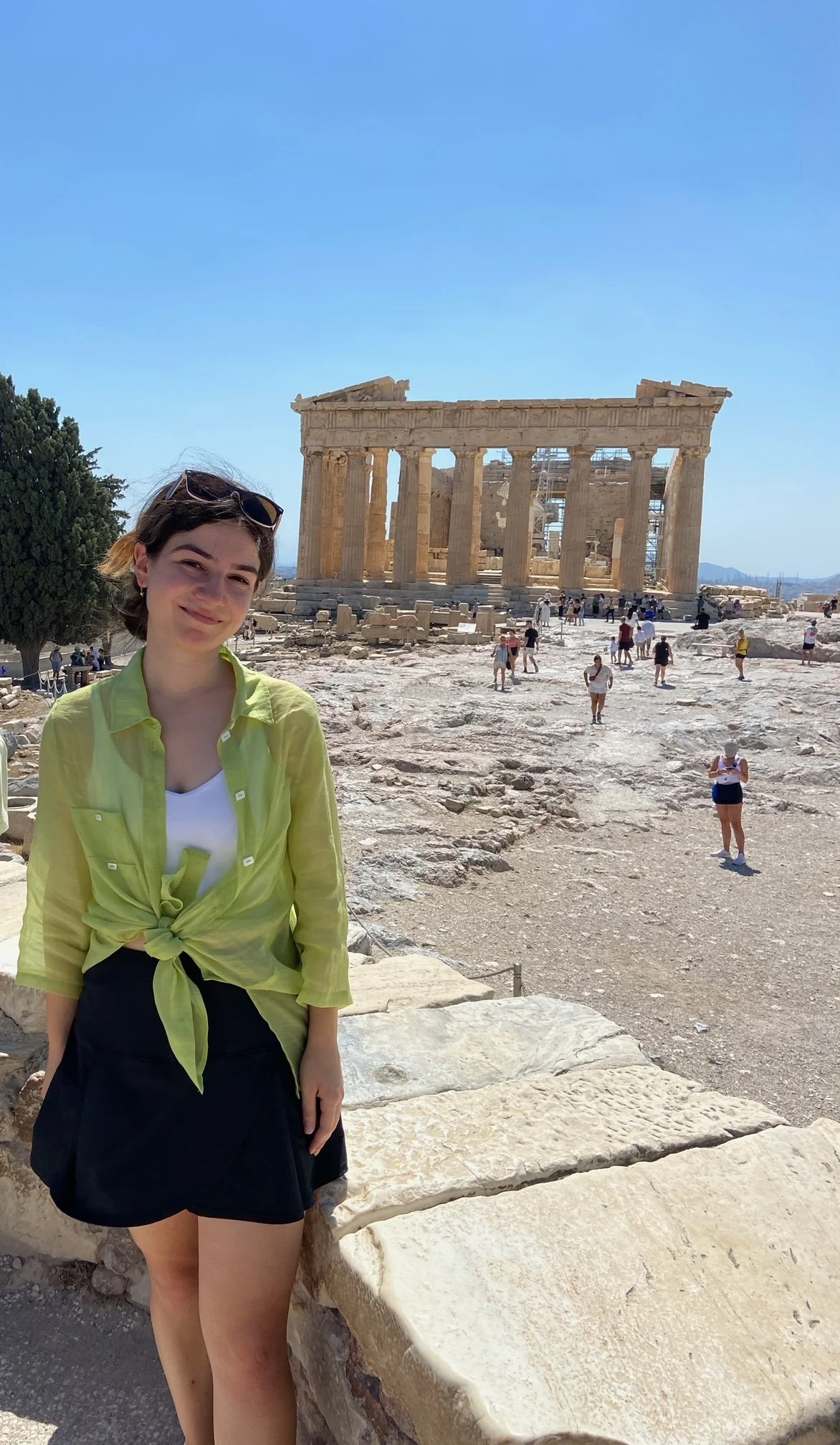
Zoe Greece

My granddaughter, Zoe, and I have been having a date for many years on Friday afternoons to watch old movies. I wish we could swim together, stroll in the woods, or walk down some of Little Rock’s beautiful trails, but my physical disability makes that too difficult. However, we can curl up in the king-size bed in our master bedroom, all lights out, each covered by our favorite blankets, while we eat popcorn and watch movies. We have seen almost every musical made. Sometimes we watch drama, and less often, comedy.

One week, Zoe saw Some Like It Hot for the first time. Recently, we watched Are You There, God? It’s Me, Margaret. I forgot to mention Zoe has just left for college in New Orleans, and I know we will miss these movie dates. We usually talk a little about the film after it is over. Sometimes there is much to discuss; at other times, there is very little. One of my favorites to see with her was Babette’s Feast, a film and food and life.

Zoe is a Greek word for life. This is a recent photograph of Zoe on her first trip with friends to Greece a recent summer. Life is what our grandchildren teach us about, life in the present moment.

In the past, I have shared with Zoe paintings from my favorite art museums, and rarely have we read poetry together. But, mainly, there is so much grandparents want to share with their precious grandchildren.

However, it is predominately about the pleasure of being in our grandchildren’s presence. They connect us to our souls. I have learned to drop everything I am doing and be with her if she texts about a potential movie date.

For me, this movie date has become an icon of what prayer time may be about. I think there is some built-in homing device through which God and we yearn for each other’s presence. Prayer is occasionally words, but mostly presence. I believe God longs to share God’s experience, God’s amazing world, with us, but mostly God longs for our presence—just as there is a conscious and maybe even a stronger unconscious longing in us just to be in God’s presence.

Feng Shui 2

Schmidt: Feng Shui 2

Guest Writer Frederick Schmidt

“Whenever you are creating beauty around you, you are restoring your own soul.”—Alice Walker.

diversity around table

Not everyone who identifies as spiritual necessarily takes that more significant responsibility into consideration. In fact, most of us are taught that spirituality is about getting God involved in our lives, fixing our problems, comforting us when we are down, and showing us the way. Our culture has taught us to think that way, and some spiritualities are devoted to that understanding of the spiritual life.

Now, at one level, I’m all for God being involved in my life. I don’t relish having problems. When God seems particularly close, I enjoy the palpable sense of peace that goes along with such moments, and I never mind knowing what to do next. But, at the same time, I don’t think that is the purpose of the spiritual life. 

We have a more significant responsibility. Feng shui doesn’t quite capture that responsibility, but it hints at a concept found in the Torah, the prophets, and the teaching of Jesus—pretty much in the entire Bible. It’s called the righteousness of God—the order God intended, to put it in more accessible terms. Put another way, we are called into partnership with Jesus to care about how the world around us does or does not conform to God’s design. 

Contributing to the righteousness of God won’t be as easy as rearranging the furniture in a room. Doing that in our world is a much bigger job. Not everyone will think that God’s opinion on where the furniture should go will agree with us. We won’t even agree among ourselves where it should be all the time. And on this side of eternity, the furniture will never be where all of it should be.

But we can witness to making God’s righteousness a reality. We can make personal choices and relate to one another in ways that reflect the presence of God in our lives. Those may not be sizeable pieces of furniture, but it’s an excellent place to start. 

Frederick Schmidt 

how to update conference room

Dys-Feng Shui 1

Schmidt: Dys-Feng Shui 1

Guest Writer Frederick Schmidt

“To believe in something, and not to live it, is dishonest.”—Mahatma Gandhi.

I don’t know much about feng shui (pronounced fung shwee), but as I understand it, it is a Chinese concept of aesthetics that applies “the laws of heaven and earth” to create harmony and order. It teaches how to maximize life’s energy to be in sync with the world around us.

Today, it is used in a somewhat more trivialized and commercial fashion by interior decorators, who probably don’t know much about ancient Chinese philosophy. But they know an exotic way to sell their services when they see one!

In the middle of a rather lengthy business meeting some years ago, those around the table found a way to kill a few free moments by joking about the rather strange table arrangement we had been given for our meeting. The worst was that people were sitting at tables behind us. They were forced to face the backs of our heads, and we were positioned with our backs to them.

Thus, one of the funnier “you had to be there to understand” moments was when we critiqued the arrangement as a product of “dys-feng shui.

Whether you find that funny or not, I think it is true that the more we live into the spiritual life, the more we take responsibility for the world around us. We notice feng shui and dys-feng shui—or to turn the vocabulary in a direction that is a bit more familiar to me; we see where the Spirit of God is at work and where the Spirit of God is marginalized.

I am not talking about some kind of soft social consciousness, never mind a body of political beliefs. Instead, I am referring to the capacity to look at the world around us through the eyes of God.

Frederick Schmidt

Joanna.  . https://www.joannaseibert.com/