Francis and Gandhi on living and dying

St. Francis: Hoeing, Gandhi: Dying

“Saint Francis, hoeing his garden, was asked what he would do if he knew the world would end tomorrow. ‘Continue hoeing my garden,’ said the saint.”—Suzanne Guthrie, Synthesis Today, Quote for June 15, 2018, attributed to St. Francis.

writing desk

I have often heard this phrase attributed to St. Francis and wondered what I would do if I knew I was about to die.

I have made writing every day a discipline for several years. But would I keep writing? Writing has become one of my best spiritual practices. As I look outside at trees, birds, and sky from the floor-to-ceiling window in my office, and my fingers hit the keyboard, I feel the peace that I hope is God’s presence.

My sacred space at home is in front of a large window at my desk in my office, which once was our daughter’s room when she was growing up. There, I write and am surrounded by family pictures, icons, and remembrances of days of joy. I would ask for prayers for the good pray-ers I know, especially the women in the Daughters of the King. I would also pray at other sacred spaces if I could visit them.

 I certainly would spend as much time as possible on my last days with my family. I might entice my grandchildren to watch a movie with me, and then secretly watch them. I would want to be with my husband as much as possible. I would like my family and friends to know how much I loved them through my actions and words. I would like to have a meal with my family and friends. I would look at old pictures to keep memories with me.

Of course, if everyone else knew the world was ending, seeing how our paths might cross would be interesting!

So, what does all this mean?

“Live as if you were to die tomorrow. Learn as if you were to live forever,” is attributed to Mahatma Gandhi.

I try to carry these quotes by Gandhi and St. Francis with me each day and share them with spiritual friends. The quotes are an excellent daily benchmark to know if we are doing the practices that bring us closer to God.
Gandhi’s quote is a paradox, an anchor metaphor for our life, a constant ambiguous paradox.

Each day, I try to spend more time meditating on quotes from authors like these, who help me realize my best connections to God, my true self, my neighbors, family, and friends.
Of course, often, the connections lead me to other places, and I pray to stay open to these new adventures.

Joanna https://www.joannaseibert.com/


Spirituality of Nursery Rhymes

Guest Writer: Isabel Anders

What’s Behind Nursery Rhymes?

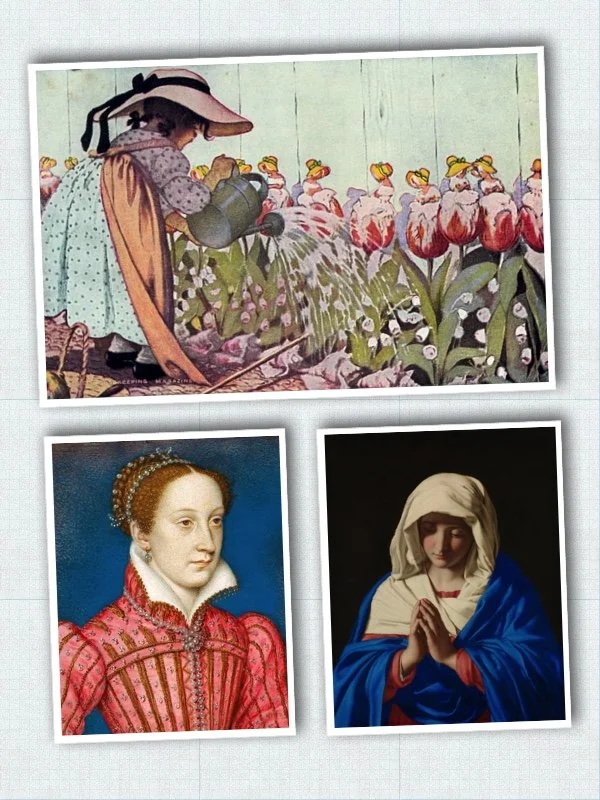
Mary, Mary, quite contrary, how does your garden grow?

Most of us are quite familiar with the sing-song lines of the classic Mother Goose rhymes that have been collected, illustrated, altered, and pondered for meaning over the years—and even centuries in some cases.

When you read some of the supposed origins and hidden messages in the folksy lines about blackbirds and puddings and a cow jumping over the moon, you realize that it wasn’t always safe (and indeed, it isn’t in our time) to openly express political views, especially criticism of the government and royalty. So the supposedly innocuous lines of nursery fun have come down to us with their multifaceted histories tucked behind them—or built into symbols we still ponder even as we sing them.

Is the Mary of the above-referenced garden the Virgin Mary, or Mary Queen of Scots, or a symbol of women and the importance of their fertility in the Garden of Life? We don’t have to know how to pick up the rhythm, sing the lines using hand motions, and pass on their colorful word pictures to a new generation, often at bedtime.

Whatever anonymous author first launched these often incongruous images—a garden yielding “pretty maids all in a row”?—they surely emerged from an intuitive, free-associative letting go. On the other hand, perhaps they originated in someone’s fertile unconscious, as images can seem to pop up for all of us out of nowhere. 

For some months, the images that come to me unbidden, often in that veiled state between sleeping and waking, tell me something about my life. They have been starting points for discussions with my spiritual director, who knows my history and current personal issues. Sometimes, they surprise both of us with their concise accuracy.

Picture language can resonate within us. Images such as the sometimes bizarre juxtapositions in Nursery Rhymes—a pie of singing birds, a cat playing a fiddle, a dish holding hands with a spoon—speak to us in ways we can’t always break down into words. There are deeper truths that nature, animals, and the earth itself sing out all around us, and we sift and interpret through our human interest grid. 

Maybe simply being open to the fantastical happening has something to do with spiritual progress. Perhaps we never totally outgrow our awe at probing the deeper origins and unexplained mystery of finding ourselves human in the world. 

As we consider these familiar rhymes, accepting the confusion and the revealing that sit side by side in our popular folk tradition—we might ourselves sometimes feel “quite contrary.” We’re questioning “the way things are,” we’re open to seeing new connections—and we’re working spiritually to keep our garden growing.

Isabel Anders has authored various books, including two collections of mother-daughter wisdom dialogues: Becoming Flame and Spinning Straw, Weaving Gold, and a book recently with Tracy Grant, Wisdom from Little Women: Louisa May Alcott.

Isabel Anders

Joanna Seibert   https://www.joannaseibert.com/

C.S. Lewis: The Great Divorce

C. S. Lewis: Great Divorce

“There are only two kinds of people in the end: those who say to God, ‘Thy will be done,’ and those to whom God says, in the end, ‘Thy will be done..”’—C. S. Lewis, The Great Divorce.

The Great Divorce is Lewis’ classic study of the difference between living in heaven and living in hell. In hell, people become increasingly isolated and separated from each other until they lose all communication. Then, before the great distances develop, there is a bus stop where groups of people in hell can go to heaven on a tour bus ride to decide if they want to live there instead. Spoiler alert! Only one person stays in heaven. The rest return to their life in hell. It is a choice.

With each character, Lewis describes what keeps each of us in hell. My favorite is the bishop, whose intellect holds him in hell, as he must return to hell because he is scheduled to give a lecture he does not want to miss. Other characters remain in hell because they cannot recognize joy. Others see all the difficulties in life as someone else’s fault. Some stay connected to their material goods, which mean the most to them. Some find people “beneath them” in heaven. One sees heaven as a trick. An artist must return to hell to preserve his reputation.

The Great Divorce is an excellent study for a book group, especially in Lent, for people to share which characters they most identify with. Lewis hands us a mirror to see where we fail to recognize we are still controlling the show and living in hell, or where we have forsaken the gifts of heaven on this earth.