a mother's life in poems

A mother’s life in poems

“Communion

Eyes look down.

 Souls look up.”—Dodie Horne, Root &Plant &Bloom, Poems by Dodie Walton Horne, edited by Jennifer and Mary Horne, 2020, p. 104.

Dodie wrote poems from childhood. She died prematurely in 1994, at age fifty-nine, from a brain tumor. How ironic that a woman who dearly loved words died of cancer in the center of her body where words form. Dodie’s daughters, Mary and Jennifer, surveyed around 370 of their mother’s poems and beautifully packaged and published them as a gift to us. 

The book is divided into sections by subject, headed with lines from her poems. For example, “They Brought Me Spring” is about motherhood. “Life in Little Rock” is about younger adulthood and self-acceptance. The “Calendars and Clocks” section is about time passing and aging. “The Questing Why” concerns religion and the spirit.

Dodie was a girlfriend, soul friend, and masseur who cared for my wounded body through many physical trials. I loved visiting her in her last home deep in the woods in Ferndale, except I was never certain each time if my car would make it through the winding, rough dirt road!

I visited Dodie during her illness. I remember leaving magnolia branches in her room on our last visit in July. She never spoke. She died soon after the visit. I treasured the thought that the magnolia fragrance filled her room and helped midwife her into God’s arms. I could not hold back tears from the synchronicity of Dodie’s last writing, “REAL LIFE,” that Jennifer and Mary left in the book.


“— ‘REAL LIFE’ events are not necessarily events; this evening in July shows me that the magnolia candles have finished spreading their light and dropped to the ground, replaced by glowing lightning bugs random cool breezes. I look out on this scene and feel it with all my senses.

—And there would be, there is: writing—in itself an act of gratitude. ‘REAL LIFE’ goes on.” 1

As our large magnolia tree blossoms by our house, I always remember Dodie and what she taught me.

Dodie couldn’t hold back the words of love and gratitude she gave to so many people in her lifetime and now beyond.

1 p. 188.

Love

Love

“Hatred stirs up strife,

   but love covers all offenses.”—Proverbs 10:12.

We are all banking on this being true. I think of all my offenses, the evil I have done, the harm I have done consciously or unconsciously, and the friends and family members I have hurt. I make amends for the damage I have done, but mostly, I try to make living amends.

I hope to learn to love how my granddaughter, Langley, is doing to this young child on her mission trip. I want to hold the Christ in others closely and tell them what a treasure they are. I want to see the Christ in them. This is what spiritual friends do for each other. They affirm and stand by each other.

More often now, I am paying it forward. If I could not make amends to the person I harmed, especially if they have died, I now show the love I wish I could have given them to someone else. Paying forward is showing love to someone else who has done nothing for us, especially someone we do not know who feels loveless. Still, making amends to the exact person we harmed will always, always be the most freeing.

I try, I judge, I make mistakes, I mess up, I hurt others, I make amends; I try to show the love that has been so often unconditionally given to me, and the cycle invariably starts all over again. It is a circular path. It is the human condition. Nevertheless, I try to stay connected to this circular pathway of others who know more than I know about love, and I hope to learn from them. I can so easily see Christ in them; occasionally, they can see the Christ in me, guiding me back onto the path of love.

Today, I learn most about how to love from my grandchildren. This is one more circular path, for I first learned about love from my own grandparents many years ago.

Joanna https://www.joannaseibert.com/


Kidd: Forgiveness

Kidd: Forgiveness

“People, in general, would rather die than forgive. It’s that hard.”— Sue Monk Kidd in The Secret Life of Bees.

If someone has harmed us, we think about them all the time and what we would like to do to them: expose them. They live rent-free in our heads and, in essence, become our higher power, our God.

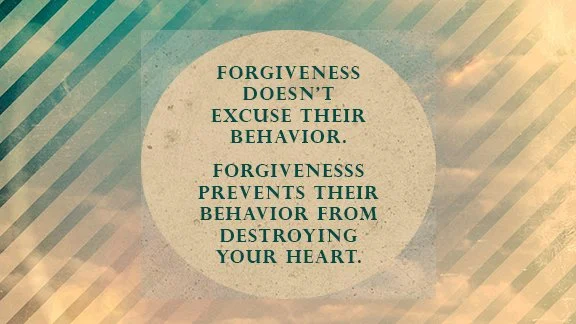
We do not want this person to be our God, our higher power. That brings us back to start the work of forgiveness. Yes, for me, it is backbreaking work. Forgiveness is not forgetting.

There are things we should never forget: the Holocaust, the Armenian genocide, slavery, abuse, 9/ 11, Hurricanes Camille, Frederic, Ivan, Katrina, this war in Ukraine, and now more than we can name.

Walter Brueggemann1 writes about forgiveness, especially from what we learn in the Old Testament. He notes that forgiveness is impossible in a system of deeds-consequence when deeds have an unbreakable, tight, predictable connection to consequences with no way out. This is the law, and if you break it, this is what will happen to you. Amen. This is the basis of much religious preaching of “hell, fire, and damnation,” trying to frighten people into a moral life.

Brueggemann believes forgiveness is only possible when we realize the astonishing readiness of God continually to reach beyond deeds and consequences to offer us unlimited restoration and extravagant forgiveness.
 There is nothing, nothing that we can do for which God does not forgive us, and God calls us to do the same.

When we start to lead a life of pardoning and newness, we begin to see the world not through our grievances, but through gratitude.

It is a new life, a different life. We saw it in Nelson Mandela, who forgives his guards for his 27 years of imprisonment as he walks out of prison.

He tells others who harbor resentments and grievances, “If I do not forgive them, I am still in prison.”

Buddhists call it the Great Compassion.

1Walter Brueggemann, “The Impossible Possibility of Forgiveness,” Journal of Preachers, Pentecost 2015, pp. 8-17.