Our Personality and Our Prayer Life

Our Personality and Our Prayer Life

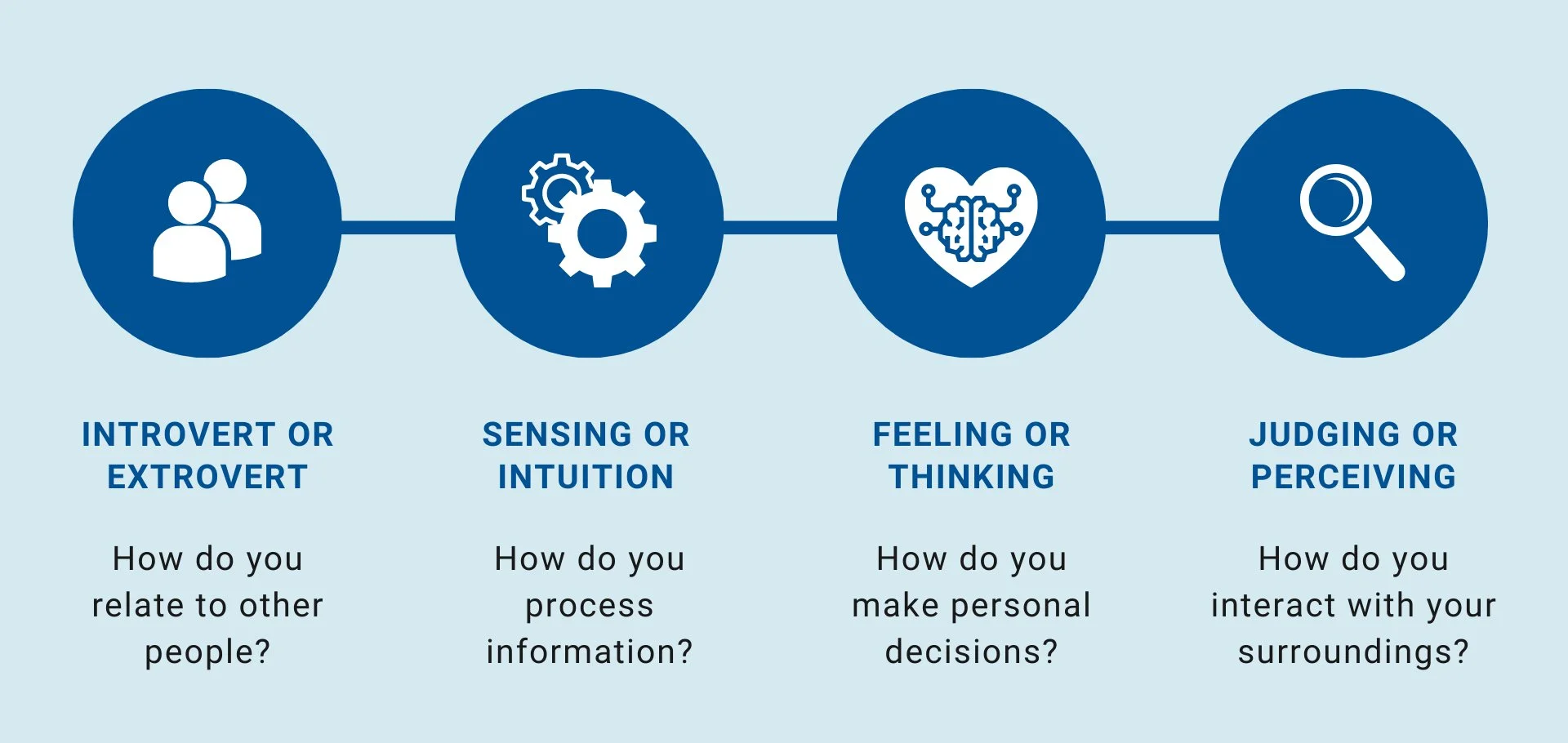
The Myers-Briggs Type Indicator is based on Carl Jung’s theory of psychological types or personality preferences in four areas: 

Energy Source. Introverts (I) get energy from inside themselves, while extroverts (E) get it from outside.

Information Method. Sensing (S) people gather factual data, while intuitive (N) people think of possibilities.

Decision Making. Thinking (T) people decide what is logical, while feeling (F) people decide on relationships and what is of value.

World View. Judging (J) people deal with the world in a planned, organized way, looking for closure when there is a problem, while Perceiving (P) people are more flexible and spontaneous, keeping options open. And when there is a problem, they keep gathering data.—Chester Michael and Marie Norrisey in Prayer and Temperament: Different Prayer Forms for Different Personality Types (Open Door, Inc., 1991).

We have discussed how knowing the Myers-Briggs personality types can help live life on life’s terms. The classic book Prayer and Temperament tells us how the Myers-Briggs test is helpful in our spiritual life, especially in deciding how to pray. Lectio Divina or Benedictine Prayer is suitable for all personality types.

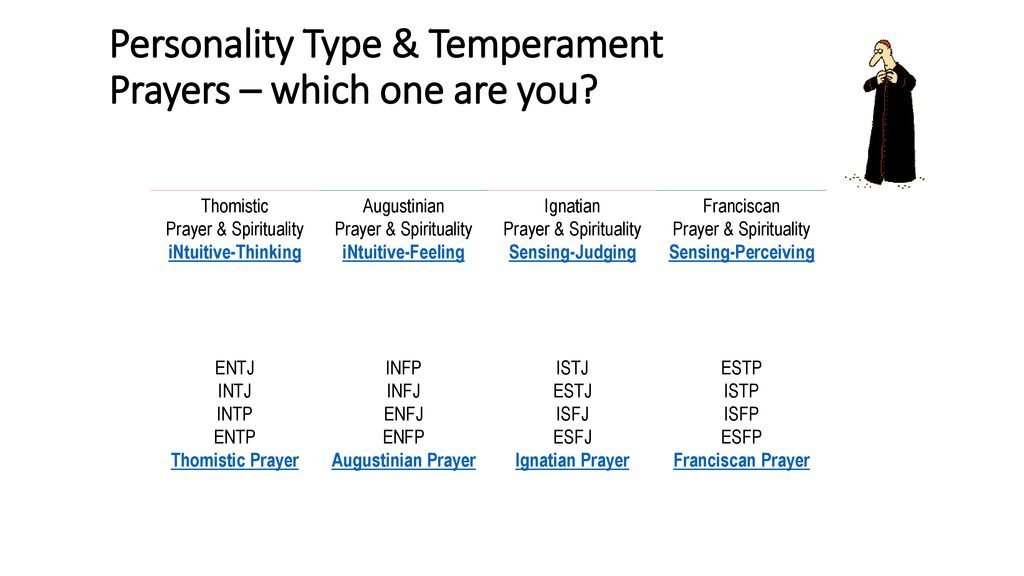
Augustinian Prayer emphasizes feeling and intuition, which may be best for the NF temperament.

The basic temperament of SP may best respond to Franciscan or prayer used by St. Francis.

Those with a temperament searching for truth, competency, and learning (NT) may best pray using the Thomistic or Dominican Spirituality of Thomas Aquinas.

The SJ temperament most easily understands the Spiritual Exercises of St. Ignatius, but NT and NF temperaments may also find the Exercises a rewarding form of prayer.

Ignatian prayer projects us into a scene, while Augustinian prayer transposes the words of the Bible so that the Bible is speaking directly to us.

Those practicing Franciscan Prayer (SP) must be free and able to go wherever the Spirit moves them. Their prayer leads to action, and their action is prayer. Therefore, they cannot tolerate long periods of silence.

Those who would best practice Thomistic Prayer (NT) are logical and orderly, thirst for truth, and address prayer almost like a scientific project or mystery to be solved.

Prayer became the mainstay of so many during the past pandemic. We learned several more ways to pray to enrich that time. We will talk more about it tomorrow.
Joanna Seibert   https://www.joannaseibert.com/
Prayer and Temperament

Prayer and Temperament

Myers-Briggs Personality Types

The Myers-Briggs Type Indicator is based on Carl Jung’s theory of psychological types or personality preferences in four areas.

1 How do you get your energy, and where do you focus your attention? Introvert (I) vs. extrovert (E). Do you get your energy from inside or outside of yourself?

2     How do you get your information? Sensing (S) or intuition (N). Do you gather factual data, or do you think of possibilities?

3     How do you make your decision? Thinking (T) or feeling (F). Do you decide what is logical or on relationships, and what is of value?

4     How do you deal with the world? Judging (J) or Perceiving (P). Do you deal with the world in a planned, organized way, or are you more flexible and spontaneous, keeping options open? When there is a problem, do you look for closure or keep gathering data?—David Keirsey and Marilyn Bates in Please Understand Me, Character and Temperament Types.

The Myers-Briggs Indicator test has been so helpful in understanding myself, my family, and those I work with. The above is, again, a short, very basic summary. There are also multiple books about it and tests you can use. When I talk to spiritual friends, I suggest they connect to a group or therapist who uses the indicator.

I remember how helpful this was in my medical practice. We soon learned that we needed all types in our group. We needed Js who wanted closure in solving problems, and Ps who tried to look at all the possibilities before deciding on an answer. We needed Ts, who wanted our group to look at what was logical, but we needed Fs, who looked at what was of value. We needed partners who were Is in our practice, who did not speak until they had processed an answer inside, but we needed Es who solved a problem by thinking outside and vocalizing their thought process. Finally, we need Ss who looked at concrete data, but Ns who looked at possibilities.

 So, the indicator can help us live life on life’s terms personally and in community, but how does it help our spiritual journey? Stay tuned. Knowing our type can help us decide what prayer practice best connects us to God.  

Joanna. https://www.joannaseibert.com/


Connections, Trips, and Soul Food

Sue Monk Kidd: Connections, Trips, and Soul Food

“Remember that little flame on the Easter candle. Cup your heart around it. Your darkness will become the light.”—Sue Monk Kidd, “A Journal Entry” in When the Heart Waits: Spiritual Direction for Life’s Sacred Questions (HarperOne, 1992).

Blue Mosque

We take another visit with Sue Monk Kidd. I wish I could have Sue Monk Kidd’s book, When the Heart Waits: Spiritual Direction for Life’s Sacred Questions, with me, and read it when meeting with other spiritual friends. I hope to remember her message about waiting. I see many people coming for direction, living the “night sea journey” in the biblical tradition of those waiting: Jonah in the belly of the whale, Christ in the tomb, or Joseph in the well where there is only darkness.

 I hope to remember Kidd’s phrase when we have difficulty letting go: “Put on your courage suit” and cross the bridge of letting go.

I began this book on Maundy Thursday in the Chapel of Repose with the Reserved Sacrament. I ended it in Greece with my husband, my daughter, and her husband in the week of Easter four as we overlooked the Acropolis. I know Kidd’s later books are about her trips to Greece, especially with her daughter, where she becomes even more connected to the feminine part of herself and God. My daughter and I have published a book together, just as Kidd and her daughter did—so much serendipity.

Kidd ends her book by describing a drawing of a mother and child that came out of her true inner self, based on a sketch she made at Kanuga, the home of my spiritual direction class. Several years ago, on Mother’s Day, we dedicated a sculpture of a mother and child in the garden next to St. Luke’s chapel that my husband had purchased.

More connections.

Later, my husband and I began another pilgrimage to our oldest granddaughter’s college graduation, again with our daughter and her husband.

As you can see, Sue Monk Kidd gets my attention and speaks to me. So today, as I relive these journeys, I try to follow more of Kidd’s direction, stay in the moment, and feed my soul real food instead of junk food.

The real food I am looking for is silence, laughter, solitude, treasuring the moments with children, grandchildren, and friends, care of my body, exercise, deep encounters, prayer, writing, reading, Eucharist, gratitude, seeing serendipity, forgiveness, and forgiving, delight, compassion, living in the present, empathy (sharing pain), and reverence for the earth, especially as I remember past trips to ancient and nearer parts of the world we both visited with our daughters on land and on the sea.

Retake a virtual trip in your mind to a country you once visited with a loved one, perhaps carrying a book by a favorite author. Maybe you traveled to England, Italy, China, Spain, Germany, Greece, Norway, France, South Africa, Canada, Mexico, or Israel.

 Give thanks for those you love who have traveled with you. Give thanks for writers who speak to your soul. Pray for that author, your family, and for people in that country to remain safe, especially the families of Ukraine and the Middle East.

tea time

Joanna joannaseibert.com. https://www.joannaseibert.com/