Spiritual Practices in our Workplaces

McQuiston: Finding Time, Spiritual Practices in our Workplace

“That’s when I stumbled across a quote from Rabbi Harold Kushner: ‘For the religious mind and soul, the issue has never been the existence of God, but the importance of God, the difference God makes in the way we live.’”—John McQuiston II in Finding Time for the Timeless: Spirituality in the Workweek (Skylight Paths, 2004).
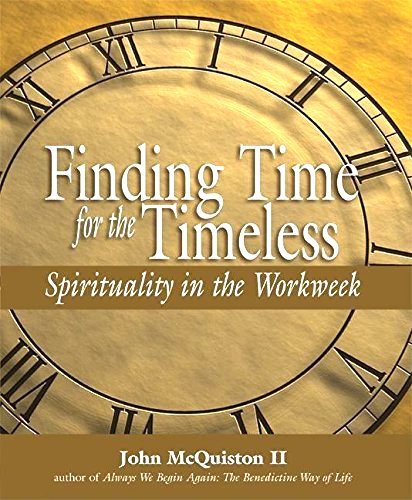
Memphis lawyer John McQuiston II is best known for his modern translation of The Rule of Benedict, Always We Begin Again. This third book by the author is a collection of real-life examples of spiritual practices of forty-two people from diverse religious and ethnic backgrounds who try to bring their spirituality to their workweek.

The quote above is from his story about a Memphis religious writer of a column called “Faith Matters,” or as he explains, “It is not Religion Matters or Church Matters, or Christianity Matters, but Faith Matters.” This became so meaningful for McQuiston that he taped it to his keyboard to remind him that he was not writing about religion per se but about how God works in our lives.

A Jewish engineer makes a gratitude list each morning in his thirty-minute drive to work. His office computer is programmed to ask him: “What are you thankful for today?” The founding of an accounting firm develops a “mental peace” each morning by walking to work. A Greek Orthodox dentist wears a cross under his shirt to constantly feel God’s presence. He frequently says the Jesus Prayer and has icons in his office.

Interspersed also in the book are five short essays by McQuiston, in which he discusses how spiritual practices increase the quality of the rest of his life, encouraging readers to find a practice that brings them joy.

There is also an annotated reading list and an excellent concluding summary or menu of the different practices described. The book is like a visit to a five-star restaurant, where we experience a little taste of spiritual practices from many modern and varied sources. We are then invited to make a selection to experience our own life-changing diet.

Joanna. https://www.joannaseibert.com/


Peterson: Kinds of Prayer

Peterson: Prayer

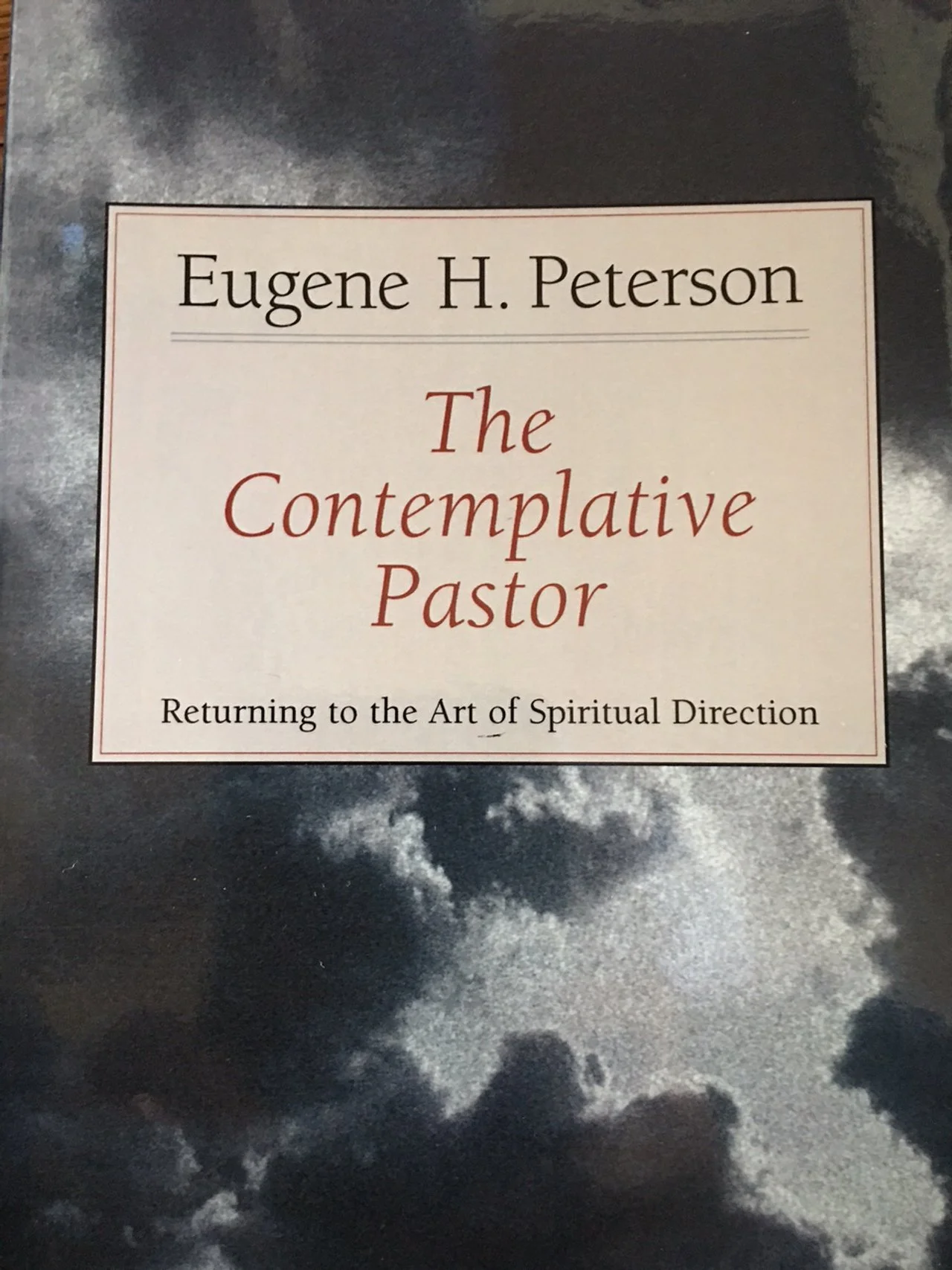
“I began to comprehend the obvious: that the central and shaping language of the church’s life has always been its prayer language. Out of that recognition, a conviction grew: that my primary educational task as pastor was to teach people to pray.”—Eugene Peterson, “What Is My Educational Task?” in The Contemplative Pastor: Returning to the Art of Spiritual Direction (Eerdmans, 1993).

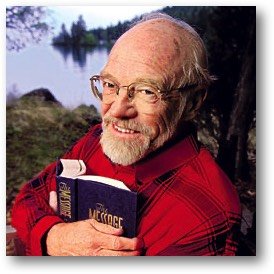
The well-known author of the popular modern Bible translation, The Message, reveals that his interpretation of the most important ministry of a pastor is being a spiritual director, teaching others how to pray. Of course, he is not downgrading teaching about faith, biblical writings, or the history of God’s people. Still, he calls pastors to be spiritual directors, returning to the wisdom of ancient spiritual leaders who trained people to connect to God and God’s love through various forms of prayer.

Peterson introduces us to making friends with our ancient forebears, beginning with Gregory of Nyssa and Teresa of Avila. Then, he challenges us to learn the language of intimacy, love, and relationship.

He reminds us of two great mystical prayer traditions, the kataphatic and the apophatic, one praying with our eyes open, the second praying with our eyes shut. Kataphatic prayer turns to icons, symbols, rituals, and incense, affirming the gifts of creation as a way to the Creator. Apophatic prayer calls for emptiness—a mind cleared of thoughts and images until one experiences the silence and nearness of God. The two ways of prayer can be mixed, and we will find one or the other more meaningful at different times in our lives.

However, this former professor of spiritual theology reminds us that the Psalms were written by people of God with their eyes open.

Joanna joannseibert.com https://www.joannaseibert.com/


Wolfe: Modified Prayer of St. Francis

Wolfe: Modified Prayer of St. Francis

This week, we discussed the classic book on personality types and prayer styles, Prayer and Temperament: Different Prayer Forms for Different Personality Types, by Monsignor Chester P. Michael and Marie C. Norrisey. The book is based on the Myers-Briggs Type Indicator Assessment, and explains five types of personal prayer developed over the centuries.

If your prayer type is Augustinian (Intuition, Feeling NF)—which finds prayer most meaningful when Scripture or a message is written for or speaks directly to you—this modification of the Prayer of St. Francis may suit you. In this prayer, adapted by a spiritual director, Jane Wolfe, God/Jesus/The Holy Spirit is praying, speaking directly to you. Jane’s premise is that we can turn any petition into listening, thanksgiving, and praise—whatever we wish.

On the other hand, the more traditional version of the Prayer of St. Francis may be more meaningful to you when you pray directly to God. So, I have also included it.

Prayer of St. Francis

Lord, make me an instrument of Your peace.

Where there is hatred, let me sow love;

where there is injury, pardon;

where there is doubt, faith;

where there is despair, hope;

where there is darkness, light;

and where there is sadness, joy.

O, Divine Master,

grant that I may not so much seek

to be consoled as to console;

to be understood as to understand;

to be loved as to love;

for it is in giving that we receive;

it is in pardoning that we are pardoned;

and it is in dying that we are born to eternal life.

Use it as a monthly reading, especially in Advent or Lent. Read one line daily for two days, as if God/Christ/Holy Spirit/your Higher Power says this to you. Then, begin again on the first day of each month.

1. I am the instrument of your peace.

2. Where there is hatred, I sow love.

3. Where there is injury, I pardon.

4. Where there is discord, I bring union.

5. Where there is doubt, I give faith.

6. Where there is despair, I bring hope.

7. Where there is darkness, I bring light.

8. Where there is sadness, I bring joy.

9. I console you.

10. I understand you.

11. I love you.

12. I give myself to you.

13. I pardon you.

14. I die for you.

15. I give you eternal life.

—Modified by Jane Lee Wolfe, “Spiritual Health and Fitness for the 21st Century,” Woodstock, Vermont. www.bogchapel.org