Serenity Prayer

Serenity Prayer

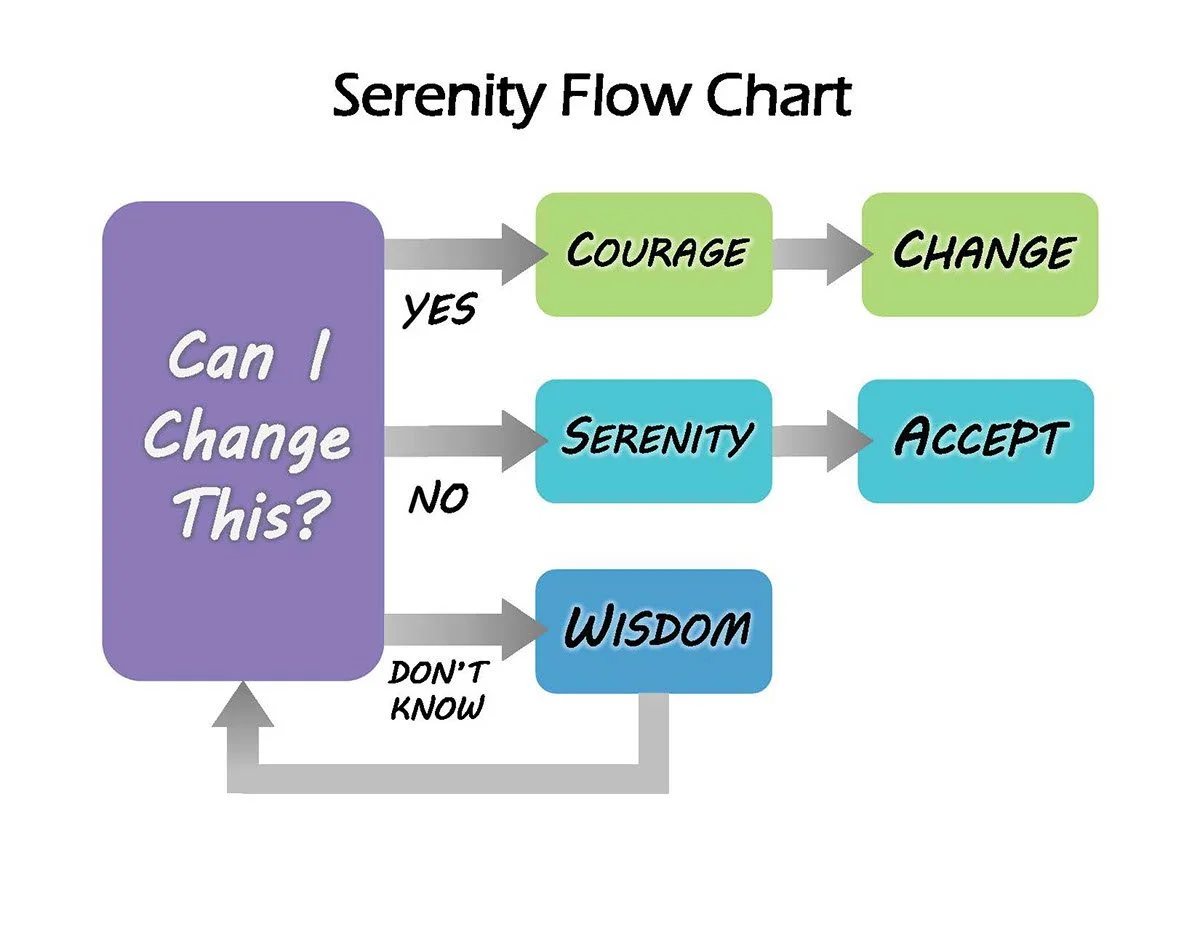
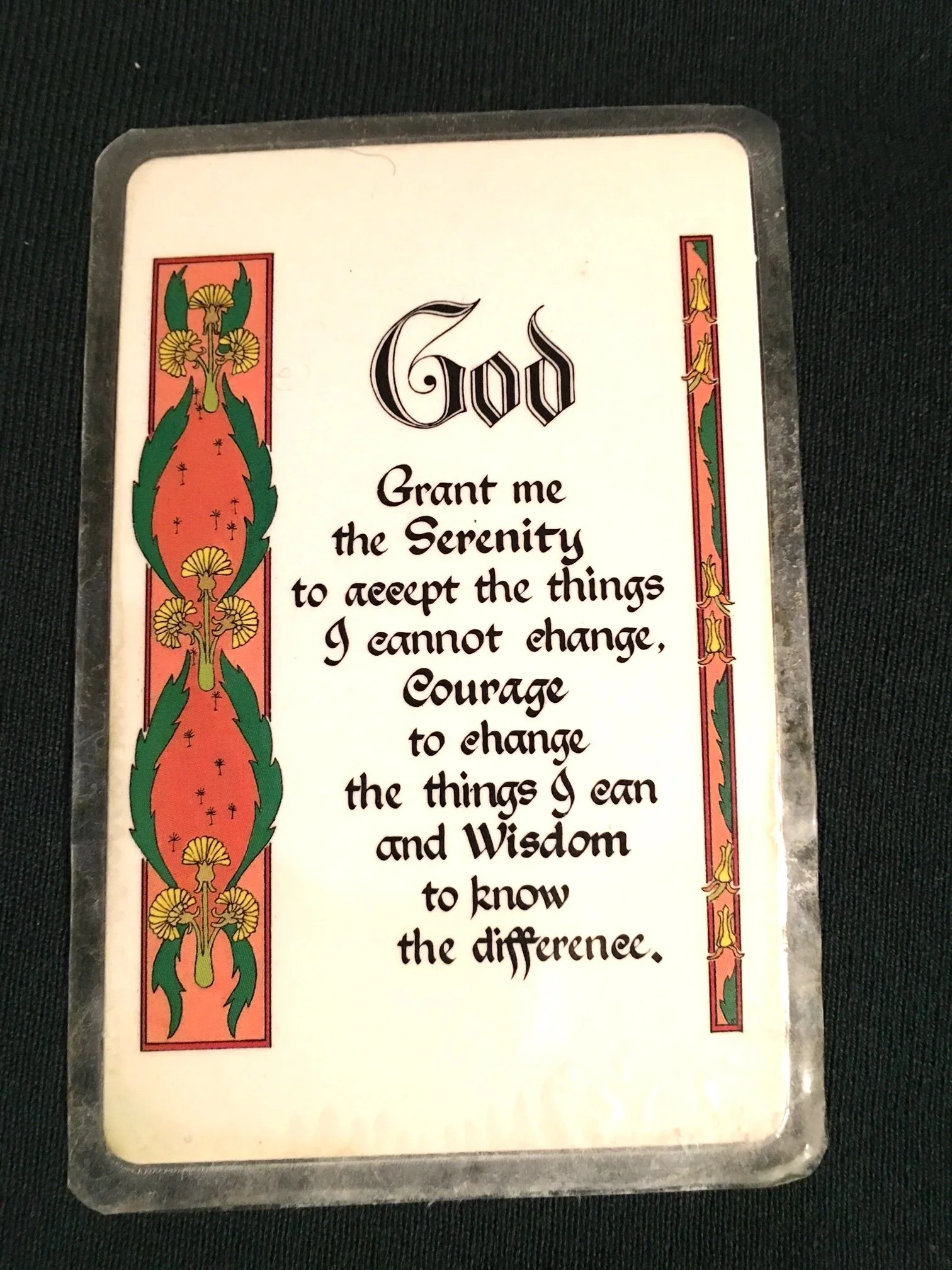
“God, Grant me the Serenity to accept the things I cannot change,

Courage to change the things I can,

And Wisdom to know the difference.”—Reinhold Niebuhr.

My grandmother kept a copy of the Serenity Prayer on her bathroom mirror. Today, I honor her by doing the same. I remember visiting her as a young girl and reading the prayer in her bathroom every morning. What I mainly remember is that I thought, “This is a ridiculous prayer! If there is a problem, I know if I try hard enough, I can solve or fix it!”

Many years later, many trials later, I have learned the truth of the Serenity Prayer the hard way. There are so many things I cannot change. The only thing I can change is myself and my reactions to other people and situations. I cannot change others. I try to share my firsthand experience with spiritual friends, but others like myself often need a firsthand rather than a secondhand experience to see this truth.

I wonder if it took my adoring grandmother as long as it did me to discover and learn to live the truth.

I wonder if she had as many setbacks as I often do—thinking I can change situations and others.

Literature for Pentecost

Arthur: Literature for Pentecost

At the Stillpoint “is a journey of the imagination guided by poets and authors, both classic and contemporary, who have known the things of God but speak in metaphor.”—Sarah Arthur in At the Still Point (Paraclete Press, 2011), p. 7.

At the Still Point, by Sarah Arthur, is a literary compilation of daily and weekly readings and prayers designed for the long green liturgical season between the Day of Pentecost and Advent. Arthur has also published similar guides for Advent, Christmas, Epiphany (Light Upon Light), Lent, Holy Week, and Easter (Between Midnight and Dawn).

In these twenty-nine weeks between the Day of Pentecost and the first Sunday in Advent, Arthur kindles our imagination as she exposes us to brief excerpts or short works of well-known writers and offerings from authors we may not know but should! As we encounter some readings in this anthology, Arthur warns us that there should be an alert: “Warning: Powerful Spiritual Moment Ahead!” She suggests we read these passages not as assignments for our English Literature class or for pleasure, but as liturgical pieces for worship, especially prayer.

Each week begins with an outline for the next seven days, comprising an opening prayer, Scripture passages, readings from literature, a place for personal prayer and reflection, and a closing prayer. Arthur suggests applying the ancient principles of Lectio divina, or divine reading that many of us have used with Scripture, now applied to selected weekly poetry and fiction writings.

We read the passage, meditate on it, pay attention to a word or phrase that connects to us, and finally rest in God’s presence with what we have experienced. It has been helpful to carry that word or phrase with me during the day or perhaps the entire week. Since this process is now used for literature and poetry rather than Scripture, Arthur has christened it holy reading or Lectio sacra.

I invite you to journey with Sarah Arthur and me during this “Ordinary Season” with an extraordinary spiritual practice of daily worship and prayer.

Joanna https://www.joannaseibert.com/

Thank you for supporting our camp and conference center, Camp Mitchell, on top of Petit Jean Mountain, by buying this book in the daily series of writings for the liturgical year, A Daily Spiritual Rx for Ordinary Time: Readings from Pentecost to Advent. All proceeds from the books go to Camp Mitchell. If you like this book, could you briefly write a recommendation on its page on Amazon? https://smile.amazon.com/Daily-Spiritual-Ordinary-Time-Pentecost/dp/B08JLTZYGH/ref=sr_1_1?dchild=1&keywords=joanna+seibert+books&qid=1621104335&sr=8-1

 More thank-you’s than we can say!!!


Merton and Spiritual Direction

Thomas Merton and Spiritual Direction

“The only trouble is that in the spiritual life, there are no tricks and no shortcuts. Those who imagine that they can discover spiritual gimmicks and put them to work for themselves usually ignore God’s will and his grace.”—Thomas Merton in Contemplative Prayers.

Thomas Merton’s concise book Spiritual Direction and Meditation is another excellent source for someone wanting to know about spiritual direction and the spiritual life. I often recommend it to spiritual friends before meeting them about direction for the first time. It should also be a frequent reread for those giving spiritual direction.

Merton reminds us that spiritual direction is not psychotherapy, and directors should not become amateur therapists. He recommends directors not worry about unconscious drives and emotional problems. They should refer.

Merton’s sections on meditations are classic, straightforward, and practical. For example, he uses the story of the Prodigal Son to serve as a model for reflection, as the son “entered into himself” and meditated on his condition, starving in a distant land far from his father. Merton also suggests the Incarnation, the birth of God into human form, as a focus for another meditation about birth events within our own spiritual life.

Merton emphasizes the importance of holy leisure, believing meditation should not be work, remembering it will take time. He reminds us of promising artists ruined by premature success, which drove them to overwork to renew again and again the image of themselves created in the public mind. On the other hand, a wise artist spends more time contemplating his work beforehand than putting paint on canvas. A poet who respects her art burns more pages than she publishes.

In the interior life, we must allow intervals of silent transitions in our prayer life. Merton reminds us of the words of St. Teresa: “God does not need our works. God has need of our love.” Our prayer life aims to awaken the Holy Spirit within us, so that the Spirit speaks and prays through us. Merton believes that in contemplative prayer, we learn more about God through love than knowledge. Our awakening is brought on not by our actions, but by the work of the Holy Spirit. 

Merton also cautions us about what he calls informal or colloquial “comic book spirituality,” which flourishes in popular religious literature. For example, when Mary becomes Mom and Joseph is Dad, and we “just tell them all about ourselves all day long.” For some, this may be a helpful path to God, but it was not Merton’s path.

Joanna. https://www.joannaseibert.com/
Thank you for supporting our camp and conference center, Camp Mitchell, on top of Petit Jean Mountain, by buying this book in the daily series of writings for the liturgical year, A Daily Spiritual Rx for Ordinary Time: Readings from Pentecost to Advent. All proceeds from the books go to Camp Mitchell. If you like this book, could you briefly write a recommendation on its page on Amazon? https://smile.amazon.com/Daily-Spiritual-Ordinary-Time-Pentecost/dp/B08JLTZYGH/ref=sr_1_1?dchild=1&keywords=joanna+seibert+books&qid=1621104335&sr=8-1

 More thank-you’s than we can say!!!