May You Live Long Enough

Guest Writer: Isabel Anders: Ricoeur and Anonymous: May You Live Long Enough

“I find myself only by losing myself”—Paul Ricoeur.

“It is always possible to argue against an interpretation, to confront interpretations, to arbitrate between them and seek an agreement, even if this agreement remains beyond our reach.”

—Paul Ricoeur.

May you live long enough …

To be able to laugh at your most embarrassing moments in the past—sportingly owning the temporary title of “dunce”—before passing it on to the next clown in this dance of win-and-lose, hit-and-error called “life.”

To side with your former adversaries, if only for a glancing moment—to accept that in certain past disagreements or outright conflicts that cobble your past: “The other person had a point.”

To realize that even your greatest “triumphs” owe much to outside influences: others’ kind and diligent contribution, the coming together of circumstances, and “sparks” of grace flung from afar that happened to hit you at the moment.

To experience prayer as the automatic breathing of petitions for others’ good—urgently present in your heart before your own needs or requests enter your awareness.

To meet someone whose efforts or example—in any category—put you to “shame,” and feel the joy that such understanding, expertise, or goodness exists in the world apart from your receiving any specific personal gain from it.

To recognize that your “defeats,” by the world’s judgment, were blessed checks and balances in the larger arc of your journey toward maturity and self-acceptance.

To feel genuinely sad for people who seemed unfair and cruel to you for no apparent reason and to lament the conditions that must have made them that way—even when their cruelty caused you genuine pain.

To let go of any idea that we might be able to judge who is worthy or unworthy of anything that comes to them in this life-or in the life to come.

“We look not at what can be seen, but at what cannot be seen; for what can be seen is temporary, but what cannot be seen is eternal.”—2 Corinthians 4:18.

“We also boast in our sufferings, knowing that suffering produces endurance, and endurance produces character, and character produces hope, and hope does not disappoint us because God’s love has been poured into our hearts. …”—Romans 5:3-5.

Isabel Anders

Author of Circle of Days: A Church Year Primer--Years B and C: A Celebration of the Major Themes and Texts of the Church Year

Year A is out as well!

my grandmother and her sisters

Life After Death

 Life After Death

“So, what do you think about life after death?”

Guest Writer: Larry Burton

As an Episcopal priest, I have heard that question, or others like it, more times than I care to count. I think the Resurrection event may not cover the question of what happens when we die like I would have thought it did. “But,” a friend said, “that was Jesus. This is me.” Fair enough.

We have been reading Frederick Buechner’s A Crazy, Holy Grace. Buechner, who died in 2022 at age 96, was a prolific author and theologian many of us greatly admire. In part of this book, he imagines a conversation with his beloved grandmother, who has been dead for over forty years. She tells him that death is like stepping off a trolley car. Life doesn’t stop, but continues as a further deepening understanding of God’s grace and love.

That imaginary conversation stopped me in my tracks. For most of my life as a theologian, I have thought (and taught) something similar, but it was far more abstract and ultimately not satisfying. Buechner has his grandmother put humanity on my abstractness and offers an image of continuity in God that stopped me flat. Did I believe what I had been teaching? Yes. No question. But now, the abstract has taken on a form that challenges and delights. 

So, I had my own imaginary conversation with my preacher father and stepmother. Both are dead. But they were delighted to talk with me. “Sorry you had to wait so long to understand,” Dad said after I told him about Buechner’s book. (My father was a Buechner fan, so he was way ahead of me.) My stepmother added her two cents’ worth: “I always thought suddenly I’d ‘get it,’ but it didn’t happen that way. There are always new layers or new heights, and my heart! My heart just continues to open wider and wider.”

My words in their mouths? Or their words in my mouth? Buechner’s grandmother challenges her grandson, just as I am challenged. Buechner’s major point is that memory can be an astounding portal into the wonders of God. So, what do I think about life after death? I am more convinced than ever that as a beloved child of God, access to the reality of God’s love is far more cosmic, mysterious, and wondrous than I had imagined. It is more than Resurrection; it is a continuing transformation, moving toward God’s very heart.

Larry Burton                

Frederick Buechner’s birthday was a few days ago on July 11.

Joanna. https://www.joannaseibert.com/


Lamott: Prayer

Lamott: Prayer

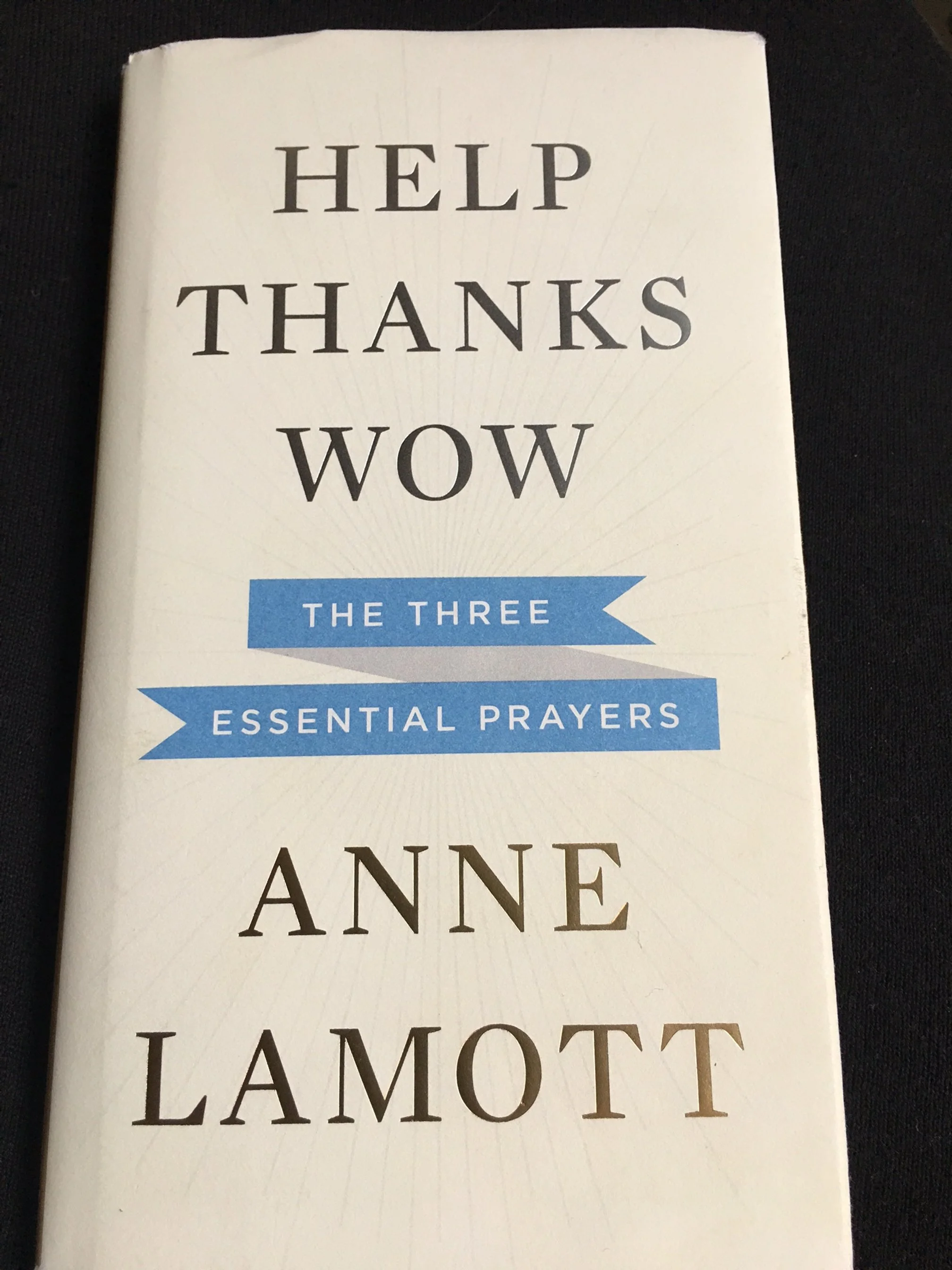
“So prayer is our sometimes real selves trying to communicate with the Real, with Truth, with the Light. It is us reaching out to be heard, hoping to be found by a light and warmth in the world, instead of darkness and cold. Even mushrooms respond to light—I suppose they blink their mushroomy eyes, like the rest of us.”—Anne Lamott in Help, Thanks, Wow: The Three Essential Prayers (Hodder & Stoughton, 2001).

When spiritual friends have difficulty praying, we talk about our present prayer life and what kind of prayer discipline has helped in the past. We discuss the multitude of ways to pray: walking and praying, praying in silence, using prayer books, Ignatian prayers, Centering Prayer, prayer with beads, praying in color, and praying the monastic hours.

Anne Lamott’s book Help, Thanks, Wow is a realistic, humorous, short, down-to-earth discourse on praying with three subject lines: giving thanks, asking for help, and praising. The book is filled to the brim with simple “one-liners” to remember and guide us through the day. One of my favorites is, “If one person is praying for you, buckle up. Things can happen.” Another is, “The difference between you and God is that God never thinks he is you.” Finally, she reminds us that gratitude is not lifting our arms and waving our hands as we see on television but rather picking up trash, doing what is required, and reaching out to others in need. When we breathe in gratitude, we breathe it out.

Lamott’s section on “Wow” likens that kind of prayer to a child seeing the ocean for the first time. I still remember standing just inside the National Cathedral as a group of fifth-graders walked in. I will not forget one small boy who looked up at the high, vaulted gray stone ceilings and exclaimed: “WOW!” These are uppercase wows. There are also lower-case wows, such as getting into bed between clean sheets. Lamott suggests poetry is “the official palace language of Wow.” She also reminds us of C. S. Lewis’s view of prayer, that we pray not to change God, but to change ourselves.

My experience is that Lamott constantly stimulates us into new faith practices or reminds us about those we have forgotten. This can bring welcome renewal to our everyday lives.

Joanna. https://www.joannaseibert.com/