Image Gently

Image Gently

“Relationship is not a project, it is a grace.”—Thomas Moore in Soul Mates: Honoring the Mysteries of Love and Relationship (HarperCollins, 1994), p. 256.

My friend, Marilyn Goske, also a pediatric radiologist, spearheaded Image Gently’s campaign to decrease radiation to children in diagnostic radiology. This organization encourages physicians to use the least radiation when performing tests on children. It applies to conventional X-rays, fluoroscopy, interventional radiology, nuclear medicine, computed tomography, dentistry, cardiac imaging, and imaging in the setting of minor head trauma.

 In addition, the organization aims to educate physicians, technologists, and nurses about the amount of radiation used and the importance of reassuring parents about their concerns. This educational program involves communication with all those directly involved in these studies and all medical organizations that support them. It has achieved overwhelming success, with over 1.9 million participants pledging to this program.

Marilyn shows us how to change the world by communicating and dialoguing with all people who share a particular interest. It involves trying to solve a problem, working together, celebrating when answers come, and honoring those who bring the vision to reality. In this way, we see the power of community.

I realize how important this could be in our spiritual lives. We find more answers to our spiritual questions in community, whereas often we cannot understand our concerns on our own.

 I remember meeting with my spiritual director, who helped me understand a dream that had baffled me for days. Each day, in the early morning, I return to the dream and uncover another insight, as though she and all those who have taught me about dreamwork are still guiding me.

We also have many aspects of ourselves: the inner masculine, the inner feminine, the child within, and many more. They reveal answers when we see them as helpful voices, rather than unwanted adversaries, especially when they come from the weaker parts of ourselves. It is in our weakness, in our vulnerability, especially in community, that God the Holy Spirit creeps in and helps us discern a path, where before we saw only a jungle.

In community, we image gently.

Joanna. https://www.joannaseibert.com/


Message in the Eucharist: Thanks and Abundance

Lessons From The Eucharist: Thanks and Abundance

“The church is the only community that has as its central symbolic act called ‘Thanks.’ The Eucharist. Eucharist is Greek for ‘Thanks.’ Participation in the Eucharist is an act of gratitude for the abundance that the creator God gives to the world!

But the extraction economy wants to think, ‘It’s mine!’ ‘I made it, I own it, I can do what I want, I don’t have to be grateful to anybody.’ Which leads me to think that participation in the Eucharist is the most subversive thing we can do. But notice what the long history of the church has done to the Eucharist. It has siphoned off its danger into something about sin and salvation and getting right with God, rather than a meal for the neighborhood.”—Walter Brueggemann.

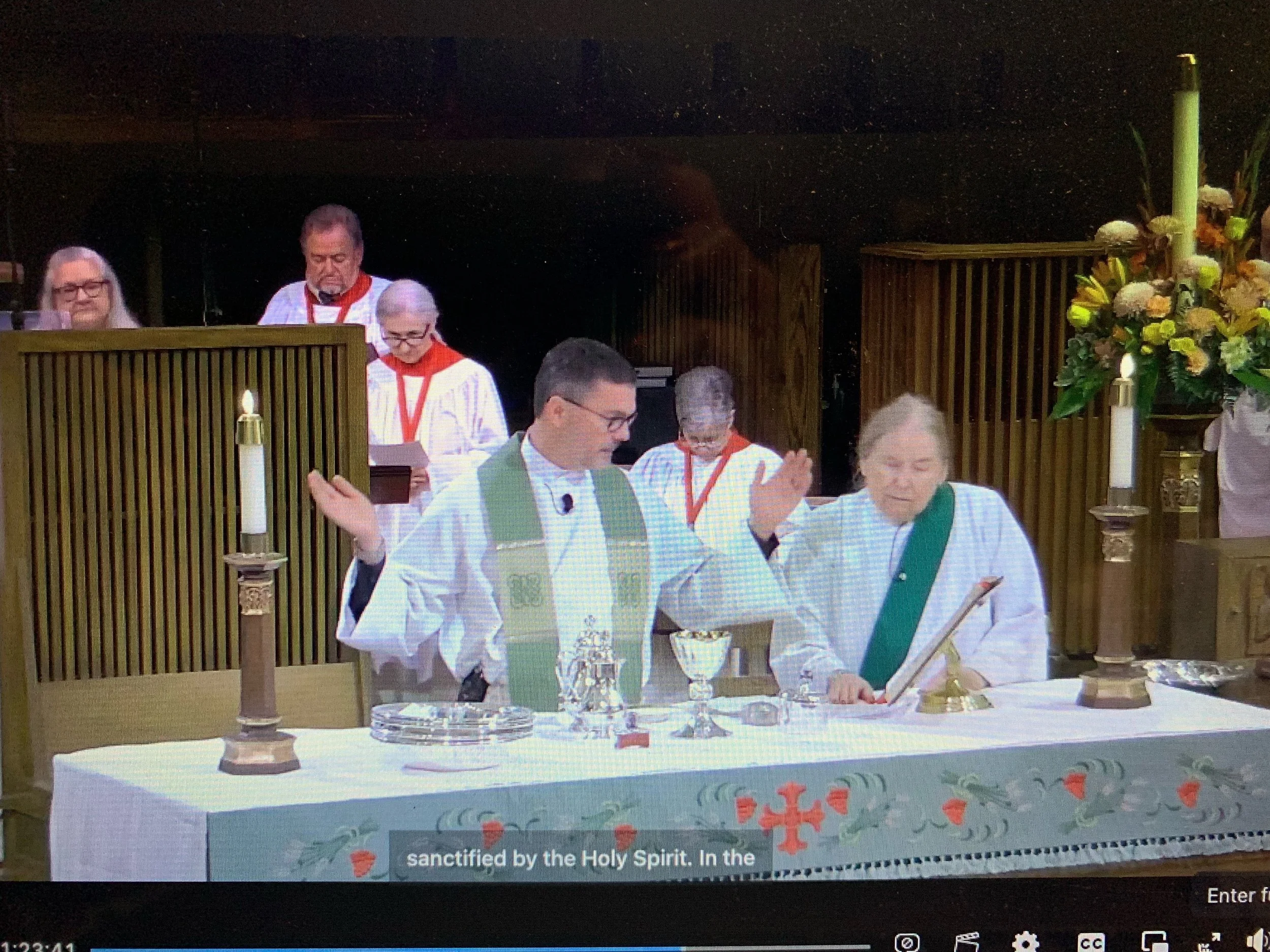
Brueggemann reminds us of something we so often forget about the Eucharist. Christ called all to the Welcome Table, which should be the center of our worship. Weekly or daily Eucharist is an experience of abundance. There is always enough bread and wine, and always some left over. The Eucharist is a reminder of a great gift: the love of God for each of us and for all.

Remembering we are giving thanks for God’s great gift of love,

Remembering this is a table of abundance for all,

 Remembering this is an assurance that we have been given a life of abundance through Christ

 Can make all the difference in how we receive the Eucharist and

How we live our lives.

Joanna. https://www.joannaseibert.com/
 

Knowing the Way to Go

Knowing which way to go

 And when you turn to the right or when you turn to the left, your ears shall hear a word behind you, saying, “This is the way; walk in it.”— Isaiah 30:21.

fork in the road

How do we hear the voice of God telling us what to do and where to go? There are many options, perhaps more than the stars. The purpose of all our spiritual practices is to position ourselves to hear God’s direction.

Many believe God is the dream maker who speaks to us in the language of dreams at night. However, my experience is that I can only find meaning in a dream group. Looking back on what I thought this dream meant, the answer was obvious, but only other people could see it.

Many discernment processes can help decide the next path. The one I use the most is Ignatian discernment, where we visualize or imagine our lives in one situation and then in the other. Ignatius suggests that we can discern our path by evaluating how we felt after imagining each situation, rather than how we felt while imagining it.

Many use spiritual direction from another person to guide them. The director is there to help the person connect with their inner soul, where answers often come from.

My experience is that the hours just after waking in the morning are often when situations become clearer. So I try to be silent and wait to see if answers come.

This reading from Isaiah also reminds me of Benedict’s direction in the prologue to his Rule: “Listen with the ear of your heart.”

Joanna Seibert https://www.joannaseibert.com/