Healing through Forgiveness

Nouwen: Healing Our Hearts Through Forgiveness 

“How can we forgive those who do not want to be forgiven? But if our condition for giving forgiveness is that it will be received, we seldom will forgive! Forgiving the other is an act that removes anger, bitterness, and the desire for revenge from our hearts. Forgiving others is first and foremost healing our own hearts.”—Henri Nouwen in Bread for the Journey (HarperSanFrancisco, 1997).

Several years ago, I was part of an amazing group of women in Searcy, Arkansas, as we discussed the topic of forgiveness. One of the first questions from two women was, “How can I forgive someone who has harmed me or someone I love when they do not see they have done any wrong?”

These are the most complex hurts for me to forgive as well. We think we are doing fine, but then we hear how the people involved see no wrongdoing on their part, and an angry dragon rears its head again. This anger is nothing like our initial reaction, but it still endangers our body, mind, and soul. We are allowing the people and the situation to continue harming us—unless we can transform that energy into something useful for our bodies and the world.

I think of a small church-related school that many of my friends were part of, which closed overnight. After several years, most of us have worked through the disappointment and have moved on. We will all carry a scar, but for the most part, the wound is healing.

Most of us decided that if we cannot forgive those involved in the closing or those who did nothing to prevent it, they are still hurting us. They occupy space in our minds, lives, bodies, and relationships with others. We all have prayed to transform this hurt’s enormous energy into something positive. We are all now discovering gold deep down below this pain.

I often visit a place where I recall the children, teachers, and school board singing and carrying small, lit candles through tears as they walked out into the world in pairs at the conclusion of the school’s last graduation. What I cherish every day is the light that each of those involved at this school now brings to many other schools, homes, churches, and places of work.

We have been sent out to share what we learned from that experience: the relationships, the love, the kindness to others, the acceptance of differences, and the belief in a loving God. For example, Jennifer, in the upper picture, who was on the school board, is now changing more lives as the president and CEO of Achieve Community Alliance, advancing independence, productivity, and community involvement for Arkansans in need. In the lower picture is Beth Maze, the school chaplain, who now leads formation at St. Paul’s in Fayetteville, the largest church in our diocese.

There was an abundance of light radiating from that school. That is why it was so hard to leave. But now, we are commissioned to carry the light we received there out into the larger world. We can make a difference in so many other lives, and so many continue to do simply that.

Joanna  https://www.joannaseibert.com/



Practicing What We Preach

 How to Practice What We Preach

“If mainstream Christianity has steadily lost force and credibility, I wonder how much might be attributed to the fact that we preach one gospel and live another. We preach the Good Samaritan and lock our church doors. We preach the lilies of the field and allocate large amounts of our monthly paychecks to pension and insurance plans.”—Cynthia Bourgeault in Mystical Hope (Cowley, 2001).

This is the old adage of ‘practicing what we preach.’ We talk one way, but act another. My experience is that much of what we do is unconscious. We consider ourselves to be good and caring individuals. A particular belief is part of our core values, but our society often speaks against it or fails to value it. This gives us excuses or wiggle room, so we don’t have to follow through.

My experience is that fear and the scarcity/zero-sum mentality most often keep us from being the person God created us to be. As a result, we cannot act on what we know at our core is true. We fear we will not have enough money. We worry someone will break in and steal what we already have. We fear our health will fail. We experience anxiety over the thought of being left alone, abandoned, or harmed. We fear that speaking out for what we believe will cause us to lose friends or even our jobs.

Being grateful and expressing thanksgiving for what we have is one of the best ways to move beyond a fear-based life. This offers us a daily reminder of how much God cares for us, loves us, and is always beside us.

Steve Wright

Steve Wright

When I am most fearful, I rise early in the morning and watch the sunrise, acknowledging the fear within me and making a gratitude list of how I have been cared for and loved. Out of deep darkness comes overwhelming light. God gives us fresh hope and a fresh start each day. Resurrection comes out of the darkness when we have the courage to look fear in the eye and realize the blessings and gifts we have been given.

Living out of gratitude rather than fear can help us practice what we preach.

Joanna https://www.joannaseibert.com/



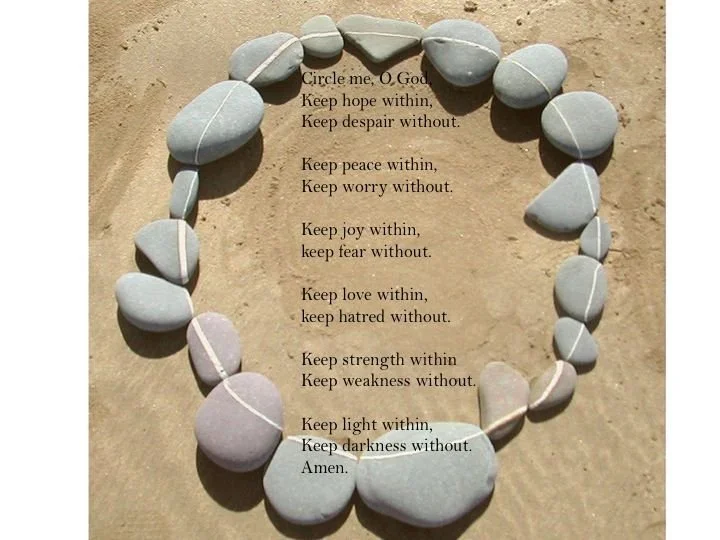
Ancient Celtic Prayers for Today

Daily Protection Celtic Prayer

“May the guiding hands of God be on my shoulders,
may the presence of the Holy Spirit be on my head,
may the sign of Christ be on my forehead,
may the voice of the Holy Spirit be in my ears,
may the smell of the Holy Spirit be in my nose,
may the sight of the company of heaven be in my eyes,
may the speech of the company of heaven be in my mouth,
may the work of the church of God be in my hands,
may the serving of God and my neighbor be in my feet,
may God make my heart his home,
and may I belong to God, my Father, completely.”—Lorica of St. Fursa (Fursey), 7th Century, Translation composite, from Facebook Page of the Rev. Dr. Frederick Schmidt.

Fred Schmidt puts a prayer on his Facebook page almost every day. I cannot get this one out of my mind. St. Fursa was an Irish monk who was among the first to spread Christianity to Anglo-Saxon England in the seventh century. A “Lorica” is a protection prayer in the Irish Celtic tradition, often used before going to battle. It may have originated from the original Latin word "lorica," meaning breastplate or armor. It may have been inspired by Paul’s writing in Ephesians 6:11 to “put on the whole armor of Christ.”

As modern Christians, we can learn a great deal from the Celts. We have a treasury of their wisdom because they highly valued writing and education. On the other hand, I think of others who worshiped God, whose traditions we know nothing about because their experience—and not the writing—was primary to them. We need both.

This form of prayer should meet us as we wake up in the morning, maybe with that first cup of coffee or tea, or even before.

We may need to return to it during the day, leaving a copy in a convenient place so we do not forget to put on “the whole armor of God.” Sometimes, life seems like going into battle. However, my experience is that when prayers like this become part of our being, we recognize that the struggle is over and love has already won.