Kelsey: Two Spiritual Paths

Kelsey: Two Spiritual Journeys

fork in the road

“There are two quite different ways of leading people on the spiritual pilgrimage, which have often been seen as opposed to each other.”

 — Morton Kelsey in Companions on the Inner Way, The Art of Spiritual Guidance (Crossroad 1983), pp. 7,8.

 Kelsey first describes the sacramental method of spiritual direction, in which we use spiritual practices involving concrete matter, music, pictures, beads, rituals, and symbols to connect to God. Kelsey calls this method the kataphatic way from the Greek meaning “with images.” The downside is that these can lead to idolatry, worshiping the means we use to reach God instead of worshiping God. For Episcopalians, it has always been the Book of Common Prayer, as illustrated by the difficulty our tradition has had in revising it. As a result, droves of people leave the church. The same thing may happen in churches when the altar is moved, when we change the order of service, or even when we change the prayers.

Kelsey describes the second path based on the belief that we best connect to God by emptying ourselves of all images, remembering that there is no way to explain or represent the holy. In silence and emptiness, we connect to the God within. This is the apophatic way, from the Greek for “without images.” It has been the way of Hinduism, Buddhism, and Christian contemplative forms, such as Centering Prayer. Kelsey believes the downside is that this inner work can occasionally lead to a reluctance to reach out to others, even though the desired result is to connect to the Christ we find within ourselves to the Christ in others.

Kelsey encourages us to practice both methods. The two are essential to a well-developed and informed spirituality.

Joanna joannaseibert.com. https://www.joannaseibert.com/
 

Butler Bass: Belonging

Butler Bass: Belonging

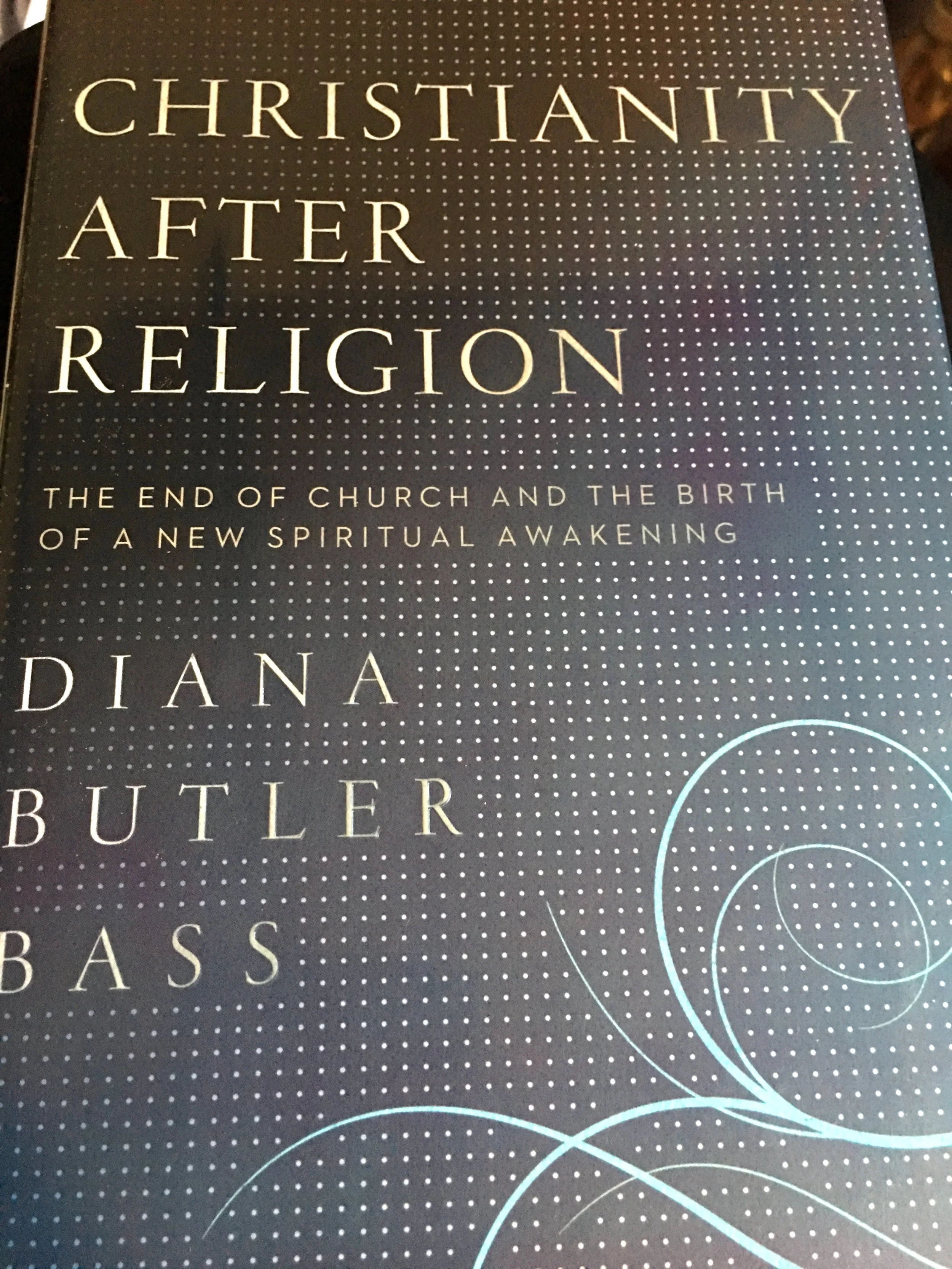
“Instead of believing, behaving, and belonging, we need to reverse the order to belonging, behaving, and believing. Jesus did not begin with questions of belief. Instead, Jesus’ public ministry started when he formed a community.”—Diana Butler Bass in Christianity After Religion: The End of Church and the Birth of a New Spiritual Awakening (HarperOne 2011), pp. 11-64.

Diana Butler Bass seeks to help us understand what is happening in today’s changing Christian landscape, where religion is no longer the center of a member’s life. She reminds us that our religion started with community, not confession.

Thomas Watkins from Wilson, North Carolina, also tries to explain how our church might change using the South’s love of football in an article in the Journal of Preacher (“Game Day: Becoming a New Church in an Old South,” Pentecost 2017, vol. 40, no. 4) “They (fans) are not asked to show their diplomas at the stadium gate.”

One of the most frequent questions of those seeking spiritual direction is, “I don’t know if I believe or what I believe anymore. Maybe I am no longer a Christian.” If the person belongs to a confessional denomination or church of orthodoxy, where they must believe a specific set of doctrines, this can sometimes be a problem.

 Some denominations are churches of orthopraxy, where members are held together because of how they worship or practice their faith. In that circumstance, a changing belief is sometimes considered an asset, a sign of growth. Our relationship to God will change as our God becomes larger, as we see the Christ in more and more people, people who are very different from ourselves.

 I often quote that line I first heard from Alan Jones at a Trinity Wall Street conference at Kanuga in the early 2000s: “The opposite of faith is not doubt, but certainty.”

Doubting signifies that God is working in us; our relationship is changing. Sometimes, this change in the relationship can feel like the movement of the Earth’s tectonic plates. Sometimes, it can be like a volcano erupting.

But, if we can take it as a good, not a bad thing, and try to stay steady, a new relationship and a new life will arise. I remember a quote from Catherine Marshall, “Those who never rebel against God or at some point in their lives have never shaken their fists in the face of heaven have never encountered God at all.”

Community is so important in this process. In a church alive with the spirit, there will be many others who have experienced this awakening who can walk and hold a steady hand when the foundations that we thought were our beliefs are threatened.

We see that these beliefs are not endangered but enlarged. We learn about these enlarging connections to God through belonging to a community.

You can follow Diane Butler Bass online at Diane Butler Bass, The Cottage, dianabutlerbass@substack.com

Joanna                https://www.joannaseibert.com/


Whyte: Spirituality at the Workplace

 Whyte: Spirituality at the Workplace

“The first step to preserving the soul in our individual lives is to admit that the world also has a soul and somehow participates with us in our work and destiny. That there is a sacred otherness to the world that is breathtakingly helpful simply because it is not us.”— David Whyte in The Heart Aroused, Poetry and the Preservation of the Soul in Corporate America (Crown Business, New York 2002), p. 280.

In his book, The Heart Aroused, poet David Whyte writes about taking our spirituality to the workplace, where it is desperately needed by ourselves and others. He believes preserving the soul means giving up our desire to avoid unscheduled meetings in the very scheduled workplace. My experience is that God drops into my life with interruptions that are not on my agenda.

Whyte believes we must relinquish the belief that the world owes us a place on a divinely ordained career ladder. We have a place in the world, but it is constantly shape-shifting. Our profound struggles can be our most significant spiritual and creative assets and the doors to creativity. The Greeks said that if the gods wanted to punish someone, they granted them everything they wanted.

Likewise, the soul’s ability to experience joy in the workplace is commensurate with our ability to feel grief. We walk into corporate offices looking like full-grown adults, but many parts of us are still playing emotional catch-up from the suffering and traumas of childhood, which unconsciously refuse to grow any older until the trauma is resolved.  

The most dangerous time for a male is around nine o’clock on Monday morning, and later in the few months following his retirement, when more injuries and illnesses occur. One is a death caused by carrying the burden, and the other is the ability to live without the burden.

Work almost always becomes a platform for self-righteous moralizing. Hurrying from one workstation to another, we hope the rushing can grant us the importance we seek. Whyte suggests that by slowing for a moment, we might open up to the emptiness at the center.

Whyte reminds us how astonishing it is to see how we shrink from the things nourishing our souls and take on every possible experience to quit it. I did this for dream work, because I became too busy with my “church work” to attend my long-time dream group. I also see this continually in my spiritual direction, where I have difficulty fitting my spiritual director into my “busy schedule.” I texted her on her birthday recently, and we hope to meet soon. Not soon enough!

Joanna   https://www.joannaseibert.com/