Buechner: Remembering Maundy Thursday
Buechner: Remembering Maundy Thursday

“WHAT YOU ARE GOING to do,’ Jesus says, ‘do quickly.’ … Jesus tells them, ‘My soul is very sorrowful, even to death,’ and then asks the disciples to stay and watch for him while he goes off to pray. … His prayer is, ‘Abba, Father, all things are possible for thee; remove this cup from me; yet not what I will but what thou wilt,’—this tormented muddle of a prayer which Luke says made [Jesus] sweat until it ‘became like great drops of blood falling down upon the ground.”

He went back to find some solace in the company of his friends, but when he arrived, he found them all asleep. ‘The spirit indeed is willing, but the flesh is weak,’ he said, and you get the sense he was speaking to himself as well as to them.”—Frederick Buechner, “Last Supper” in The Faces of Jesus: A Life Story (Paraclete Press, 1974).

We constantly grapple with our own humanity. Many spiritual friends I meet, including myself, spend a lifetime striving for perfection. Holy Week is a time to reflect on Jesus’ struggle with his humanity, as best depicted in the synoptic Gospels of Matthew, Mark, and Luke at the Passion Gospel readings on Palm Sunday.

 On Maundy Thursday in these Gospels, Jesus reveals how complex the human condition is. As he asks for this cup to pass, he sweats “blood.” On Good Friday, we read from John as Jesus cries out as he dies of thirst.

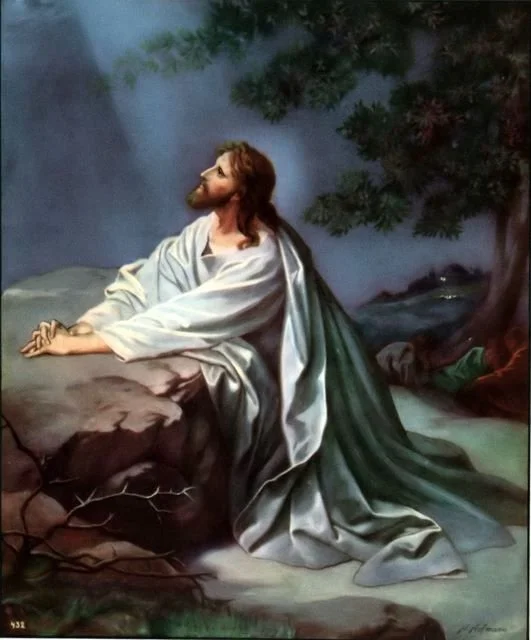
A large painting of Jesus praying at Gethsemane hangs at the front of the sanctuary inside the Methodist Church where I grew up in Virginia. The image of Jesus praying in the Garden differs from other depictions of his prayer in the Gospels. A thorn bush is beside him, and the sleeping disciples in the distance are barely visible. This time, Scripture shows us Jesus’ human side. This image is a reminder to hold onto when we pray through tough situations and feel alone. 

We can relate to and identify with Jesus and others who have experienced similar struggles. I observe this in grief recovery groups, where people listen because they understand the pain others are going through. I see this in twelve-step groups, where alcoholics, addicts, and co-dependents hear from others walking a similar path. 

It's amazing that our God loves us so much that God chose to be among us and suffer. This week, we especially remember that God has experienced and understands what it's like to suffer and be human. There is no greater love. 
dan abrams

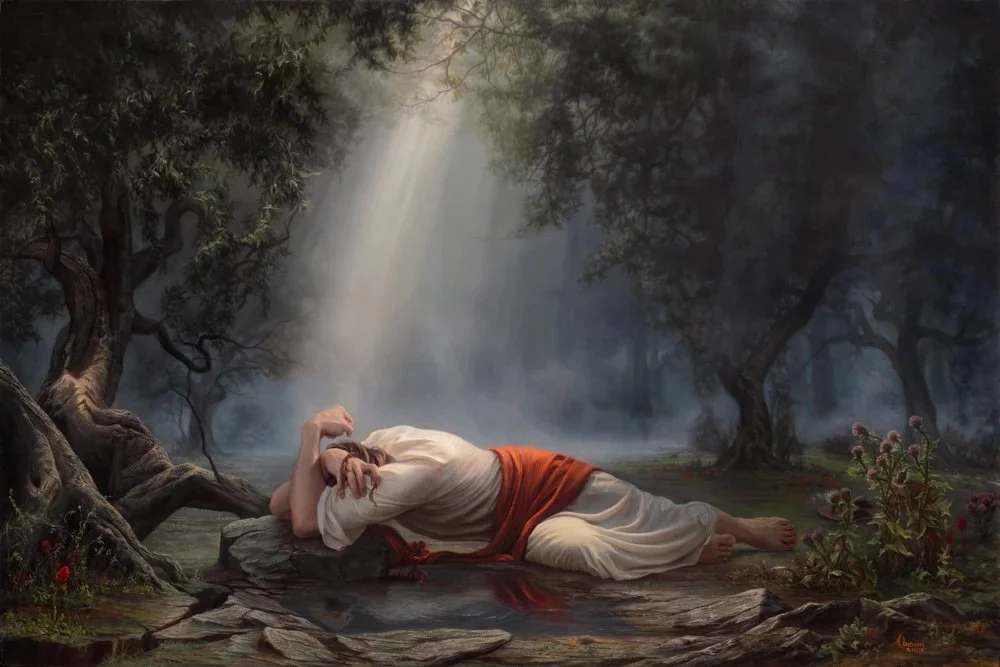
I picture each of us praying, sometimes in distress, beside Jesus in the Garden of Gethsemane. Unlike the disciples, we have some understanding of the danger ahead. I see each of us praying with Jesus in the garden, asking that “this cup will pass.” He is right there with us, fully aware and experiencing exactly what we are going through. There is no greater love than His Presence in our times of great stress.

Joanna  joannaseibert.com. https://www.joannaseibert.com/
Let This Cup Pass. Approaching Maundy Thursday

Let this Cup Pass. Approaching Maundy Thursday

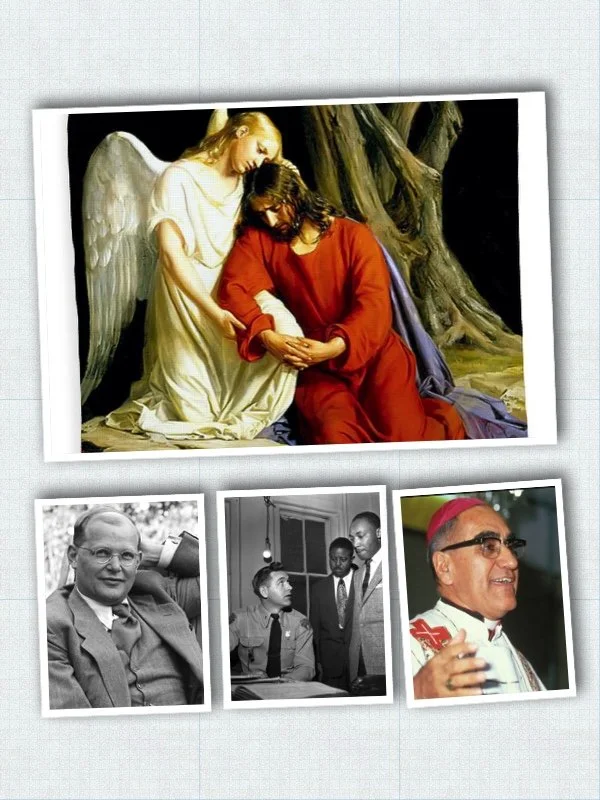
And going a little farther, he threw himself on the ground and prayed, ‘My Father, if it is possible, let this cup pass from me; yet not what I want but what you want.’” — Matthew 26:39.

Jesus, Romero, MLK, Bonhoeffer

 Romero (March 24), MLK (April 4), Bonhoeffer (April 9)

Interestingly, Oscar Romero, Martin Luther King, and Dietrich Bonhoeffer, three of the most well-known 20th-century Christian martyrs, die close to Easter. Archbishop Romero is shot on March 24 at age 62 at the altar in El Salvador while celebrating the Eucharist after speaking out against the current government’s brutality. Martin Luther King is shot on April 4 at age 39 in Memphis, where he is supporting striking city sanitation workers. Bonhoeffer is hanged on April 9, also at age 39, for taking part in plans to assassinate Hitler. He is killed 23 days before the Nazi surrender. 

Romero is shot as he lifts the chalice at the end of the Eucharistic rite. When a death squad kills him, his blood falls onto the altar and mixes with the contents of the blood of Christ in the chalice. 

All three men are icons for our Lenten and Holy Week journey, people who speak their truth even when it offends the ruling authority.  

Jesus also dies when his message offends the temple’s religious leaders, who then scheme with the Roman authorities to kill him. Jesus is not killed at age 33 by the Jews but by the ruling Jewish religious elite. They persuade the elite Roman officials that Jesus’ presence threatens the peace in occupied Palestine. 

Romero, MLK, and Bonhoeffer don’t start their Lenten journeys as the voices of truth. They are all quiet, modest men. The Vatican approved Romero as bishop with the El Salvadoran government’s approval because he seemed “quiet and safe." Black leaders choose King to lead the bus boycott because of his youth and because he is the newest and youngest black pastor in Montgomery at age 25. Bonhoeffer is simply a deep-thinking Lutheran theologian. 

But on their journey, the three witness the injustices in the world caused by those in authority over the powerless. They die to an old life of quiet conformity and silence, and are reborn into a new life of speaking out Christ’s truth in love. 

Eventually, like Jesus, all three realize they will be killed for trying to address the injustices and lack of love in the world around them. Their writings all suggest that they, like Jesus, ask that this cup pass from them, but it doesn’t. So, with a price on their heads, they walk straight into the turbulent storm.

We remember them today, just as we recall the night the one they followed is also about to die. We pray for even a little of their courage and strength to speak out against the injustices in our world, supported by authorities where we live, work, play, and worship.

We pray for the strength to do “the next right thing,” as Jesus taught Oscar, Martin, and Dietrich.  

Joanna Seibert. joannaseibert.com. https://www.joannaseibert.com/

 

Taking Up Our Cross in Holy Week

Take up Your Cross

“There is great pain and suffering in the world. But the pain hardest to bear is your own. Once you have taken up that cross, you will be able to see clearly the crosses that others have to bear, and you will be able to reveal to them their own ways to joy, peace, and freedom.”—Henri Nouwen in You Are the Beloved (Convergent Books 2017).

We often wonder what Jesus means when he asks us “to take up our cross.” Is our cross the difficult co-worker or family member who keeps us awake at night, trying to discern how to love and live with them? Is it a painful physical ailment that has now become chronic? Has a job become our cross? Maybe it is an addiction. Is it the cross of food or financial instability?

Nouwen believes our cross is often the inner pain we bear. We push into our unconscious, and it bubbles back up, sometimes like an ugly dragon. The pain is produced by parts of our personality we dislike, which we see in others and reject, rather than owning them ourselves.

The deep inner suffering may also live within us because of some trauma or pain inflicted by others whom we cannot forgive. They are still hurting us. We may have forgotten who the person is, especially when they are a family member, but we still live with the pain.

Nouwen tells us that this inner pain is often even more challenging than all the suffering in the world.

As we meditate on Christ’s wounds this Holy Week, we can believe that the Christ within us can lead us to our own wounds and suffering. Connecting and feeling Christ’s wounds brings us to awareness of the inner suffering that blocks our pathway to the God within us.

Nouwen believes that once we recognize and name our inner cross of pain, we will more clearly see the crosses others bear. 

I see this in grief recovery groups. The participants recognize others’ pain and begin to connect to them. Those who are suffering may know the depth of each other’s suffering best.

The miracle is that those who have experienced this inner pain are the ones who heal each other best.

 This is called resurrection. It happens in community.

Joanna  joannaseibert.com. https://www.joannaseibert.com/