Wedding of Jennifer Cobb and Christopher Travis

Wedding of Jennifer Cobb and Christopher Travis

Saturday June 24, 2017 10:30 am Curran Hall

Jennifer and Christopher, what a privilege for Patricia and me to be with you and your families on your wedding day. You, your children, your parents, your families are very special to both us. 

Jennifer, I have known you longer as you grew up with our sons, but we really got to know both of you better when Patricia and I were at Trinity Cathedral, and you both were so involved on the board of the Cathedral School. You both worked so hard to make that school work for your children and so many others, and you did an amazing job.

Then without warning overnight the school was taken away from us./ My most sacred memory of all that tragedy is that of you, Jennifer,  singing as you walked out of the Cathedral with tears flowing down your face/ and carrying a single bright candle/ out of the church/ at the closing and final graduation the next day.  Well, you both indeed have become our icons of carrying a bright light out from all that tragedy to make this world a brighter place. You both have carried out the bright light of what you and your children learned at that school, and have made this city,/ this state,/ a much better place because of you.

 As you were doing all this, isn’t it amazing how the process of recovery also brought you together,/ and you fell in love. Out of great tragedy,/ came love. This is always, always the way God works. It is also called resurrection. Remember this. Remember this. Out of every difficulty you will face together in this new life, the God who so loves both of you/ so deeply can bring light and a new life to every situation. Never forget this. Keep reminding each other. You are resurrection people. Your love, your marriage is a resurrection story.

 Joanna

At dismissal:

Deacon:

Jennifer and Christopher asked us to end this ceremony with a special dismissal./ It was written by Dean Charles Higgins as a charge to graduates of The Cathedral School. Both Jennifer and Chris heard it spoken at their graduations, as did Graham, Shawn and Charles. It perfectly captures the values Jennifer and Chris wish to teach and model for their children.

Dear friends and family,

As you leave here today,

 see to it in your life and work that you put truth above ambition,

 compassion above popularity,

justice above self-interest,

and love above all.

Bear yourselves with uprightness and integrity to the glory of God,

 and may God guide and bless you always.

Trinity Sunday, Trinity Episcopal Church, Searcy

Trinity Church, Searcy, Arkansas

Trinity Sunday, June 11, 2017

There can be no better place to be on Trinity Sunday than at Trinity Church in Searcy.  But if you are like I am, you sometimes wonder why does our God need three names, three persons? How can one God inhabit three forms and be both three and one? / Most important, can belief in this Trinity really make any difference in our lives? Will the Trinity make a difference in how we will drive their cars, how we will fill out their income taxes, how we will respond to war, or how we treat the person sitting across the aisle or living across the interstate from them? /

Robert Capon says that when human beings try to describe God we are like a bunch of oysters trying to describe a ballerina. We simply don’t have the equipment to understand something so utterly beyond us,/ but that has never stopped us from trying. /

First let us start by saying the Trinity is a mystery. Do not let this word “mystery” turn you off intellectually. It means that the truth will be revealed to our understanding but never completely, because it requires that we are in relationship to the intimate parts of God. Saint Irenaeus said that God remains a mystery even in heaven. Through all eternity we will be finding new things out about God, and the mystery will be more and more revealed. There is never a time when we can say, “God, this is not a new thing you have shown us.”

The Trinity is not a quantifiable being. In human arithmetic, 1+1+1= 3. In celestial arithmetic 1+1+1= 1. Several years ago, I heard a Greek orthodox bishop give a series of lectures on the Trinity at Oxford. That’s Oxford, England, not Oxford, Mississippi. Surely a bishop in Oxford should be able to explain the Trinity. For one whole hour he drew six possible diagrams for the Trinity, triangles, circles, concentric circles, overlapping circles. Then at the end, he said, “and the answer is, the best diagram for the Trinity is this:” He erased all his work and left a blank board. It is a mystery.  

Part of our problem of understanding the Trinity is that we have no actual images of two of the persons. We have descriptions of Jesus, the human face of God, but no one has seen the Father or the Spirit. In western art the Spirit is traditionally characterized as a dove /and God as an old man with a beard. This has led to many problems, especially if the old man with a beard in your real life is not noted for his kindness and love.

A recent popular image of the Trinity is described in the book, The Shack, by William Young, now made into a movie.  In this modern midrash of the Trinity, a man named Mac Phillips meets the Trinity at the scene of the brutal murder of his young daughter. God is a large beaming African American woman who engulfs Mac in her arms, saying,” My, my, how I do love you.” She tells him to call her Papa. Jesus appears as a blue-collar man with Middle Eastern features. The Spirit is a distinctively Asian woman who shimmers like the wind and is alternately translucent or visible only out of the corner of Mac’s eye. More important than their identity is their relationship to each other. Mac writes, “I have never seen three people share with such simplicity and beauty. Each seems more aware of the other than of themselves.” The three constantly call Mac to join them in their circle of relationship. Jesus tells Mac not to ask “what would Jesus do.” “My life was not meant to be an example to copy. That would kill your independence. I came to give you life, our life together. We desire that you re- turn to us so that we will come and live and make our home and share our life inside of you, so that you may begin to see with our eyes, hear with our ears, and touch with our hands. But we will never force our union on you.” 

The Shack reminds us that if we tend to think of the Trinity by distinguishing each of its parts, we will miss the mark. If we only see the Trinity as separate persons, we will miss the power of their community. The ultimate beauty of the Trinity is in its relationship and love of each to the whole. Each part makes decisions based on the input from the others. Their minds and hearts are constantly in relationship to each other, not centered on themselves. The three parts in this relationship teach us how to love each other. The three persons of the Trinity are desperately in love with, in COMMUNITY, and CONNECTED to each other. The parts of the Trinity indwell in one another. They are transparent to each other. They have no secrets from one another.  (John 17:21-23)

God is the Creator, and father, and lover,/ and the saving, beloved Christ.  The love between them is so powerful that from that love, its own person is formed, the sustaining, empowering Holy Spirit. There is no jealousy, no fear of rivalry. (John 3:35, 10:17, 15:9, 17:23-24.) Barbara Brown Taylor describes this concept of the Trinity as the “sound of three hands clapping.”

 Perhaps we learn more about the Trinity from images where this love relationship is absent. What is hell but the absence of God, the absence of relationship. Possibly you have heard this story:

A Rabbi asks to see Heaven and Hell. His wish is granted and he's taken to a room where everyone is seated at a long dinner table with delicious food in front of them.  However, everyone there is starving and emaciated.  This is because, the Rabbi discovers, while each has a long spoon strapped to his or her wrist, the spoon is so long they cannot pick up the food and actually put it in their mouths. They are utterly frustrated and bitterly unhappy. The Rabbi is told that this is Hell. 

He is then taken to another room with everyone seated at an identical long table with delicious food, and each individual also has a long spoon strapped to his or her wrist.  These people, however, are well-fed, for they have learned that their spoons are perfectly designed to allow them to feed each other, which they are doing quite naturally.  They are joyous and contented.  The Rabbi is told that this is Heaven./

So what does this inter-relationship of the Trinity say to us? Since we are made in God’s image, everything about the Trinity can also be said about us. The Trinity calls us to a radical reorientation in our way of seeing and being in the world. We must live in community. We are what we are in relationship to. We are to be transcripts of the Trinity on earth. Either we love like the Trinity or we have no life. The God of the Trinity is not an I but a we, not mine but ours.  The doctrine of the Trinity is not designed to TELL us the truth about God / but to SHOW us how to LIVE the truth… in community, in relationship.

Yes, our belief in the Trinity and the interpersonal love of the Trinity can transform our lives. Our relationship to and understanding of the Trinity can definitely make a difference in how we drive our cars, how we fill out our tax returns, how we relate and respond to war, how we treat the person sitting across the aisle from us as well as the person living across the interstate from us. Today, the Trinity will especially make a difference in the lives of each of us in this sacred space that for so many years has honored the Trinity. You have a legacy, you are the standard bearers to show all the world how to love like the Trinity.

Your mission, then, should you wish to accept it,

 is to go and represent the Trinity - created in love, saved in love, and sustained in love by our Triune God. Love like the Trinity in Searcy and in the world.  This mission is not impossible, because with God, all things are possible.  You can do this - we can do this - together, in relationship, in community - with God's help.  Keep remembering those final words of Jesus in today's Gospel. "I am with you always, to the end of the age" (Matthew 28:20).


 Bishop Timothy Kallistos, Summer Institute, Oxford, August, 2004.

Barbara Brown Taylor, “Three Hands Clapping,” Home by Another Way, pp. 151-154.

Fleming Rutledge, “The Multicultural Good News,” The Bible and the New York Times, pp. 169–175.

Rowan Williams, “the Hospitality of Abraham,” The Dwelling of the Light, Praying with Icons of Christ,  pp. 45-63.

Henri Nouwen, Beyond the Beauty of the Lord, Praying with Icons, pp. 19-27.

John Burton, “Seeing the Trinity from the Inside,” Preaching as Pastoral Care, pp. 70- 73.

Frederick Buechner, “Trinity,” Beyond Words, pp. 394-395.

William Young, The Shack, pp. 122, 146, 149, 175, 198.


 Joanna Seibert
 

Closing Eucharist Mourner's Path

Mourner’s Path Closing

June 8, 2017   St. Marks Episcopal Church, Little Rock

What a journey we have been on. Pat, Patricia, and Susan and I have had the privilege of spending eight weeks with a group of very brave people who have shared with us their loves, their losses, and their triumphs.

You have listened and told each others’ stories of loved ones who have died. You have shared their pictures. You have talked about how you learned to grieve as a child. We have talked about the physical side of grieving. We have talked a lot about tears. We have learned that tears are helpful and appropriate in our grief. Jesus, our mentor, wept at the death of his dear friend, Lazarus. You have shared what you miss the most and what you are doing to live on, how the relationship continues in a very different way, and about small victories in your life. You have talked about how difficult it is to live on and make decisions now especially when the one you loved was bigger than life and that their life sometimes ended so tragically.  You have talked about places on this journey where you seem stuck, but you also have talked about how you honor and remember your loved ones in standing stones. You have shared how you have stayed connected through God nods, dreams, books such as Tear Soup, pictures, emails, bracelets, notes from friends of yours and your loved one, meeting with clergy, being with children and grandchildren your loved one also loved, Facebook Mother’s day messages, serving and caring for others that knew or did not know the one you loved. You have talked about best times, memories to hold on to such as Christmases. You have talked more about those small victories: just getting out of bed, returning to church, just coming to Mourner’s Path, going outside and doing something your loved one liked to do, living in the moment, being more aware of the pain of others, making new friends for a venue of your old stories, walking, giving up being the cruise director, seeing cardinals, working in gardens. Tonight, just before this service you have let each person know about the change you have seen in yourself and in them during these eight weeks. Finally, you have written a letter to your loved one that you will offer at this altar.

We have questioned where was God is all this sadness and tragedy that you have experienced. Sometimes the God of your understanding seemed absent or at some great distance. We have told you to let us and the group hold that faith in God for you when it becomes too hard. Many have come through this experience with a different relationship with God and a new understanding of the person God created you to be.

Each of you has a different story and is at a different place on this journey. That is what has been especially beautiful about our group. I think each of you has respected the other and not insisted that your neighbor’s journey be like your journey. I, as well, can only share my experience. This is what I learned from another mother whose child was tragically killed.

Several weeks after her daughter’s funeral, I met Mary for coffee. Her daughter, Anne, had been killed in a tragic train accident in another country the summer before she was to enter college. We met on an usually cool summer morning. I felt Mary in the room before I even saw her. After a tearful hug we began talking about Anne’s funeral. We marveled at the number of friends Anne had and the people she had touched in her young life. We went over all the details of the glorious celebration of Anne’s life that was right here at St. Mark’s: the music, the choir, the liturgy, the reception and how no one wanted to leave. Mary then began slowly to talk about the new directions she already felt in her life.  She told me how she had spent much time trying not to wear masks in her life, but that this great loss had made her even more desiring of not being anything that was false to her.  She was living her life one day at a time.  She was not making a lot of plans and was trying to be open to what God had in store for her that day.  She also had a vision of what her life's mission should be: to become the person God had intended her to be with all her heart.  Mary was not certain what that was, but she was more open than she ever had known. She spoke of feeling God's presence and support throughout this entire tragedy.  She wondered how anyone could survive such a loss without love and faith in God. / Then she could barely speak as she softly whispered that she had some insight into the thoughts of our Lord's mother, another Mary, at the cross. 

Each of you has had a Mary experience of being at the foot of the cross. Some of you were far off on a hill, others were right at the foot of that cross. Our sessions were during the Easter season. I think that each of you has also experienced a taste of resurrection, a new life, which like new birth has often been very painful. Each of you is in a new relationship to the one you have loved who died as well as in a new relationship to God.

I hope you will also get to know a powerful community of people who have been surrounding all of us these past eight weeks with God’s embrace. These are the prayer partners who are sitting with us. I have learned from them the power of prayer, for they have been the glue/ praying for us and holding us together these past weeks. /

May you continue to feel the loving arms of this group you have met with for eight weeks, your prayer partners, and our God who has always been silently holding you in your loss.

Henri Nouwen writes that when we die, our love remains.  Love is eternal.  Love comes from God and returns to God. Love is the life of God within us.  It is the divine, indestructible core of our being.  This love not only remains but also bears fruit from generation to generation.

 The love of God that dwelt in the heart of each of those you loved who died will come to you and offer you consolation and comfort. Our experience is that you have also felt that love in the members of this group, and that as you continue your journey, you will continue to feel that love, share that love, and hold and heal others as you have helped heal and hold each of us.

Joanna


Easter 7A Ascension Searcy

Easter 7A Trinity Searcy       Ascension

May 28, 2017 Acts 1:6-14

This is the last Sunday in the Easter season, the Sunday after Ascension. The excitement and enthusiasm of Easter Day is receding in our rearview mirror. The lilies are faded, the music is toned down, the congregation is smaller. Ascension is a little like the day after the party, the day after all the visiting family packs up and drives away. It’s the day to wash the sheets and put away the special dishes. Barbara Brown Taylor describes Jesus’ ascension as the most forgotten event of the church year. Who wants to celebrate being left behind? Who wants to mark the day that Jesus goes out of this world? We are daily so hungry for the presence of God. The one thing we do not need is a day to remind us of God’s absence.

 Today’s question is how do we continue as resurrection people after ascension?/ In Acts today we hear about the simultaneous presence/ and then absence of Christ. Where does Jesus go?  Tradition has it that he goes to heaven, which may not be up, as much as it is beyond. Jesus goes there to finish what he liturgically starts with us six months ago. Jesus’ Christmas present to us was being born into the body of this world. His ascension gift is that through him/ the body of the world is borne back to God. Jesus presents his own ruined risen body to be at the right hand of God. Jesus imports flesh and blood into those holy precincts. He paves the way for us, so that when we arrivelater, everyone will not be so shocked by us. Jesus restores the goodness of all creation and ours in particular. By ascending bodily into heaven, he shows us that flesh and blood are good, not bad; that they are good enough for Jesus,/ good enough for heaven,/ good enough for God. By putting on flesh and blood and keeping them on, Jesus not only brings God to us; he also brings us to God.

Absence always does hurt the most when we remember what presence was like. Absence is the arm flung across the bed in the middle of the night into the empty space where once was a beloved sleeper. Absence is the child’s room now empty and hung with silence and dust. Absence is the overgrown lot where our old house once stood, the house where people laughed and believed happiness would last forever. Absence is the body parts which no longer work.

You can not miss what you have never known, which makes our sense of absence and especially our sense of God’s absence the very best proof that we knew God once, and that we will know God again. There is loss in absence, but there is hope.

It is our sense of God’s absence that brings us together to this place today in search of God’s presence.  Former Bishop Porter Taylor of Western North Carolina describes a liturgy conference where people discuss their most important part of the Eucharist liturgy. I know you are shocked to know it was not the sermon. For the majority, including the bishop, it is the moment in the Eucharist where each of us holds open our hands to receive the bread of life. It is the moment that we acknowledge our dependence on a reality that we have known, that we search for, beyond us that has the power to nourish and sustain us.//

  Like the band of forlorn disciples, you return to this sacred space in Searcy again and again. It is the last place you saw him, so of course it is the first place anybody thinks to look for him to come again. You have been coming here a long time now, but even in his absence this is a good place to remember him, to recall best moments, argue about the details, to swap the old stories until you begin to revive again, life flowing back into you, as you retell the stories of God’s presence here in this place in your lives.

“Men and women of Galilee, men and women of Searcy, why do you stand looking up toward heaven?”

That is what two well dressed men in white robes say to us and to the disciples on the mount called Olivet as they gaze openmouthed into the sky,/ and the disciples most probably would have stood there like that all afternoon had their attention not been directed back to earth. These angels may have been sent to remind us that if we want to see Jesus again, there is no use looking up. More likely we should look around /at each other,/ at the world,/ at the ordinary people in our ordinary lives, because that is where we are most likely to find Jesus, not the way we used to know him, but a new way, not in his own body but in our bodies, your bodies. The risen, the ascended Lord is no longer in a particular place on earth. He can now be everywhere on earth, especially in each of us./

If the disciples had it their way, they might have tied Jesus up with their fishing nets so that he could not get away again, so that they would know where to find him forever. Only that is not what happens. Jesus is taken away as the disciples stand looking up toward heaven. Then they stop looking up toward heaven, look at each other instead, and get on with the business of being the body of Christ on this earth.

And once they do this, surprising things happen. They say things that sound like him. They do things they have only seen him do before. When two or three gather together,/ it is as if there is someone else in the room whom they cannot see, the  abiding presence of Christ, as available as bread and wine, as familiar as each other’s faces. It is as if he has not ascended but exploded with all the holiness that once was concentrated in him alone, flying everywhere/ with the seeds of heaven now sown in all the fields of the earth.

We gather here this morning to worship in this historic church with the many memories of so many of you, to acknowledge God’s absence, and to seek God’s presence, to sing, to pray, to be silent, to be still, to hold out our empty hands to be filed with bread, to drink wine, with the abiding presence of the absent Christ until he comes again. Do you sometimes miss him? Do you long for assurance that you are not left behind? Why do you sit or stand looking up toward heaven? Look around you, look around you!  There he is! Here/ is the light of Christ.


Bradley, Schmeling, “Reflections of the lectionary,” Christian Century, p. 20, May, 28, 2014.

Barbara Brown Taylor, “Looking Up to Heaven,” Gospel Medicine, pp. 72-78.

Barbara Crafton, “Almost Daily Email from Geranium farm,” Ascension, 2004.

Joseph Harvard, III, “Preaching the Easter Texts: Can I get a Witness?, Journal for Preacher, Easter, 2014, p, 10.

12 step eucharist and Jackson Kemper

Jackson Kemper

May 24, 2017 First 12 step Eucharist at St. Mark’s Episcopal Church

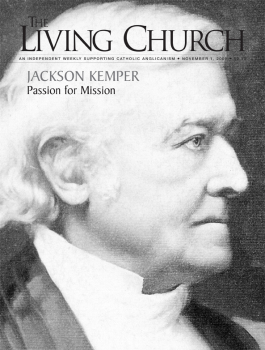
 Today at our first 12 step Eucharist at St. Mark’s we also remember Jackson Kemper, the first missionary bishop of the Episcopal Church. Kemper is especially known for his work with Native Americans as he founded parishes in what was considered the Northwest Territory (Indiana, Missouri, Wisconsin, Minnesota and Nebraska). Bishop Kemper founded Nashotah House and Racine College in Wisconsin, and from 1859 until his death served as the first bishop of the Diocese of Wisconsin.

I think that Jackson Kemper, our church’s first missionary bishop. would like our first 12 step Eucharist to be on the day we honor him. I think he would also like the reading from Corinthians, “I laid a foundation, and someone else is building.”  That is a good definition of 12-step work. When we are in recovery, we tell our story, our foundation, but so often we are only planting a seed, and those still in their addiction, may not start to build their recovery until they also hear someone else. I can count on my hands the number of people I have told my story to who then went into recovery, but I know the others may hear the message later from someone else and together our stories may make an impact.

 This Eucharist with the 12 steps is showing us how the foundation of AA came from the church, actually from an Episcopal priest at Calvary Episcopal Church in New York City, Sam Shoemaker.  One of the most spiritual experiences I have had was attending Shoemaker’s church and being part of a 12-step meeting in the space that once was his office. I imagined all those, but particularly Bill Wilson who worked on the 12 steps with him in that office.

  So many of us heard all these steps growing up in our religious traditions, but somehow, we missed important parts of them. We had to see this way of life with the new glasses in a community of others who had traveled the same road that we did. Then at some point, we had another moment of clarity as we realize the 12 steps are part of our tradition of our church all along. So, we are all now in the right place, exactly where we should be this evening as we celebrate and give thanks for the miracle of our recovery, we give thanks for all who gave and continue to give us the foundation for recovery, and we give thanks for St. Mark’s for supporting recovery ministries.

Joanna Seibert

Jackson Kemper

Jackson Kemper

Samuel Shoemaker

Samuel Shoemaker