The Trinity Continued
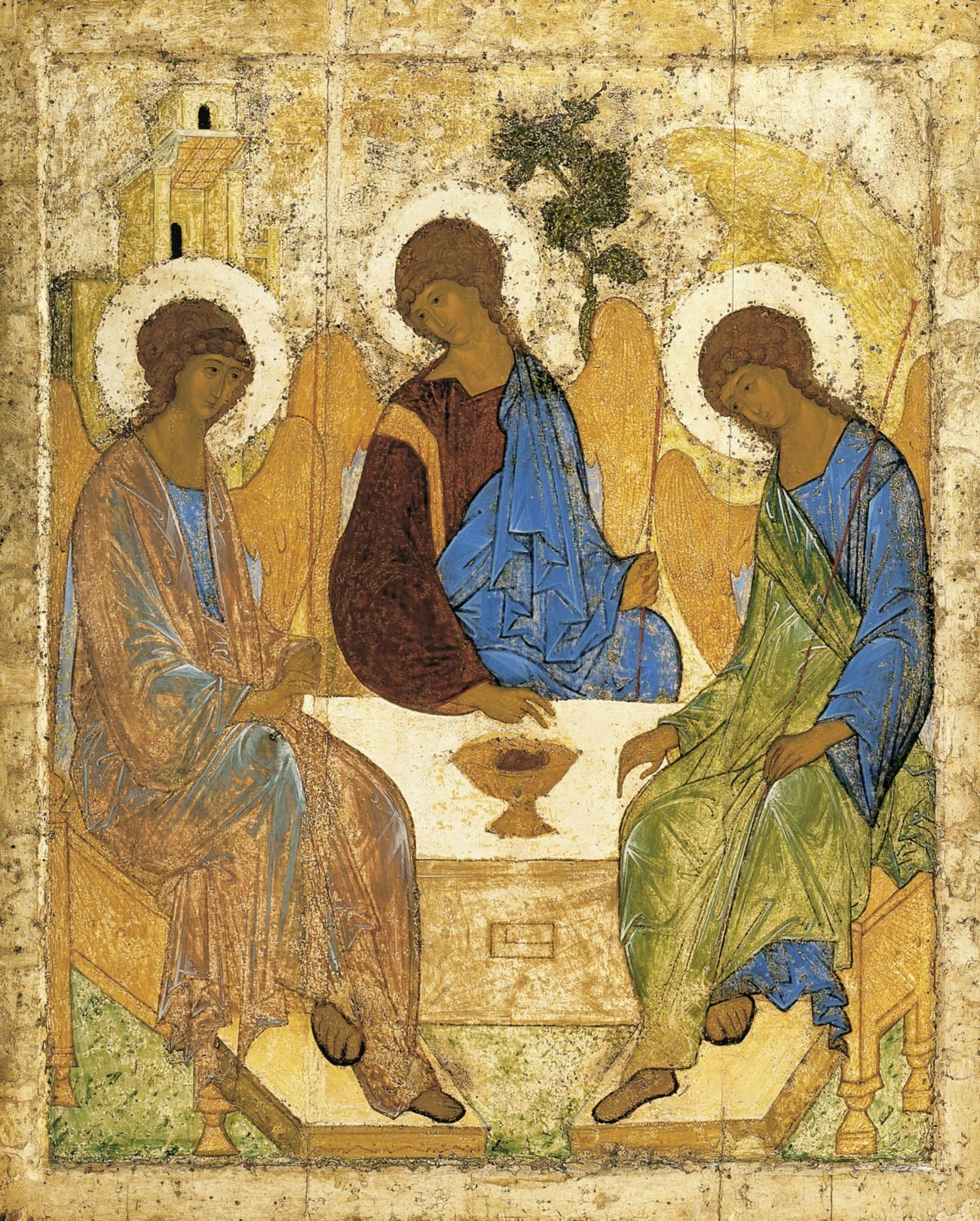
Rublev Old Testament Trinity
“Trinitarian theology holds that true power is circular or spiral rather than hierarchical. If the Father does not dominate the Son, the Son does not dominate the Holy Spirit, and the Spirit does not dominate the Father or the Son, then there’s no domination in God. All divine power is shared power.”—Richard Rohr, The Divine Dance: The Trinity and Your Transformation (Whitaker House), pp. 95-96.
Robert Farrar Capon says that when humans try to describe God, we are like a bunch of oysters attempting to describe a ballerina. But we can’t help but try, especially as we strive to understand the doctrine of the Trinity, perhaps the greatest mystery of the Christian faith.
At a summer course at Oxford University, a Greek Orthodox bishop, Timothy Kallistos, introduced us to Andrei Rublev’s 15th-century icon, The Trinity, or The Hospitality of Abraham. It depicts the three angels who visited Abraham at the Oak of Mamre (Gen. 18:1-8) to announce the coming birth of his Son, Isaac. We have interpreted it as a symbol to help visualize the mystery of the interrelationship within the Trinity of Father, Son, and Holy Spirit.
Each figure is in circular harmony with the others, humbly pointing to one another in mutual love. We miss the mark if we relate only to the Trinity in its separate parts. The Persons are in a community, transparent to one another, indwelling, and in love with one another. They have no secrets from one another, no jealousy, no rivalry. Instead, they teach us how to live in community. Barbara Brown Taylor describes their relationship as the sound of “three hands clapping.”
The doctrine of the Trinity calls us to a radical reorientation in how we see and live in the world. We are what we are in relationship. The God of the Trinity is not an I but a we; not mine but ours. Our belief in and understanding of the Trinity can make a difference in how we drive our cars, how we fill out our tax returns, how we relate to others of different faiths, colors, and political views; how we stand on war; how we treat the person sitting across the aisle from us, as well as those living across the Interstate and beyond our country’s borders.
Richard Rohr’s and Barbara Brown Taylor’s thoughts are excellent to meditate on when we are in conflict with another person, especially when the Christ within us has difficulty seeing the Christ in that person.
[See Barbara Brown Taylor, “Three Hands Clapping,” in Home By Another Way (Cowley), pp. 151-154.]
Thank you for supporting our camp and conference center, Camp Mitchell, on top of Petit Jean Mountain, by purchasing this book from the daily series of writings for the liturgical year, A Daily Spiritual Rx for Ordinary Time: Readings from Pentecost to Advent. All proceeds from book sales benefit Camp Mitchell. If you enjoy this book, please take a moment to write a brief recommendation on its Amazon page at https://smile.amazon.com/Daily-Spiritual-Ordinary-Time-Pentecost/dp/B08JLTZYGH/ref=sr_1_1?dchild=1&keywords=joanna+seibert+books&qid=1621104335&sr=8-1
More thank-yous than we can say!!!
Joanna https://www.joannaseibert.com/