Ascension Day

Ascension Day

Koerbecke. National Gallery of Art

“Now the eleven disciples went to Galilee, to the mountain to which Jesus had directed them. When they saw him, they worshiped him, though some doubted. And Jesus came and said to them, ‘All authority in heaven and on earth has been given to me. Go therefore and make disciples of all nations, baptizing them in the name of the Father and of the Son and of the Holy Spirit, and teaching them to obey everything I have commanded you. And remember, I am with you always, to the end of the age.’”—Matthew 28:16-20.
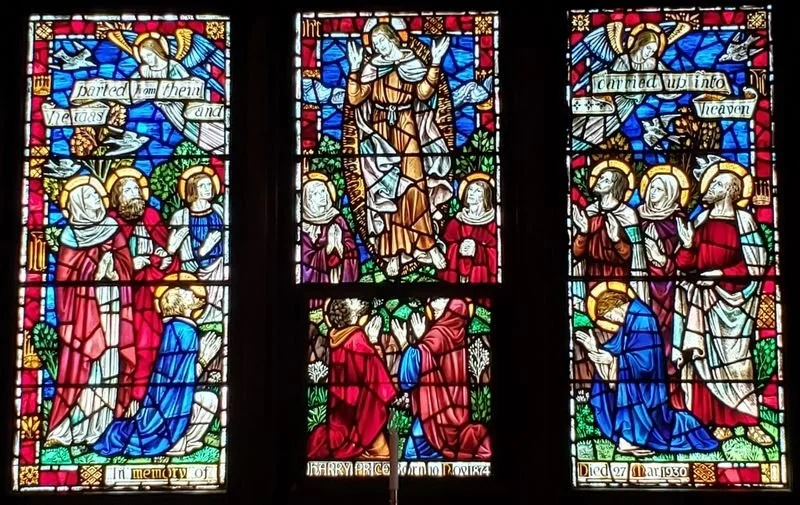
Ascension window Menasha

 This Sunday, we celebrate the little-known Feast of the Ascension of Jesus to Heaven, 40 days after Easter. Barbara Crafton1 describes this as the feast of the “simultaneous presence and absence of Christ.” 

Charles Chatham, 2, a former priest at St. Mark’s, reminds us that the New Testament scholar Raymond Brown coined the helpful phrase about the Ascension: “the presence of the absent Jesus.”

There is an absence of the physical body of Christ, but in some mysterious way, he is still with us, within us, beside us, and within our neighbors as well.

Barbara Brown Taylor3 often writes about our desire to feel Jesus's presence. We think he is absent. She urges us to look around us rather than look up to heaven. Look to our neighbors. Look inside ourselves. Jesus is still here. Remember how God cared for us in the past. God has never abandoned us. 

We know that the Ascension means Jesus took part of the world’s humanity to be forever part of God, the Holy. But Taylor describes the Ascension as if Jesus not only ascended but exploded, with the holiness once concentrated in him alone flying everywhere, far and wide, and with the seeds of heaven now sown in all the fields of the earth at that time and in the future. The body of Christ is not somewhere beyond our telescopes but here, beside us and within us. 

We celebrate this presence in the Eucharist each week. Christ’s presence is still with us, “always to the end of the age,” as Matthew tells us. Jesus also promises that in ten days, we will celebrate the presence of the Holy Spirit within each of us at the Feast Day of Pentecost. 

Both feast days are a mystery.

Kate Alexander4 at Christ Church offers us a prayer attributed to the 16th-century Spanish mystic and Carmelite nun Teresa of Avila, which may help explain what so many are trying to tell us:

“God of love, help us to remember

That Christ has no body on earth now but ours,

No hands but ours, no feet but ours.

Ours are the eyes to see the needs of the world.

Ours are the hands with which to bless everyone now.

Ours are the feet with which he is to go about doing good.

Ours are the eyes through which he looks

Compassion for this world. Amen.

1Barbara Crafton, “Ascension,” Almost Daily Email from Geranium Farm, 2004.

2 Charles Chatham, “Presence of the Absent Jesus,” in Thinking Faith #172, 2012.

3Barbara Brown Taylor, “Looking Up to Heaven,” Gospel Medicine, pp. 72-78.

4 The Rev. Kate Alexander, “Feast of the Ascension, Year B,” Christ Church, Little Rock, May 21, 2009.

Joanna Seibert https://www.joannaseibert.com/

Bless you for supporting the ministry of our church and conference center, Camp Mitchell, on top of Petit Jean Mountain, by buying this book, A Daily Spiritual Rx for Lent and Easter, part of the daily series of writings for the liturgical year. If you like this book, could you briefly write a recommendation on its Amazon page? More thank-yous than I can say!!! 


aln a Maine Manner of Speaking

aIn a Maine Manner of Speaking

Guest Writer: Ken Fellows

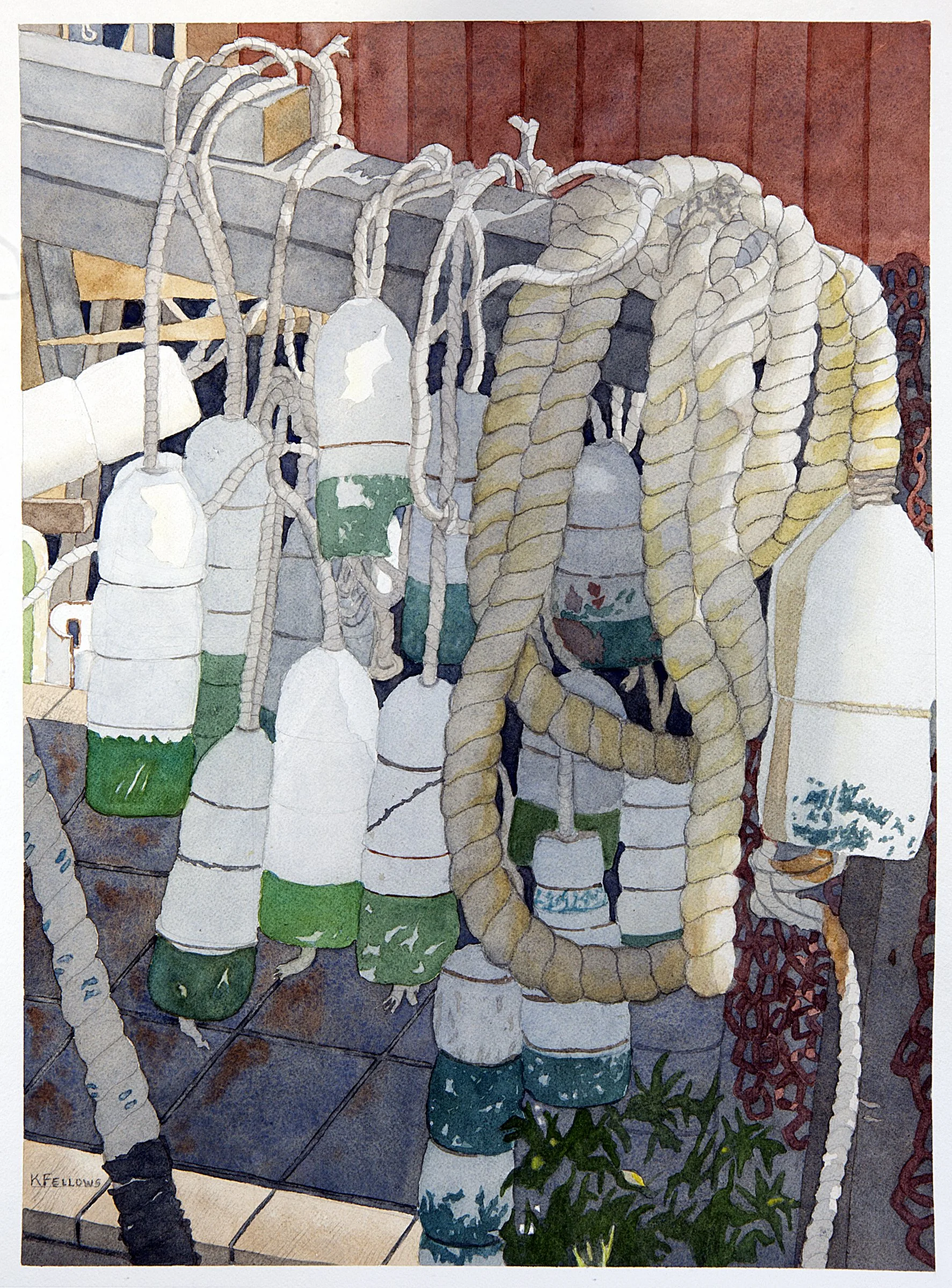
Maine Porch Railing Ken Fellows

                                                              Tourist: “How far is it to Portland?”

                                          Maine Farmer: “The way you’re headed, about 30,000 miles …

                                                             with some stretches of pretty bad wheelin’.

     Years ago, when we moved to our home in Kittery, Maine, I was charmed by local speech … words like “Sat’day” for Saturday and “barse-ackwards” for reversed, and colloquialisms (“go’in over town,” “right as rain”). I was also smitten by our new neighbors’ comments, often cryptic, wry, and ironic. But it was the short, off-kilter conversations I found most beguiling. 

    My first encounter with local brevity came while building an addition to our Kittery house. A muscular, middle-aged Mainer, perspiring and frustrated, was trying to back a huge cement truck along the narrow edge of a new foundation. A stunted, bushy tree next to his truck was another vexing obstacle.

Assuming I could help, I shouted up to him: “I don’t care much about that tree.” The driver whipped around and glared down at me from the truck’s cab. Clearly annoyed, he deadpanned: “Neetha’ do I.” Reflecting on that brief exchange, I marveled at how that Maine truck driver, in just three little words, had expressed his extreme contempt for my help, established me as an irritating interloper, and effectively curtailed any further distractions from the gallery. Our future relationship had been established.

     A graying lobsterman, Henry M., lived in a house backing onto ours. He was an extreme example of Maine reticence. He was a thin, spry man, polite but taciturn. He often left products of his fishing on our doorstep but never knocked on our door or ventured to stop in when we were obviously at home.

He waved from his yard but rarely spoke. I suspect he wanted to be neighborly but was inhibited by our being “from away” and perhaps embarrassed by our age and background differences. He was probably a treasure trove of Maine lingo and local stories, but his shyness kept me from gathering any samples.

     A 60-year-old lobsterman, Bud S., lived next door. Over many years, our relationship was quiet and distant, yet never unfriendly. We met occasionally on our adjoining creekfront lots, he repairing his lobster boat while I fussed over a dock with a landing float I was building. I was always impressed by his reticent speech and calm demeanor bordering on indifference. He never initiated a conversation, and his responses to questions were mumbled and abbreviated. Yet I found his persona intriguing and amusing … a quintessential Maine character. His bearing always put me in an uncharacteristic calm. 

      Having returned to Kittery after a long winter, I was devastated on a sunny April day to discover the floating-raft section of my new dock was gone. I assumed it had washed down tidal Chauncey Creek and out to sea during the winter's high tides. Bud happened to be there, painting his boat for the next fishing season at the waterside. His back to me, he remained thoroughly engaged in his work and characteristically mute as I loudly voiced my anger and frustration. For at least 10 minutes of my uninterrupted, distraught whining about my loss and the expense of building another raft, Bud concentrated on his painting, nodded once or twice, but never turned around. Exhausted and deflated, I finally turned to leave. 

Without expression, in his usual laconic tone, Bud muttered: “Well, you could build anotha’ one, I suppose (pause …), but my cousin down the cri’ck saw your raft floating by some weeks ago and hauled it up on his beach (pause) … I could help haul it back whenever you like.” And so another Mainer had let a ‘new-be’ stew awhile before generously offering needed information and help.

     Maine lingo – it’s often reluctant, on target, exasperating, and amusing, all in the same mumbled breath. It slows city folk down, lowers their voices, and encourages their consideration and reflection. It makes them more accepting and much easier to deal with.

Ken Fellows

Joanna. . https://www.joannaseibert.com/


Parker Palmer: How Trees Save Our Lives

Parker Palmer: Trees

“I used to take trees for granted. But these days, I know that spending time in their presence leaves me refreshed and renewed. I wonder if trees photosynthesize the soul as well as sunlight?”

But most of all, I’m drawn to trees because of something W. S. Merwin says in this lovely poem—the way they slowly and quietly cycle through the seasons, as though nothing had happened while our individual and collective lives whirl madly around them. This is Parker Palmer’s response to W. S. Merwin’s poem “Elegy for a Walnut Tree,” published in the weekly column “On Being with Krista Tippett” (5/3/2017).

I want to remember what Parker Palmer tells us about the outdoors, especially trees. Could “trees photosynthesize the soul”? Being outside with trees does something to my soul. Photosynthesis is a process plants use to convert light energy into chemical energy (sugar from carbon dioxide and water), which is later used to fuel the plants’ activities, and it releases oxygen as a waste product. Plants are like transformers, changing one form of energy into another, turning light energy into chemical energy. 

Being outside in a forest transforms and quiets my soul. Soon, the busyness of my mind, the committee in my head, and my to-do list no longer rule me. I am grounded in the earth. I move out of my mind and into my body. I see a world greater than myself, a power at work beyond my limits. 

As I return to the forest, I observe how the trees quietly “cycle through the seasons.” The trees are a permanent icon, reminding us to be the “steady bow,” as the parent Khalil Gibran writes in The Prophet. We are indeed all parents caring for this earth, which in turn also parents us and cares for us.

My father was a forester who, for so many Saturdays, took people out to plant more trees. Often, we would drive by the pine forest to see how the trees were growing. This produced changes in my synapses, so I always had difficulty seeing a tree cut down.

This poem is significant to me today because two large trees in my neighbor’s yard, just outside my window, were uprooted last year. Soon, men with chainsaws took the trees away. I still grieve their absence. 

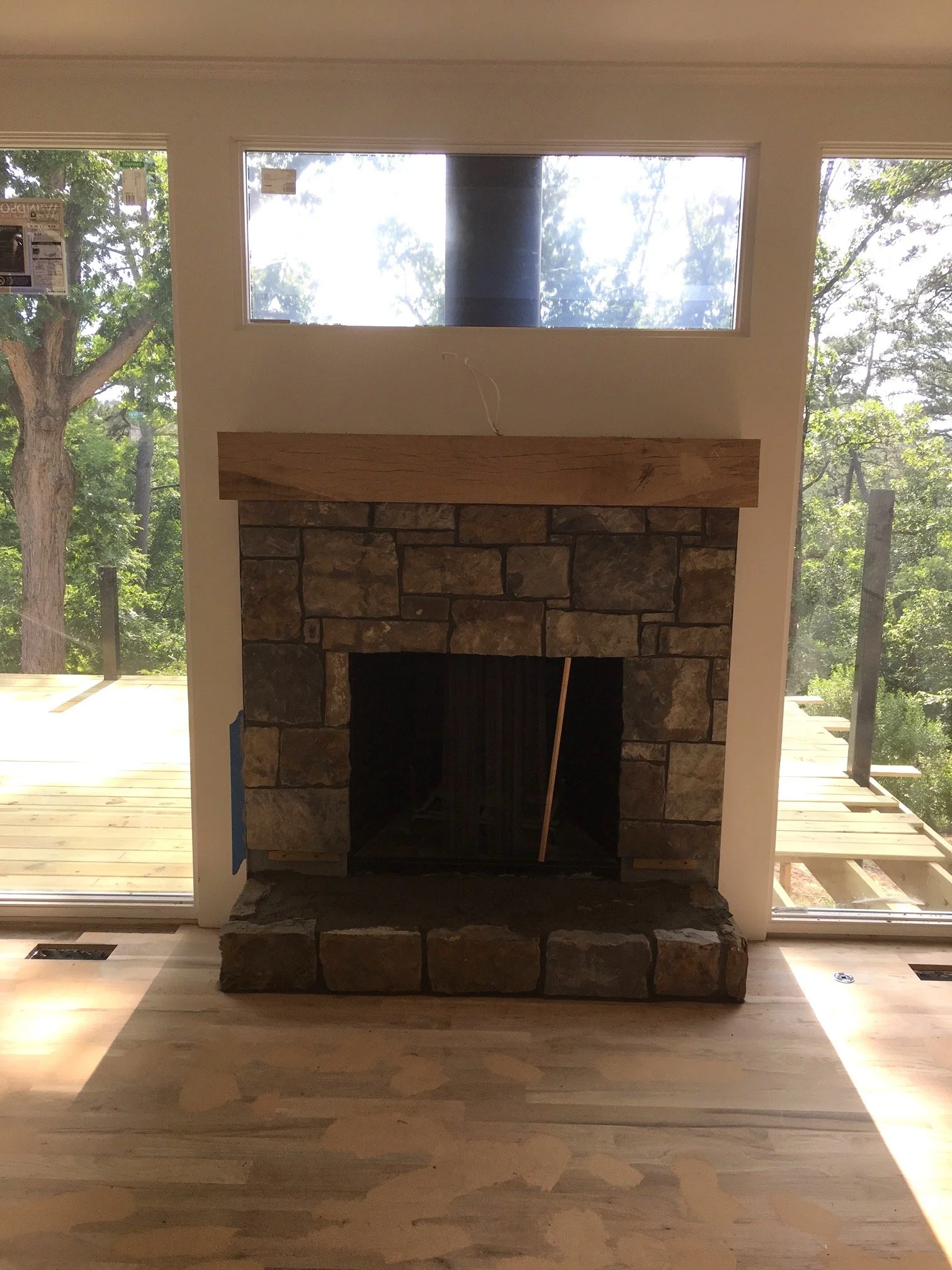
It helps to remember that our son and his wife had to cut down a dying tree near where they were building a house. They honored the tree by using its wood to make a mantel for their fireplace. Our daughter holds an advanced degree in forestry and returned to Arkansas after teaching at the Wilderness Institute at the University of Montana. I have hope for the future.

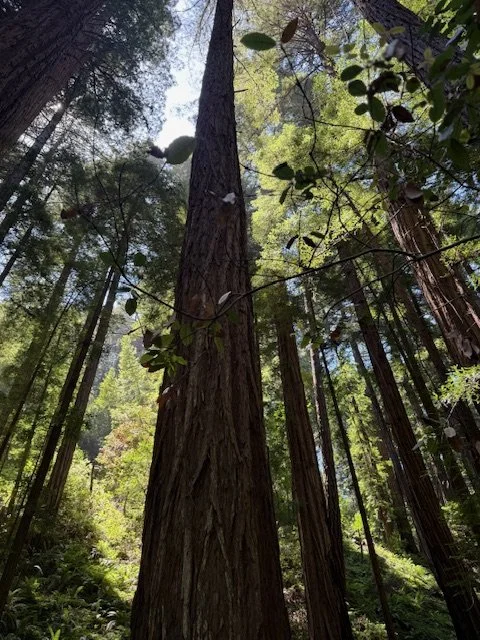
Donna Kay sent me this picture of trees that were meaningful to her.

Trees were nature’s healers for all those who spent more time outdoors during the past pandemic.

Elegy for a Walnut Tree

by W. S. Merwin

Old friend now there is no one alive
who remembers when you were young
it was high summer when I first saw you
in the blaze of day most of my life ago
with the dry grass whispering in your shade
and already you had lived through wars
and echoes of wars around your silence
through days of parting and seasons of absence
with the house emptying as the years went their way
until it was home to bats and swallows
and still when spring climbed toward summer
you opened once more the curled sleeping fingers
of newborn leaves as though nothing had happened
you and the seasons spoke the same language
and all these years I have looked through your limbs
to the river below and the roofs and the night
and you were the way I saw the world

"Elegy for a Walnut Tree" by W.S. Merwin, from The Moon Before Morning. © Copper Canyon Press, 2014. Reprinted with permission.

Joanna. joannaseibert.com